

We’ve all been there—that frustrating feeling of being stuck in quicksand. You know you should be doing something, but the will to even start is completely gone. This isn’t a character flaw or a personal failure. It’s a clear signal from your body and mind that something is out of balance.
The roots of low motivation are a complex mix of biological, psychological, and lifestyle factors that have quietly disrupted your body’s natural drive system.
Why You Suddenly Feel Unmotivated and Stuck
Think of your motivation like an engine. When it’s running smoothly, you feel engaged, purposeful, and ready to move forward. But when it starts to sputter and stall, even the simplest tasks can feel like trying to climb a mountain in flip-flops.
Figuring out what’s causing your lack of motivation is the first step toward getting that engine firing on all cylinders again. This goes way beyond simple willpower. Your drive is deeply wired into your brain chemistry, your emotional state, and your everyday habits. It’s a delicate dance between internal forces and external pressures.
The Interconnected Web of Causes
Low motivation rarely comes from a single source. More often, it’s the result of several different factors piling up at once, creating a massive drain on your energy and ambition.
We can break these down into three main buckets:
- Biological Factors: These are the invisible forces at work inside your body. Things like imbalances in key neurotransmitters like dopamine (your reward and motivation chemical), hormonal shifts, or underlying medical issues can directly sabotage your ability to feel driven.
- Psychological Factors: Your mental and emotional health is a huge piece of the puzzle. Chronic stress, burnout from work or life, and mental health conditions like depression and anxiety are notorious for quietly draining your motivational reserves.
- Lifestyle Factors: How you live day-to-day matters more than you might think. Things like poor nutrition, not getting enough quality sleep, and living a sedentary life can create the perfect foundation for apathy and fatigue to set in.
That persistent feeling of exhaustion is often the most obvious sign that your motivation is fading. Beyond the specific biological and mental roadblocks we’ll cover here, understanding the broader potential causes of constant fatigue and tiredness can offer some crucial clues.
Think of this guide as your roadmap to diagnosing the real issue. The table below gives a quick overview of the key areas we’re about to explore, helping you spot the factors that feel most familiar.
The Core Reasons Your Motivation Has Faded
A quick look at the primary factors that drain your drive, which we explore in detail throughout this guide.
| Category | Primary Drivers | How It Feels |
|---|---|---|
| Biology | Neurotransmitter Imbalance, Hormone Disruption, Medical Issues | Feeling “flat,” foggy, and physically incapable of starting tasks. |
| Psychology | Burnout, Depression, Chronic Stress, Lack of Purpose | Feeling cynical, detached, hopeless, or overwhelmed by everything. |
| Lifestyle | Poor Sleep, Nutrient Deficiencies, Lack of Exercise | Feeling perpetually tired, sluggish, and mentally drained. |
Recognizing that this feeling is common, understandable, and—most importantly—fixable is the first real step toward getting your drive back.
The Biology Behind Feeling Blah
When you feel completely unmotivated, it’s all too easy to chalk it up to laziness or a lack of discipline. But more often than not, that feeling of being stuck has less to do with your character and more to do with your chemistry. To really get to the root of low motivation, we need to look under the hood at your brain’s internal operating system.
Think of your brain as a complex command center. It relies on chemical messengers, called neurotransmitters, to dictate everything from your mood and focus to your drive to get things done. When these messengers are balanced, the whole system runs smoothly. But when they get out of sync, you feel it—everything becomes sluggish and unresponsive.
The feeling of being unmotivated is rarely caused by a single issue. As the visual below shows, it’s usually a mix of biological, psychological, and lifestyle factors that all feed into each other.
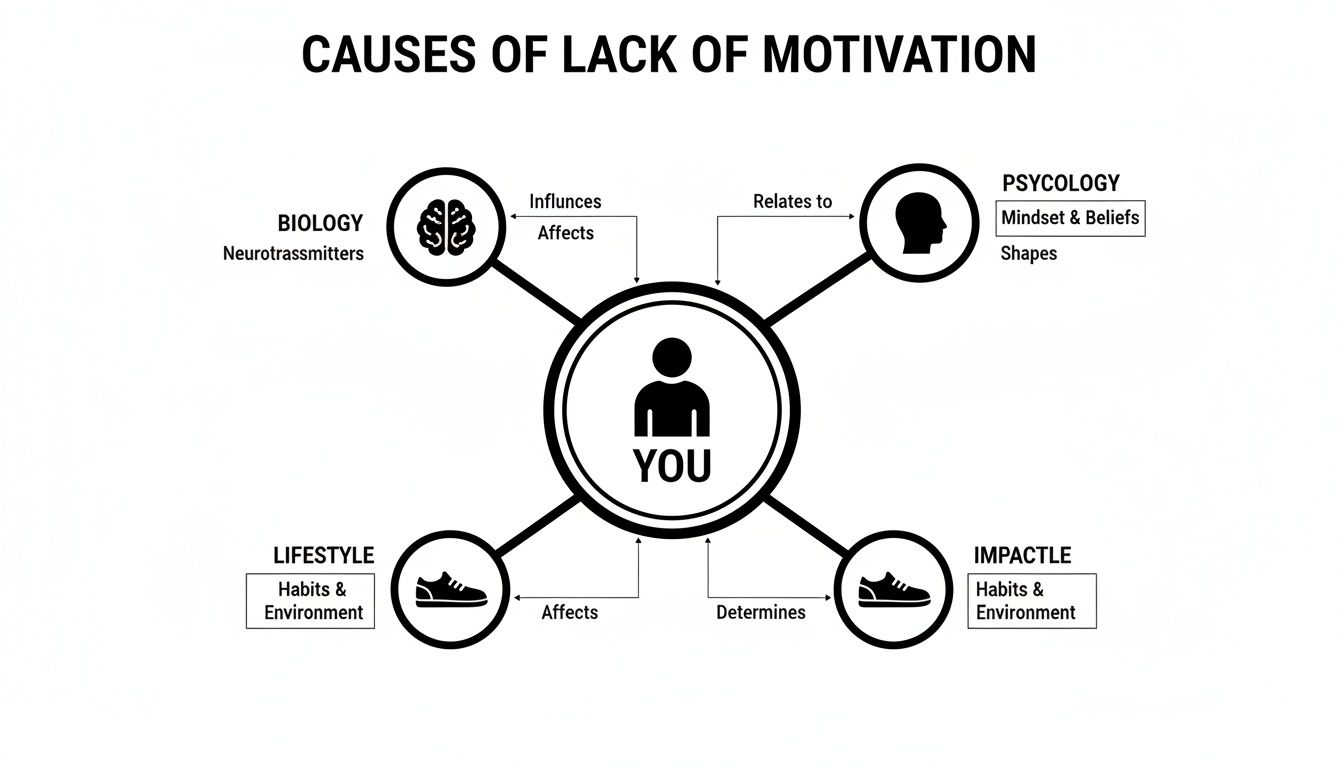
This interconnectedness is key. To fix the problem, you have to understand all the moving parts.
The Key Players in Your Motivation System
Three neurotransmitters, in particular, play starring roles in your ability to feel driven and engaged. Getting to know their jobs helps demystify why you sometimes feel so completely “blah.”
- Dopamine (The Gas Pedal): This is your primary chemical of anticipation and reward. Dopamine gives you that jolt of excitement when you think about hitting a goal and the satisfying feeling that makes you want to do it all over again. Low dopamine makes even the most appealing tasks feel pointless.
- Serotonin (The Cruise Control): Serotonin is all about regulating your overall mood and creating a sense of well-being. When it’s low, you might feel more irritable, anxious, or unstable, which makes it tough to maintain the steady emotional state you need to stay focused on long-term goals.
- Norepinephrine (The Alertness System): This neurotransmitter governs focus and vigilance. It helps you pay attention and stay on task. A shortage of norepinephrine can lead straight to brain fog and an inability to concentrate, making any effort feel utterly exhausting.
When these chemicals fall out of balance—often due to chronic stress, poor sleep, or inflammation—your internal drive system starts to sputter. This isn’t a personal failing; it’s a physiological problem.
How Dopamine Dominates Drive
Of all the brain chemicals, dopamine has the most direct and powerful link to motivation. It’s not just about feeling pleasure; it’s about the pursuit of it. Dopamine is released when you anticipate a reward, which is what creates the forward momentum to actually do something.
Imagine you’re craving a slice of pizza. Dopamine is the force that gets you off the couch to order it. The real kick isn’t in eating the pizza itself—that involves other reward systems—but in the delicious anticipation of it arriving.
A chronically low dopamine state can lead to apathy, procrastination, and a general lack of enjoyment in life. Your brain’s reward circuit essentially goes quiet, making it difficult to find the energy to pursue goals.
This is exactly why activities that used to excite you might now feel flat and uninteresting. Your brain simply isn’t producing enough of the chemical messenger that says, “Hey, this is worth doing!” Learning how to support your body’s natural production is crucial, and our guide on how to increase dopamine naturally is a great place to start.
Hormones and the Stress Connection
It’s not just neurotransmitters. Hormones also have a massive influence on your motivation, and the most notorious of them all is cortisol, the “stress hormone.”
In short bursts, cortisol is your friend—it gives you the jolt of energy you need to handle a threat. The problem starts when you’re under chronic stress, and your body is flooded with cortisol day after day. This sustained high level can be incredibly destructive to your brain.
Specifically, chronic cortisol exposure can:
- Disrupt Prefrontal Cortex Function: This is the part of your brain in charge of planning, decision-making, and self-control. High cortisol impairs its ability to work properly, making it almost impossible to think clearly and follow through on tasks.
- Interfere with Dopamine: Cortisol can actually blunt your brain’s dopamine system, making you less sensitive to rewards. This means you need more and more stimulation just to feel the same level of motivation you once did.
- Deplete Energy Reserves: Constant stress keeps your body stuck in “fight or flight” mode, which is incredibly draining. It leads to a deep, cellular fatigue that no amount of sleep seems to touch.
Understanding these biological drivers is the first and most important step. Your lack of motivation is a real, measurable phenomenon rooted in your body’s chemistry—not just a state of mind.
When Your Mind Becomes the Roadblock
While our biology definitely sets the stage for motivation, our day-to-day life—especially at work or school—often directs the play. Sometimes, the biggest barrier isn’t a chemical imbalance but a perfectly logical psychological response to circumstances that feel pointless, draining, or completely overwhelming.
Your mind becomes the roadblock not because it’s broken, but because it’s reacting sanely to a broken situation.
This is particularly true in our professional or academic lives. When your daily grind feels totally disconnected from any meaningful result, your brain’s motivation circuits simply power down. Why spend precious energy on something that offers no reward, purpose, or recognition? This isn’t laziness; it’s an act of self-preservation.
The Rise of Quiet Quitting and Disengagement
One of the most common psychological reasons for a lack of motivation is chronic work disengagement. It’s so widespread now that it has a name: “quiet quitting.” It describes that feeling of psychological detachment where you do your basic duties but invest zero extra effort, passion, or creativity. You haven’t actually resigned, but you’ve emotionally checked out.
This isn’t just a niche problem. It’s a global trend that points to a massive motivational crisis. Recent data shows that only about 23% of employees around the world feel truly engaged at work. That leaves a staggering 59% in the “quiet quitter” zone, feeling detached from their jobs and doing the bare minimum to get by.
This widespread apathy costs the global economy an estimated $8.8 trillion every year in lost productivity. When people lack autonomy, have unclear goals, or don’t connect with their managers, their inner drive just fades. You can read the full research from Gallup to see just how deep this trend runs.
This state of indifference is a direct response to an environment that fails to meet basic human needs for:
- Autonomy: The feeling that you have some control over your work and decisions.
- Purpose: A clear sense of why your work actually matters.
- Recognition: Knowing that your contributions are seen and valued.
When these things are missing, the mind concludes that extra effort is a bad investment, and motivation grinds to a halt.
From Disengagement to Burnout
While quiet quitting is a form of running on low power, burnout is a much more severe state of emotional, physical, and mental exhaustion. It’s not just feeling tired of your job; it’s feeling fundamentally used up.
The World Health Organization now officially recognizes burnout as an occupational phenomenon.
Burnout is a state of complete exhaustion defined by feelings of energy depletion, increased mental distance from one’s job or feelings of negativism or cynicism related to it, and a sense of ineffectiveness and lack of accomplishment.
Think of quiet quitting as running your phone on low-battery mode to conserve power. Burnout is when the battery is completely dead and refuses to hold a charge. The cynicism becomes so profound that you might struggle to care about anything, both at work and at home. This is a major red flag that you’re dealing with something far beyond a simple lack of motivation.
The Silent Drain of Anxiety and Depression
Underpinning many motivational struggles are two of the most common mental health conditions: anxiety and depression. They act like silent thieves, slowly siphoning away the psychological resources you need to feel driven and engaged.
Depression directly attacks the very core of motivation. One of its hallmark symptoms is anhedonia—the inability to feel pleasure from things you used to enjoy. It throws a wrench in the brain’s reward system, making it almost impossible to look forward to anything. When nothing seems appealing, the motivation to act simply evaporates.
Anxiety, on the other hand, hijacks your motivation in a different way. It often traps you in “analysis paralysis.” Your mind becomes so busy worrying about everything that could go wrong—failure, judgment, making a mistake—that you’re too overwhelmed to even start.
The fear of doing something wrong becomes more powerful than the desire to move forward, leaving you feeling stuck. Both conditions create a vicious cycle: a lack of action fuels feelings of worthlessness or worry, which in turn kills your motivation even more.
How Your Daily Habits Secretly Drain Your Drive
Ever feel like your motivation just vanished? It’s not some mysterious force that comes and goes. Think of it more like a resource—one that your daily routines are either building up or slowly draining away.
The small choices you make every day—what you eat, how much you move, how you handle stress—create the entire foundation for your drive and energy. When these habits are out of sync, your brain’s executive functions, the very skills you need for planning and follow-through, start to sputter. This is where that feeling of being stuck comes from, not from a lack of willpower, but from a depleted biological system.

The Fuel Problem: How Nutrition Impacts Motivation
Your brain is a high-performance engine, and it runs on the nutrients you give it. If you’re filling the tank with low-quality fuel, you can’t expect high-quality performance. The link between your diet and your drive is direct and powerful.
Specific nutrient deficiencies can literally starve your brain of the building blocks it needs for motivation. For example, your brain needs amino acids from protein to produce key neurotransmitters like dopamine. B vitamins are crucial for converting food into cellular energy, and minerals like iron are non-negotiable for delivering oxygen to brain cells. When these are in short supply, your brain simply can’t manufacture the chemicals required to feel engaged.
Watch out for these common nutritional roadblocks:
- Iron Deficiency: Without enough iron, oxygen can’t get to your brain efficiently, leading to profound fatigue and mental sluggishness. It’s one of the most common reasons for low energy.
- Low B Vitamins: Vitamins like B12 and B6 are co-factors in creating dopamine and serotonin. A deficiency can directly cripple your brain’s ability to produce these essential mood chemicals.
- Omega-3 Imbalance: These healthy fats are part of your brain’s physical structure, essential for cell communication. Not getting enough is linked to lower moods and brain fog.
This kind of nutritional deficit can also create a mental haze that makes it hard to focus. Our guide on how to overcome brain fog dives deeper into how the right nutrition can restore mental clarity.
The Movement Paradox: Why Too Little Exercise Drains Your Energy
It feels like a twisted joke: when you’re unmotivated, the last thing you want to do is exercise. But a lack of physical activity is often the very reason you feel that way in the first place. Your body and brain are designed to move. When they stay sedentary, your motivation systems get sluggish.
Even moderate, consistent exercise acts as a potent natural stimulant. It triggers the release of a cocktail of chemicals that directly fight feelings of apathy and fatigue.
Physical activity is one of the most reliable ways to boost dopamine, the neurotransmitter of reward and anticipation. It also releases endorphins, which improve mood, and norepinephrine, which sharpens focus.
This creates a positive feedback loop. A short walk can lift your mood just enough to make the next task feel less daunting. Over time, that consistency retrains your brain to connect action with reward, slowly rebuilding your drive from the ground up.
The Hijacked Brain: How Chronic Stress Kills Motivation
Of all the lifestyle factors, nothing is more destructive to motivation than unchecked, chronic stress. While a little short-term stress can be a kick in the pants, long-term exposure to the stress hormone cortisol effectively hijacks your brain’s higher functions.
Chronic stress forces your body into a constant state of “fight or flight.” This survival mode prioritizes immediate threats over long-term goals. As a result, the prefrontal cortex—your brain’s CEO in charge of planning and focus—gets pushed offline.
When your brain is constantly scanning for danger, there’s simply no mental bandwidth left for pursuing your goals. You get stuck in a reactive state, drained of the cognitive resources needed to plan, start, and sustain any real effort. This isn’t a failure of character; it’s a predictable biological response to a world of relentless pressure.
Natural Ways to Reignite Your Inner Fire
Once you have a better handle on why your motivation has faded, it’s time to take action. Getting your drive back isn’t about finding a single magic pill. It’s about building a system of small, sustainable habits that work together to refuel your internal engine.
The journey starts with simple but powerful behavioral tricks that help retrain your brain’s reward system. From there, targeted natural supplements can give your brain the raw materials it needs to get the job done. This one-two punch of strategic action and biological support creates a solid foundation for lasting change.

Master Your Momentum with Behavioral Shifts
When you’re staring down a mountain of work, the sheer size of it can be paralyzing. The secret is to stop looking at the peak and just focus on the very first step. This is the simple idea behind goal chunking.
Goal chunking just means breaking a daunting project into tiny, almost laughably small micro-tasks. Instead of “write the report,” your first task becomes “open a new document and write one sentence.” That’s it. When you complete that tiny task, you get a small but crucial release of dopamine, your brain’s reward chemical.
This small win kicks off a powerful feedback loop:
- Action: You complete a tiny, non-intimidating task.
- Reward: Your brain releases a bit of dopamine, making you feel good.
- Motivation: That good feeling makes you more likely to tackle the next small step.
By stringing together these tiny victories, you build momentum. You’re slowly retraining your brain to associate action with reward, overcoming the inertia that keeps you stuck. To go a step further, you can actively challenge the negative thoughts that kill your drive by using tools like a cognitive therapy thought record to regain control.
Supporting Your Brain’s Dopamine Pathways
Behavioral strategies are critical, but they work best when your brain has the chemical resources it needs. This is where targeted nutritional support comes in, especially if your low motivation is tied to dopamine function.
One of the most researched natural compounds for this is L-Dopa, the direct precursor your brain uses to make dopamine. While prescription L-Dopa exists for certain conditions, it’s also found in abundance in the Mucuna pruriens plant, also known as velvet bean.
Important Note: A supplement is a tool, not a cure. Its job is to support a healthy foundation of good sleep, stress management, and nutrition—not replace it. Think of it as an assistant, not the CEO.
Using a standardized supplement ensures you get a consistent and effective amount of the active ingredient. A high-quality product like Mucuna L-Dopa 20% by Keter Wellness is standardized to contain a minimum of 20% L-Dopa. This precision means each 700 mg capsule delivers a reliable dose to support your brain’s natural dopamine production.
A Holistic Strategy for Lasting Drive
A supplement like standardized Mucuna can support focus, mood, and drive by giving your brain the essential building block for dopamine. To see how it fits into a broader plan, you can explore a list of other natural dopamine supplements to understand how different compounds work together. The ultimate goal is a holistic plan where smart supplementation enhances the benefits of your healthy lifestyle choices.
Remember, everyone’s chemistry is different. It’s always wise to start with a lower dose, like one capsule daily, to see how your body responds.
Always consult with a healthcare professional before starting any new supplement. This is especially true if you are pregnant, nursing, taking prescription medications (particularly for mood or neurological conditions), or have an existing medical condition. They can help ensure your choices are safe and right for you.
A Few Common Questions About Motivation
After digging into the biology, psychology, and lifestyle habits behind low motivation, it’s completely normal to have some practical questions pop up. Understanding the why is the first step, but figuring out how it all applies to you is what really counts. Let’s tackle some of the most common concerns.
My goal here is to help you connect the dots between the science we’ve discussed and your own real-life situation. That way, you can move forward with a clearer head and a solid plan.
Is It Burnout or Depression?
This is a critical distinction to make, because the path forward looks very different for each. Both can leave you feeling completely drained and unmotivated, but they come from different places and affect you in different ways.
- Burnout is almost always tied to a specific area of your life, usually work or another chronic stressor. It shows up as exhaustion, cynicism, and a feeling that you just can’t be effective in that one domain. The key is that it often gets better when you get some distance from the source of the stress.
- Depression is much more pervasive—it tends to cast a shadow over everything. It’s not just about work; it’s a persistent low mood, a loss of interest in things you used to love, and a sense of hopelessness that sticks around.
If your lack of motivation comes with a heavy dose of sadness, changes in your sleep or appetite, and feelings of worthlessness, it’s time to talk to a healthcare professional. They can give you a proper diagnosis and point you toward the right kind of support.
How Long Will It Take to Feel Better?
Patience is your best friend here, as the timeline is different for everyone. When you start making lifestyle changes—like eating better, moving your body, and prioritizing sleep—you might notice small, subtle shifts in your energy and mood within a few weeks. The real magic happens with consistency; that’s what builds lasting momentum.
With supplements like standardized Mucuna L-Dopa, the response is also individual. Some people report feeling a positive lift in their focus and drive pretty quickly. For others, it might take several weeks of consistent use to notice a real difference. It’s all about supporting your body’s systems over the long haul.
A sustainable approach means being patient with the process. For example, starting with a single capsule of a supplement daily lets you check in with your body, see how you respond, and build a routine that actually works for you.
Can I Get Hooked on Supplements?
That’s a totally valid concern, and the short answer is all about responsible use. Supplements are designed to support your body’s natural processes, not replace the foundational habits of a healthy life. Think of them as a useful tool in your toolbox, not the entire workshop.
The goal is to use them as one part of a bigger strategy. By also addressing the root causes of what’s draining your drive—like stress, poor nutrition, or unhelpful thought patterns—you build a more resilient, long-term sense of motivation. Talking with a healthcare provider can help you put together a sustainable plan that feels right for your body.
At Keter Wellness, we believe in empowering you with high-quality, plant-based solutions to support your well-being. Learn more about our transparent and potent formulations at /.
Leave a Reply