

You cancelled plans again. Not because anything’s wrong, exactly — you just couldn’t find the energy to care about them. The dishes have been in the sink for three days. The book you were excited about sits face-down on the nightstand, unopened since page 20.
And the worst part? You can’t explain it to anyone, because on paper your life is fine.
If this sounds familiar, you may be looking at low dopamine symptoms in women — a pattern that’s routinely dismissed, mislabeled, or blamed on personality. Dopamine, your brain’s motivation and reward chemical, doesn’t behave the same way in women as it does in men. It rises and falls with your hormones. So while every article you read points to depression or “just needing more sleep,” there’s often a piece of the picture missing.
Here are nine of them — and why they show up differently for you.
A quick, honest note: This article is educational. Low dopamine isn’t a medical diagnosis you can confirm from a blog post, and persistent low mood or exhaustion always deserves a conversation with your doctor. What follows is meant to help you recognize patterns and understand the science — not to replace medical care.
First: Why low dopamine symptoms in women are different
Dopamine is the neurotransmitter behind drive, focus, and the little hit of satisfaction you get from finishing something. In women, its activity is closely linked to estrogen. When estrogen is high, it tends to amplify dopamine signaling. When estrogen drops, dopamine activity often dips with it.
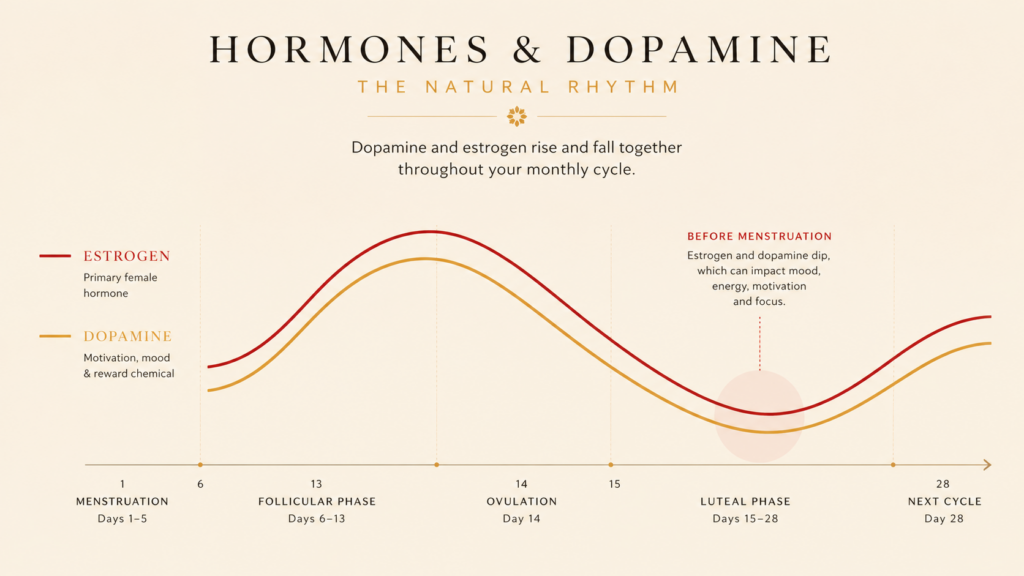
That’s not a minor footnote — it’s the reason so many women notice their motivation, mood, and focus swing on a monthly rhythm. The days before your period (when estrogen falls) are a classic low point. So is perimenopause, when estrogen becomes erratic and then declines for good.
In other words: if your energy and drive feel like a tide going in and out, you’re not imagining it. There’s a real hormonal mechanism underneath it.
Want the full breakdown of what low dopamine feels like in general? Start with this helpful post: What Does Low Dopamine Feel Like? 12 Signs to Know
1. Motivation that vanishes for no reason
Not laziness. Not a character flaw. Just a genuine inability to get yourself moving on things you know you want to do.
Dopamine is what converts “I should” into “I’m doing it.” When it’s low, the bridge between intention and action collapses. You end up staring at a simple task feeling like it’s physically uphill.
Women often internalize this as guilt — “why can’t I just get it together?” — when the more accurate question is what’s happening with your neurochemistry.
2. The joy is gone from things you used to love
Psychologists call this anhedonia: the reduced ability to feel pleasure. Your favorite show, a good meal, time with friends — they register, but they don’t land. The reward signal that used to fire just… doesn’t.
This one is especially common in the luteal phase (the week or so before your period) and during perimenopause, both estrogen-low windows.
3. Brain fog and the disappearing focus
Dopamine helps regulate attention and working memory. Low levels can leave you re-reading the same paragraph, losing your train of thought mid-sentence, or walking into a room with no idea why.
Many women are told this is “just stress” or “just being busy.” Sometimes it is. But when it tracks with your cycle, hormones and dopamine are worth considering.
4. Cravings — especially for sugar and carbs
When dopamine is low, the brain goes looking for a fast way to spike it. Sugar, refined carbs, caffeine, even scrolling your phone are all quick dopamine hits.
Those premenstrual chocolate cravings aren’t a lack of willpower. They’re partly your brain trying to self-medicate a dopamine dip with the fastest tool available.
5. Fatigue that sleep doesn’t fix
You slept eight hours and still feel like you’re moving through wet sand. Dopamine plays a direct role in physical energy and drive, so low levels can produce a bone-deep tiredness that no amount of rest seems to touch.
If tired-all-the-time is your main symptom, our timing guide covers when Mucuna is typically taken for daytime energy vs. evening: When to Take Mucuna: Morning vs Evening
6. Low mood that isn’t quite “depression”
This is the tricky one. Low dopamine can look a lot like depression — flatness, low motivation, no joy — but it can exist on its own, tied to hormonal shifts, without meeting the criteria for a depressive disorder.
That’s exactly why it gets missed. It’s important enough to repeat: if low mood is persistent or severe, please talk to a healthcare provider rather than trying to sort it out alone. Hormones and neurotransmitters are worth investigating with a professional, not instead of one.
7. Symptoms that get worse right before your period
If you notice that several signs on this list intensify in the days before your period, that’s the estrogen–dopamine link in action. As estrogen falls in the luteal phase, dopamine activity tends to follow — which is why PMS so often includes low motivation, irritability, brain fog, and cravings all at once.
8. The perimenopause shift
Somewhere in your late 30s to early 50s, estrogen stops being predictable. During perimenopause, many women describe a new and unfamiliar flatness — a loss of drive and sparkle that feels different from ordinary stress. Declining estrogen, and the dopamine changes that come with it, are a big part of that story.
9. Trouble feeling motivated by rewards that used to work
A deadline, a treat, a goal you set — they used to pull you forward. Now they don’t. When the dopamine reward system is underpowered, the usual carrots stop working, and discipline alone has to do all the lifting. Exhausting, and not sustainable.
What actually helps
The good news: dopamine is responsive to how you live. Some of the most effective levers are free.
Movement. Even a brisk walk reliably supports dopamine activity. You don’t need a punishing workout — consistency beats intensity.
Protein early in the day. Dopamine is built from an amino acid called tyrosine, found in protein-rich foods. A protein-forward breakfast gives your brain the raw material.
Real sleep. Dopamine receptors reset overnight. Chronic short sleep blunts the whole system.
Sunlight and morning light. Light exposure supports healthy dopamine signaling — one reason a morning walk does double duty.
Protecting your reward system. Endless scrolling floods the brain with cheap dopamine and can leave ordinary pleasures feeling dull by comparison. Deliberate breaks from the phone help recalibrate.
Where Mucuna Pruriens fits in
Mucuna pruriens — also called velvet bean — is a plant that naturally contains L-Dopa, the direct precursor your body uses to make dopamine. Rather than a synthetic stimulant, it supplies the raw building block itself. That’s why it’s become one of the most talked-about natural options for people looking to support healthy dopamine levels, women very much included.
Our Keter Wellness Mucuna is standardized to 20% L-Dopa in a 700mg capsule, so each dose is consistent — which matters, because guessing at potency with raw powder is where a lot of people go wrong.
If you want to try it, two of our other guides will save you the trial-and-error:
- How much to take: Mucuna Pruriens Dosage: The Complete Guide
- When to take it: When to Take Mucuna: Morning vs Evening
A sensible starting point for many women is a single morning capsule, taken on an empty stomach, then adjusting from there — but read the dosage guide first, and if you’re on any medication (especially antidepressants, MAOIs, or anything affecting dopamine), clear it with your doctor before starting.
The bottom line
If you’re a woman who feels flat, foggy, and unmotivated — and it seems to rise and fall with your cycle — low dopamine tied to your hormones is a real possibility that too few people talk about. The signs are easy to dismiss as stress, laziness, or “just how I am.” They’re often none of those things.
Start with the free levers: movement, protein, sleep, light. Consider a natural L-Dopa source like Mucuna if you want targeted support. And if the low mood or exhaustion is persistent, loop in a doctor — hormonal and neurochemical shifts are exactly the kind of thing that’s worth investigating properly.
You’re not broken. Your chemistry might just need a little support.
Frequently Asked Questions
What are the main signs of low dopamine in women?
Common signs include low motivation, loss of pleasure in things you used to enjoy, brain fog, sugar and carb cravings, fatigue that sleep doesn’t fix, and low mood — often worsening in the days before your period.
Why do low dopamine symptoms get worse before my period?
Dopamine activity is closely linked to estrogen. As estrogen falls in the luteal phase (the week or so before menstruation), dopamine activity tends to dip too, which can bring on low motivation, cravings, and brain fog.
Can Mucuna Pruriens help with dopamine in women?
Mucuna pruriens naturally contains L-Dopa, the precursor the body uses to make dopamine, so it’s often used to support healthy dopamine levels. Women who take medication — especially antidepressants or MAOIs — should talk to a doctor first.
Is low dopamine the same as depression?
No. Low dopamine can look similar to depression, but it can also occur on its own, often tied to hormonal shifts. Persistent or severe low mood should always be discussed with a healthcare provider.
Leave a Reply