

You know that feeling when you finish something big — a project, a workout, a hard conversation — and you expect to feel good, but nothing comes?
No satisfaction. No relief. Just a flat, empty “okay, what’s next.”
That’s not a character flaw. That’s your dopamine system telling you something.
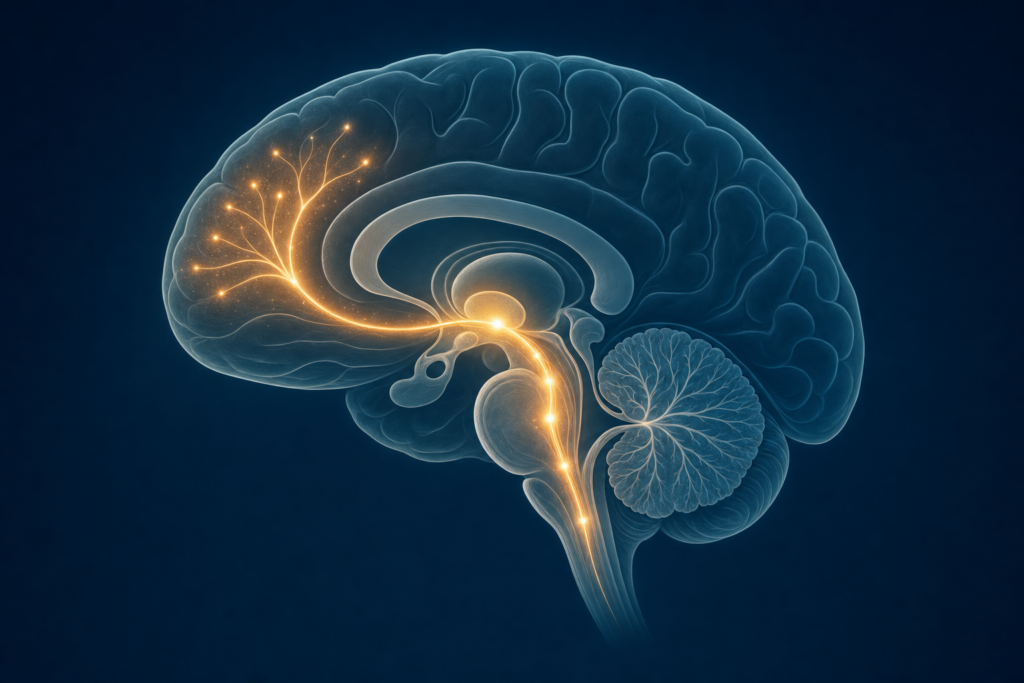
Dopamine is the brain’s reward and motivation chemical. When levels are where they should be, you feel driven, focused, and able to enjoy things. When they dip, everyday life starts to feel like you’re pushing through wet concrete.
The tricky part: low dopamine symptoms don’t announce themselves clearly. They creep in gradually, disguising itself as laziness, burnout, or just “being a certain kind of person.” This post walks through the 12 most common signs so you can recognize what’s actually going on.
What is dopamine, and why does it matter?
Dopamine is a neurotransmitter — a chemical messenger that brain cells use to communicate. It plays a central role in:
- Motivation and drive — the “wanting” system that gets you moving toward goals
- Reward and pleasure — the satisfaction you feel when you accomplish something
- Focus and attention — the ability to stay locked in without drifting
- Mood regulation — a baseline sense of okayness that keeps anxiety and depression at bay
- Movement — dopamine also controls motor function, which is why severe deficiency shows up in conditions like Parkinson’s disease
Dopamine doesn’t make you feel euphoric on its own — that’s a common misconception. It’s more accurate to say it makes things feel worth doing. Without it, nothing feels worth the effort.
12 signs your dopamine may be low
1. You’ve lost motivation for things you used to care about
This is the hallmark sign. Not just “I don’t feel like it today” — more like the desire itself has gone missing. Hobbies you used to love feel pointless. Goals that once excited you now feel distant and irrelevant.
Dopamine is directly tied to the brain’s reward anticipation circuit. When levels drop, the brain stops generating the anticipatory pull that makes pursuing things feel worthwhile. Nothing seems worth starting.
2. You feel flat, not sad
Depression is often described as overwhelming sadness, but low dopamine tends to feel different — more like emotional numbness or blunting. You’re not devastated. You’re just… nothing.
This “anhedonia” (the clinical term for inability to feel pleasure) is one of the more disorienting symptoms because there’s no obvious trigger. Life looks fine on paper. You just can’t feel it.
One important note: these signs can show up differently depending on your biology. For women especially, dopamine is closely tied to estrogen and the menstrual cycle — if that’s you, Low Dopamine Symptoms in Women breaks down the hormonal side in detail.
3. You struggle to concentrate
If your attention keeps sliding off tasks — even tasks you want to complete — low dopamine may be part of why. Dopamine is critical to the prefrontal cortex, the part of the brain that handles focus, planning, and working memory.
This is also why dopamine is so central to ADHD. The concentration difficulty isn’t a willpower issue; it’s a neurochemical one.
4. You rely on stimulants just to feel normal
Coffee is great. But if you need multiple cups before you feel like a functioning human — and even then you feel more “not terrible” than actually good — that’s worth paying attention to.
Caffeine works partly by increasing dopamine sensitivity. When your baseline is low, you need more stimulation just to reach neutral. The same pattern shows up with sugar cravings, social media scrolling, and other quick dopamine hits that feel necessary rather than pleasurable.
5. You have trouble sleeping, but you’re always tired
Low dopamine disrupts the sleep-wake cycle in a specific way: you feel exhausted during the day but can’t fall asleep easily at night. This happens because dopamine interacts with melatonin production and regulates the brain’s arousal system.
You might lie in bed with a restless, unsettled feeling — not anxious exactly, just unable to wind down. Then you wake up feeling like the sleep didn’t count.
6. You’ve noticed memory and recall slipping
Forgetting why you walked into a room. Losing words mid-sentence. Feeling like your thinking is slower than it used to be.
Dopamine plays a key role in working memory — the short-term mental scratch pad you use to hold and manipulate information. When it’s low, information doesn’t stick the same way, and retrieval becomes effortful.
7. You feel physically slower or heavier
Beyond the mental fog, some people describe a physical quality to low dopamine — a sense of heaviness or slowness in the body. Getting up feels like an effort. Movement feels reluctant.
This isn’t surprising given dopamine’s role in motor control. Even at levels that don’t cause clinical movement disorders, suboptimal dopamine can make you feel physically sluggish and unmotivated to move.
8. Nothing feels rewarding anymore
You do things. You complete them. You move on. But the sense of accomplishment that should follow — the quiet satisfaction of finishing something — isn’t there.
This is the reward circuit going quiet. Dopamine is released when you accomplish something, reinforcing the behavior and creating the drive to do it again. Without that feedback loop, effort stops feeling worth it, which over time erodes your willingness to try.
9. You’re more irritable than usual
Low dopamine isn’t just low mood — it can look like low patience. Small frustrations that you’d normally brush off become disproportionately irritating. You snap more easily. Recovery after being annoyed takes longer.
Dopamine helps regulate emotional reactivity. When it’s depleted, the buffer between stimulus and response gets thinner.
10. You’ve gained weight, especially around the midsection
Dopamine influences the brain’s hunger and satiety signals. When it’s low, the reward you’d normally get from eating a satisfying meal doesn’t fully register — so the drive to keep eating persists even after you’ve had enough.
This can lead to overeating, particularly of high-calorie, high-sugar foods (which provide a short-term dopamine spike). The weight gain that follows, especially visceral fat, can further suppress dopamine signaling — a frustrating cycle.
11. You’ve lost your sex drive
Libido is dopamine-dependent. The anticipation and desire that precede intimacy are driven largely by the dopamine reward circuit. When that circuit is underactive, sexual interest tends to fade — not because of relationship issues or stress necessarily, but because the brain’s motivational pull toward pleasure has gone quiet.
This is worth knowing because it’s often misattributed. It’s not always about the relationship. Sometimes it’s neurochemistry.
12. You feel like a different person than you used to be
This one is harder to pin down but often the most meaningful. People with low dopamine frequently describe a sense of having lost their former self — the version that was energetic, curious, driven. They remember feeling like that but can’t access it.
If you look back at who you were a few years ago and feel a significant gap — in motivation, mood, or engagement with life — it’s worth asking whether something has shifted in your neurochemistry, not just your circumstances.
What causes dopamine to drop?
Dopamine levels don’t fall randomly. Common drivers include:
- Chronic stress — cortisol suppresses dopamine production over time
- Poor sleep — the brain replenishes dopamine during deep sleep; consistently poor sleep depletes it
- Nutritional deficiencies — dopamine is synthesized from the amino acid tyrosine, which comes from dietary protein. Low protein intake or deficiencies in iron, B6, or magnesium can impair production
- Overstimulation — excessive social media, video games, or other high-dopamine activities can blunt receptor sensitivity over time
- Aging — dopamine production naturally declines with age, beginning around the mid-30s
- Inadequate L-Dopa precursors — L-Dopa is the direct precursor to dopamine in the brain. Without enough L-Dopa, the brain has less raw material to work with
What can you do about it?
The most important first step is recognizing the pattern. Many people spend years treating individual symptoms — seeing a doctor for sleep, a therapist for mood, a nutritionist for weight — without anyone connecting the dots to dopamine.
Once you recognize the pattern, the levers are mostly lifestyle-based:
- Sleep — prioritize 7–9 hours; dopamine is replenished during slow-wave sleep
- Exercise — physical movement is one of the most reliable natural dopamine boosters
- Protein intake — especially foods high in tyrosine (eggs, chicken, legumes)
- Reduce overstimulation — cutting back on screens and quick-hit dopamine sources allows receptor sensitivity to recover
- Stress management — anything that reduces chronic cortisol load helps
On the supplement side, Mucuna pruriens is worth understanding. It’s a plant that naturally contains L-Dopa — the direct chemical precursor to dopamine — which crosses the blood-brain barrier and supports the brain’s dopamine production. It’s one of the few natural sources of L-Dopa available and has been used in Ayurvedic medicine for centuries under the name kapikacchu.
If you want to understand how Mucuna pruriens works and whether it might fit your situation, our complete guide covers the science, dosing, and timing in detail.
And if you’re wondering how soon you’d feel it, most people notice a standardized dose within 45 to 90 minutes — though the deeper benefits build over a few weeks of consistent use.
The bottom line
Low dopamine rarely looks like a single dramatic symptom. It tends to accumulate quietly — motivation fading here, sleep suffering there, pleasure dimming gradually — until one day you realize you feel like a muted version of yourself.
Recognizing these 12 signs is the first step. The next is understanding your options.
Leave a Reply