
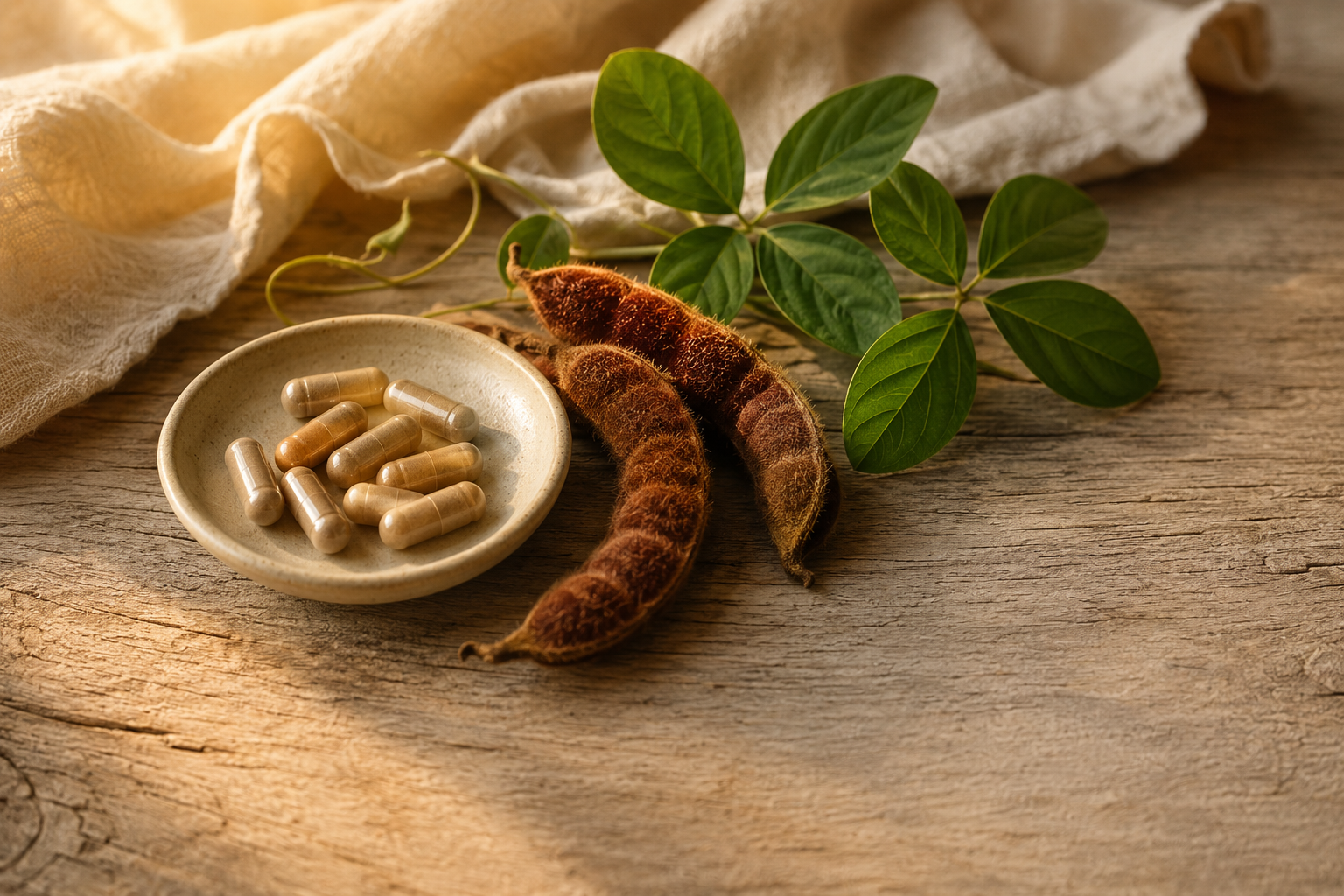
Most articles about supplement side effects are written by people who don’t sell the supplement.
We do. We’ve sold a standardized Mucuna pruriens extract for over twelve years, which means we’ve heard from a lot of customers — including the ones who didn’t get along with it. So, this page isn’t going to tell you that velvet bean is a gentle, harmless herb with no downsides. That would be both untrue and unhelpful.
Here’s what actually happens, why it happens, and how to think about whether it’s a fit for you.
The short answer
The most commonly reported Mucuna pruriens side effects are digestive: nausea, stomach discomfort, bloating, and occasionally vomiting. After that come headaches, trouble sleeping, dizziness, and a jittery or restless feeling. Most of these are dose-related, most show up early rather than late, and most people who experience them find they ease off within the first week or two — or resolve entirely when the dose comes down.
Serious problems are uncommon in healthy adults at reasonable doses. But Mucuna isn’t a supplement where “more is better,” and it isn’t right for everyone. Some people should talk to a doctor before touching it at all. We’ll cover exactly who below.
Why Mucuna causes side effects at all
This is the part most articles skip, and it’s the part that makes everything else make sense.
Mucuna pruriens contains L-DOPA — the direct chemical precursor your body uses to make dopamine. That’s the entire reason anyone takes it. It’s also the entire reason it has a side effect profile.
Here’s the wrinkle: when you swallow L-DOPA, not all of it makes it to your brain. A significant portion gets converted to dopamine outside the central nervous system — in your gut, your bloodstream, your peripheral tissues. And dopamine created out there can’t cross back into the brain to do anything useful. It just circulates.
Peripheral dopamine influences digestive motility, heart rate, and blood pressure. That single fact explains almost the entire side effect list. The nausea isn’t mysterious or allergic — it’s dopamine acting on the part of your gut and brainstem that regulates the vomiting reflex. The occasional lightheadedness on standing isn’t random — it’s a blood pressure effect.⁷
Understanding this reframes the whole question. Mucuna side effects aren’t a sign that something’s gone wrong. They’re usually a sign that you’ve taken more L-DOPA than your body wants to process at once.
The common ones¹ ²
Nausea and stomach upset
The most frequently reported effect, by a wide margin. It ranges from mild queasiness to genuine nausea, and for a small number of people, vomiting. It typically hits within the first hour or two, which lines up with when L-DOPA levels peak.³
The good news is this is the most fixable side effect on the list. Lowering the dose helps. So does the timing of when you take it relative to food — which we cover in detail in our guide to when to take Mucuna.
Headache
Common, usually mild, usually early. Often clears within the first week as your system adjusts.
Trouble sleeping
Mucuna supports alertness and drive. That’s the point — and it’s also why taking it late in the day is a mistake for a lot of people. If you’re lying awake at midnight, look at what time you took it before you conclude the supplement doesn’t work for you.
Dizziness or lightheadedness
Especially when standing up quickly. This is the blood pressure effect. Usually mild, usually dose-related, and worth paying attention to if you already run on the low side.
Restlessness, jitteriness, or feeling “wired”
Less common than the digestive effects but real. Frequently a signal that the dose is too high for you specifically. Dopamine is not a “more is better” system — overshooting doesn’t feel like extra motivation, it feels like anxiety.
Bloating and gas
Mucuna is a legume. Some people get the ordinary legume response. Not much science here, just biology.
The variable that matters most: dose
If there’s one thing to take away from this page, it’s this. Nearly every side effect above is dose-dependent. Higher intake means more likely and more intense. Lower intake means the opposite.
This is why “start low” isn’t throwaway advice — it’s the single most effective thing you can do to avoid problems. Beginning at a conservative dose and giving your body a week or two to adjust before considering an increase prevents the large majority of bad first experiences with this herb.
The people who have miserable first weeks with Mucuna are, overwhelmingly, the people who started at a full dose on day one because the label said they could.
Our complete dosage guide walks through how to think about starting amounts, adjusting, and cycling.
Why the form you buy changes your risk
This part matters more than most buyers realize, and it’s worth being direct about since we have an obvious stake in it.
Raw Mucuna seed powder contains L-DOPA naturally — but the amount swings enormously. When researchers measured L-DOPA across 56 seed samples spanning four Mucuna varieties, content ranged from 0.58% to 6.42% by dry weight.⁴ That’s an eleven-fold difference between the weakest and strongest seed, before anyone grinds, ships, or bottles anything.
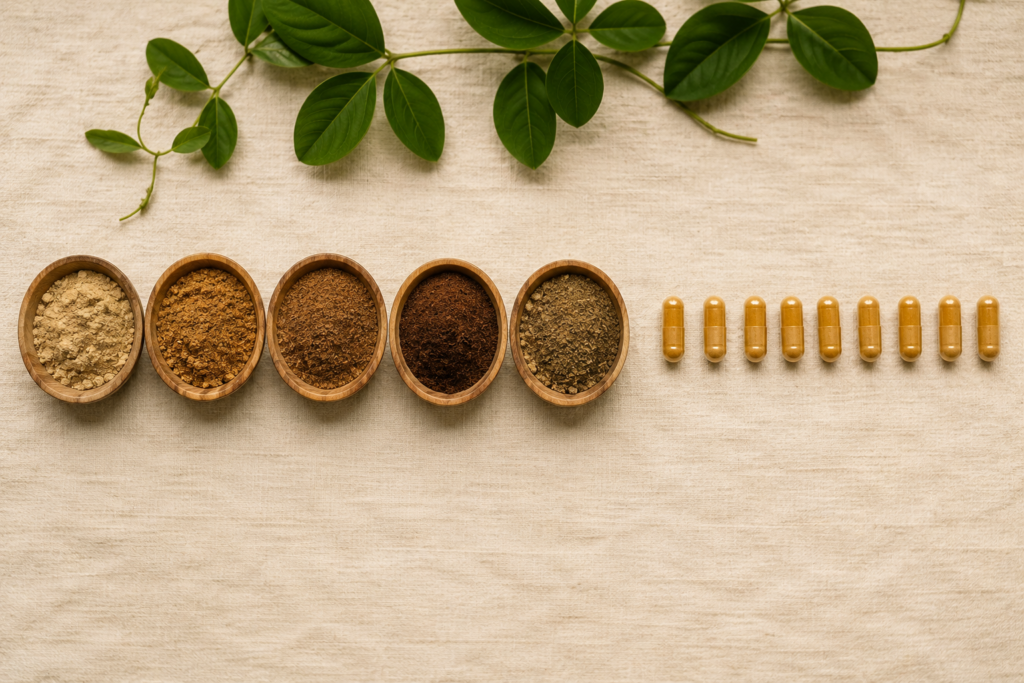
Sit with that number for a second. It means two jars of raw Mucuna powder, both honestly labeled, both from reputable sellers, can differ by a factor of ten in the only compound you’re buying them for. If you’re taking raw powder, you are not really dosing — you’re estimating, and your estimate resets every time the harvest changes.
A standardized extract is tested and adjusted so that each batch delivers a verified L-DOPA percentage. You know what you’re taking. When you find the amount that works for you, it stays the amount that works for you.
This doesn’t make a standardized extract inherently gentler — a standardized product delivers a real, meaningful dose of L-DOPA, and if you take too much of it you’ll feel it. What it does is make your dose predictable, which is what actually lets you dial in a level your body tolerates and stay there.
We publish a certificate of analysis for our batches for exactly this reason. Whatever brand you end up choosing, ask for one.
A note on raw seeds
Occasionally someone reads that Mucuna is a food crop and reasons that eating the raw beans must be fine. It isn’t. There’s a published case report of a woman who ate a handful of raw Mucuna seeds and ended up in an emergency department with severe digestive symptoms followed by confusion and hallucinations. Whole raw seeds are not a supplement, and the plant’s seed pods are covered in hairs that cause intense itching on contact — which is where the “pruriens” in the name comes from.⁵ ⁶
Who should talk to a healthcare provider first
Some of these are firm. Please take them seriously.
Talk to your doctor before taking Mucuna pruriens if you:
- Take any antidepressant, particularly an MAO inhibitor or an SSRI
- Take any medication that affects dopamine, or any medication prescribed for a neurological or psychiatric condition
- Take blood pressure medication, or have low blood pressure
- Take diabetes medication
- Have a heart rhythm condition
- Have glaucoma
- Have a history of psychosis or a psychiatric diagnosis
- Have stomach ulcers or a significant digestive condition
- Are scheduled for surgery or any procedure involving anesthesia
- Are pregnant, trying to become pregnant, or breastfeeding
- Have a known allergy to legumes or anything in the pea family
That list isn’t us being cautious for legal cover. Mucuna delivers a compound with real pharmacological activity, and several of those interactions have genuine mechanisms behind them — the antidepressant and blood pressure ones especially. A five-minute conversation with your provider is worth more than anything you’ll read online, including this page.
Don’t take Mucuna alongside a prescription levodopa medication unless your doctor is directing it. Stacking two sources of the same active compound is not something to work out on your own.
What we don’t know
Honesty means naming the gaps.
Most of the clinical research on Mucuna pruriens has been conducted in specific medical populations under supervision — not in healthy adults taking a supplement for general wellness support. That’s the study population that exists, and it’s not quite the population reading this page.
Short-term use at moderate doses appears well tolerated in the available literature. But the long-term picture in healthy users is genuinely under-studied. Anyone who tells you with total confidence what daily Mucuna use does over ten years is telling you something the evidence doesn’t currently support in either direction.
This is part of why cycling — periods of use followed by deliberate breaks — is a common practice among long-term users. It’s a reasonable precaution based on how dopamine systems work, though it’s worth being clear that it’s pharmacological logic rather than proven protocol.
How to lower your odds of side effects
- Start low. Lower than you think you need. Stay there a week.
- Take it earlier in the day. Alertness at 9am is a benefit. Alertness at 11pm isn’t.
- Pay attention to food timing. Protein-heavy meals compete with L-DOPA absorption, which affects both how well it works and how it sits.
- Change one thing at a time. If you start Mucuna and two other supplements in the same week, you won’t know what caused what.
- Give it a real trial before increasing. Early nausea often fades. Increasing the dose to chase an effect while your body is still adjusting is how mild becomes miserable.
- Consider cycling. Build in breaks rather than running continuously and indefinitely.
- Know your product. A standardized, tested extract lets you control the one variable that matters most.
When to stop and get help
Stop taking it and contact a healthcare provider if you experience:
- Vomiting that doesn’t stop, or that prevents you from keeping fluids down
- Chest pain, or a racing or irregular heartbeat
- Fainting
- Confusion, hallucinations, or significant changes in thinking or perception
- Any allergic reaction — hives, swelling, difficulty breathing
- Involuntary or unusual movements
- Any symptom that alarms you
That last one isn’t filler. You know your own baseline better than any article does. If something feels wrong, stop and ask someone qualified.
Frequently asked questions
Does Mucuna pruriens cause nausea in everyone?
No. It’s the most commonly reported effect, but plenty of people never experience it. It’s strongly tied to dose and to timing relative to food.
Do side effects go away?
Often, yes. Mild digestive effects and headaches frequently ease within the first week or two as your body adjusts. Effects that don’t fade, or that get worse, are a signal to lower the dose or stop.
Is Mucuna pruriens safe to take every day?
Many people use it daily, and many build in regular breaks. Long-term daily use in healthy adults isn’t well studied, which is a real limitation rather than a reassuring one. Talk to your provider about what makes sense for you.
Can I take Mucuna with my antidepressant?
Ask your doctor. This is one of the interactions with a genuine mechanism behind it, and it’s not something to experiment with.
Is a standardized extract more likely to cause side effects than raw powder?
Not inherently — but it does deliver a known, meaningful amount of L-DOPA rather than a variable one. The advantage is predictability: you can find your dose and actually stay at it.
The bottom line
Mucuna pruriens has side effects because it works. It delivers a real compound with real activity, and that’s the deal — the same property that makes it worth taking is the property you have to respect.
For most healthy adults, at a sensible dose, taken earlier in the day, that respect is easy to give. Start low, pay attention, and don’t chase effects by escalating.
For a meaningful minority — people on certain medications, people with certain conditions, people who are pregnant — it’s a conversation with a doctor first, without exception.
If you decide it’s a fit, buy something tested. Ask for the certificate of analysis. Know what’s in the capsule.
See our standardized Mucuna Pruriens 20% L-DOPA extract and current COA →
References
Most controlled human research on Mucuna pruriens has been conducted in clinical populations under medical supervision rather than in healthy adults using it as a dietary supplement. The sources below are cited for their reported tolerability and adverse-event data.
- Katzenschlager R, Evans A, Manson A, et al. Mucuna pruriens in Parkinson’s disease: a double blind clinical and pharmacological study. J Neurol Neurosurg Psychiatry. 2004;75(12):1672–1677. PMC1738871
- Cilia R, Laguna J, Cassani E, et al. Mucuna pruriens in Parkinson disease: a double-blind, randomized, controlled, crossover study. Neurology. 2017;89(5):432–438. PMC5539737
- Cilia R, Laguna J, Cassani E, et al. Daily intake of Mucuna pruriens in advanced Parkinson’s disease: a 16-week, noninferiority, randomized, crossover, pilot study. Parkinsonism Relat Disord. 2018;49:60–66. PMID 29352722
- Pulikkalpura H, Kurup R, Mathew PJ, Baby S. Levodopa in Mucuna pruriens and its degradation. Sci Rep. 2015;5:11078. PMC4460905
- Maillot A, Schmitt C, Marteau A. Poisoning after ingestion of Mucuna pruriens seeds on Reunion Island. Wilderness Environ Med. 2022;33(1):122–124. PMID 34895813
- Infante ME, Perez AM, Simao MR, et al. Outbreak of acute toxic psychosis attributed to Mucuna pruriens. Lancet. 1990;336(8723):1129. PMID 1978001
- Lampariello LR, Cortelazzo A, Guerranti R, Sticozzi C, Valacchi G. The magic velvet bean of Mucuna pruriens. J Tradit Complement Med. 2012;2(4):331–339. PMC3942911
Last reviewed: July 2026.
Leave a Reply