

When you hear about “natural dopamine supplements,” we’re not talking about a pill that contains dopamine itself. Instead, these are supplements that give your body the raw materials—the essential building blocks and cofactors—it needs to produce its own dopamine. Key players here are amino acids like L-Tyrosine and direct precursors like L-Dopa, which often comes from a plant called Mucuna pruriens.
Understanding Natural Dopamine Supplements
Let’s use an analogy. Think of your brain’s dopamine system as a busy factory that produces motivation, focus, and that feeling of satisfaction. For this factory to run efficiently, it needs a constant, reliable supply chain of high-quality raw materials. Natural dopamine supplements are essentially that—a direct delivery of the exact parts your factory needs.
The key difference here is how they work. Instead of artificially flooding your system and causing a spike, these supplements support your body’s own natural processes. They provide the specific nutrients needed to make and regulate this crucial neurotransmitter, promoting a healthy balance rather than creating jarring highs and lows.
The Core Concept: Building Blocks
At their heart, these supplements aim to fill nutritional gaps that could be holding back your brain’s dopamine production. Your brain can’t just create dopamine from nothing; it has a very specific recipe that requires a few key ingredients.
- Direct Precursors: This is where something like Mucuna pruriens shines. It provides L-Dopa, a compound that’s just one chemical step away from becoming dopamine. It’s like giving your factory a nearly finished product that just needs the final touch.
- Fundamental Amino Acids: Then you have L-Tyrosine, the foundational amino acid that kicks off the entire dopamine production line. This is the very first, most basic raw material you need to get started.
- Essential Cofactors: Think of vitamins like B6 and minerals as the skilled workers on the factory floor. They help with the chemical conversions, turning those raw materials and precursors into actual, usable dopamine.
The real power of natural dopamine supplements lies in their ability to support your body’s innate capacity for balance. By providing the right resources, you empower your brain to regulate its own motivation and reward systems more effectively.
This guide will walk you through the science behind these key ingredients, explaining exactly how each one contributes to a healthier, more resilient dopamine system. We’ll cover the benefits, safety considerations, and what to look for in a high-quality product, so you can make a truly informed decision.
Before we dive deep, here’s a quick look at the main supplements we’ll be discussing.
Key Natural Dopamine Supplements at a Glance
This table gives a quick summary of the most effective natural supplements for supporting dopamine levels, highlighting what they do and why they’re beneficial.
| Supplement | Primary Mechanism | Main Benefit |
|---|---|---|
| Mucuna Pruriens | Provides a direct source of L-Dopa, a dopamine precursor. | Directly supports dopamine synthesis for mood and motivation. |
| L-Tyrosine | Acts as a foundational amino acid building block for dopamine. | Enhances cognitive function, especially under stress. |
| Rhodiola Rosea | Helps protect against stress-induced dopamine depletion. | Improves mental resilience, energy, and mood stability. |
| B-Vitamins (B6, B9) | Serve as essential cofactors in dopamine synthesis. | Facilitates the conversion of precursors into active dopamine. |
Now, let’s explore each of these in more detail.
So, What Exactly Is Dopamine and Why Should You Care?
Ever get that rush of satisfaction from crossing something off your to-do list? Or the simple pleasure of hearing a song you love? That little jolt of motivation that gets you off the couch to chase a goal? That’s dopamine at work.
At its core, dopamine is a neurotransmitter—think of it as a chemical text message your brain cells use to communicate. It’s famously known as the “motivation molecule” because it’s the star player in your brain’s reward system. When you do something your brain likes—eat a great meal, get a good workout, or hit a deadline—it rewards you with a little burst of dopamine.
This chemical pat on the back makes you want to repeat that behavior, hardwiring habits and driving you toward pleasure and achievement. When dopamine is flowing correctly, the world feels full of possibility. But when it’s not, even small tasks can feel like a monumental effort.
When Your Dopamine Is Out of Whack
A dopamine imbalance is more than just an “off” day; it can seriously drag down your quality of life. Low dopamine often shows up as a frustrating collection of symptoms that are easy to feel but hard to name.
Sound familiar?
- Constant Procrastination: You know what you need to do, but finding the internal “oomph” to start feels impossible.
- Brain Fog: Your thinking feels muddy, and you struggle to focus or recall simple details.
- Anhedonia: The things you used to love—hobbies, music, spending time with friends—just don’t spark joy anymore.
- Deep-Seated Fatigue: A persistent feeling of being mentally and physically drained, no matter how much you rest.
- Moodiness: You find yourself feeling apathetic, irritable, or down for no apparent reason.
When these feelings stick around, they get in the way of everything. The ambition is still there, but the brain’s chemical signal to get going is faint. This is exactly where the idea of supporting your body’s natural dopamine production comes in—it’s about restoring that get-up-and-go signal.
The goal isn’t about chasing a temporary high. It’s about building a stable, resilient dopamine system that provides the steady motivation and focus you need to thrive every single day.
It’s no surprise that people are catching on. The global market for natural health supplements, including popular natural dopamine supplements like Mucuna pruriens extracts standardized to 20% L-Dopa, is booming. Valued at USD 68.0 billion, it’s expected to hit USD 105.0 billion by 2035 as more people look for plant-based ways to support their mood and drive. You can discover more insights on the natural health supplement market growth and what’s behind this trend.
Building a Strong Foundation for Dopamine
While supplements can be a powerful tool, they can’t do the job alone. They work best when you’ve already created a healthy environment for your brain to operate in.
Think of it like this: supplements are the high-performance parts for your engine, but you still need quality fuel and regular oil changes.
Your daily habits are the real foundation. Here are the three non-negotiables:
- Diet: Your brain needs the right raw materials. A diet with plenty of protein gives you amino acids like tyrosine, which is the direct building block for dopamine.
- Exercise: Moving your body is one of the best ways to trigger a natural dopamine release and actually make your brain’s dopamine receptors more sensitive and efficient.
- Sleep: This is when your brain does its housekeeping. Quality sleep allows your brain to flush out waste and reset its neurotransmitter levels for the next day. It’s not optional.
Nail these three areas first, and you’ll create the perfect conditions for natural dopamine supplements to make a real difference.
The Best Natural Supplements for Dopamine Support
When you’re looking to support your brain’s dopamine levels, it helps to think of it like tuning up a car. You can take different routes—some are direct highways, while others are scenic backroads that build long-term resilience. The world of natural dopamine supplements works the same way, offering a whole toolkit of ingredients that support your brain’s motivation and reward system from different angles.
Each supplement has a unique job. Some provide the direct, ready-to-use parts to assemble dopamine, while others are more about protecting the system from stress or supplying the essential tools for production. Let’s break down the key players that have shown the most promise in both research and real-world experience.
This map below gives a great visual of dopamine’s central role in our lives—it’s the engine behind our motivation, our sense of reward, and our overall mental balance.
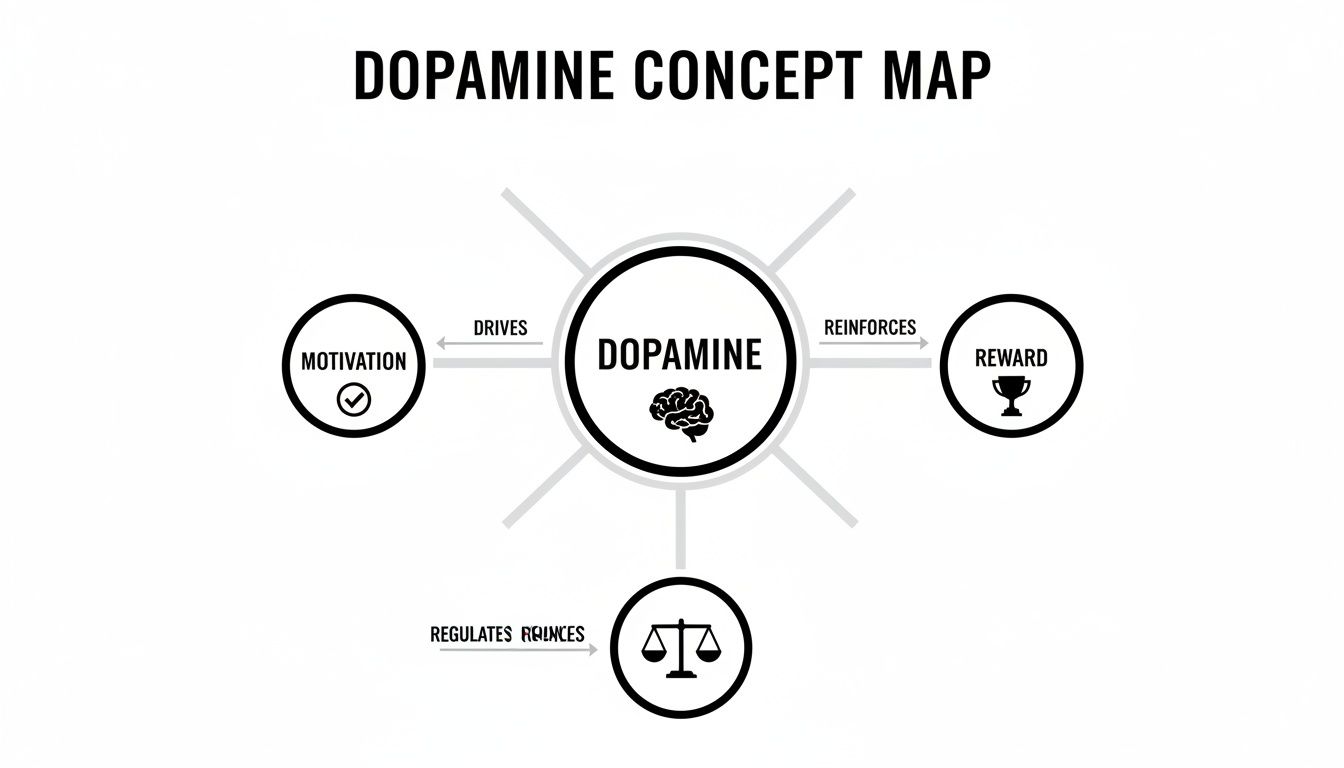
It’s a good reminder that supporting dopamine isn’t just about chasing a single feeling. It’s about nurturing the core systems that drive our daily actions and give us that sense of accomplishment.
Mucuna Pruriens: The Direct Precursor
Imagine you’re building a car, but instead of starting from scratch, a fully assembled engine is delivered to your door. All you have to do is install it. That’s a great way to think about Mucuna pruriens, a tropical legume also known as the velvet bean.
This remarkable plant happens to be one of nature’s richest sources of L-Dopa, the molecule that is the direct precursor to dopamine. This is a huge deal. Once L-Dopa crosses from your bloodstream into your brain, it only needs to go through a single conversion step to become active dopamine. This direct pathway makes Mucuna pruriens one of the most potent natural dopamine supplements you can find.
Simply put, Mucuna pruriens hands the brain a nearly finished product. This provides a powerful and efficient way to support dopamine synthesis, which can translate into better mood, drive, and focus.
The real key to its effectiveness, though, comes down to standardization. A supplement standardized to 20% L-Dopa, for example, guarantees you’re getting a consistent, reliable amount of the active compound in every single dose. That predictability is what separates a high-quality extract from a generic powder with questionable potency—it’s crucial for getting noticeable and dependable results.
L-Tyrosine: The Foundational Building Block
So, if Mucuna pruriens provides the engine, think of L-Tyrosine as the raw steel needed to forge that engine from scratch. L-Tyrosine is an amino acid that sits at the very beginning of the dopamine production line. Your body takes tyrosine, converts it into L-Dopa, and then that L-Dopa becomes dopamine.
This makes L-Tyrosine a fundamental building block. Supplementing with it is like making sure your brain’s factory has a steady supply of essential raw materials, which is especially critical during times of high stress.
- Stress Resilience: When you’re stressed, your brain burns through dopamine at a much faster rate. L-Tyrosine helps replenish those depleted stores, which in turn supports cognitive functions like memory and focus when you’re under pressure.
- Cognitive Support: By providing the necessary fuel, tyrosine helps maintain mental clarity and alertness without the jitters you might get from stimulants.
Taking L-Tyrosine is a smart, proactive strategy. It ensures your dopamine production line never runs out of its most basic and vital ingredient.
Rhodiola Rosea: The Stress Protector
Now, let’s talk about factory security. Rhodiola rosea is a classic adaptogenic herb that acts like a skilled security team, protecting your dopamine system from the wear and tear of chronic stress.
Stress floods your body with cortisol, a hormone that can slowly deplete your dopamine levels over time, leaving you feeling drained, flat, and unmotivated. Rhodiola helps your body adapt to and resist both physical and mental stressors, buffering you from their negative effects.
It works by influencing key brain chemicals and may even help reduce the breakdown of dopamine, preserving the precious neurotransmitter you already have. This protective action is fantastic for maintaining mood stability, fighting off mental fatigue, and fostering a sense of calm resilience.
B-Vitamins: The Essential Factory Workers
Finally, every factory needs a skilled crew to assemble the final product. That’s where B-Vitamins come in—particularly B6, B9 (Folate), and B12. They are the essential “co-factors,” or the workers on the dopamine assembly line.
These vitamins act as catalysts, helping to convert L-Tyrosine into L-Dopa and then, crucially, L-Dopa into dopamine. Without them, the entire production line would grind to a halt, no matter how much raw material you have on hand.
- Vitamin B6: A non-negotiable coenzyme for that final, critical conversion of L-Dopa to dopamine.
- Vitamin B9 (Folate): Supports the overall synthesis of all key neurotransmitters, including dopamine.
- Vitamin B12: Absolutely essential for neurological health, playing a supportive role in keeping the brain’s chemical balance in check.
Making sure you have enough of these B-vitamins is like ensuring your factory is fully staffed with competent workers ready to get the job done right.
It’s clear that people are catching on. The global market for dopamine support supplements recently hit USD 1.42 billion, with forecasts showing strong double-digit growth as more people prioritize their mental wellness. This is all part of the much larger brain health supplements industry, which is projected to jump from USD 12.56 billion to over USD 32.13 billion. You can explore more data on this significant market growth and see what’s driving these consumer choices.
How to Choose a High-Quality Dopamine Supplement
Stepping into the world of supplements can feel like navigating a maze. With so many bottles making similar promises, how do you know what actually works? This is especially true for brain health and herbal supplements, a market that’s booming for a reason.
The dietary supplements market hit a staggering USD 192.65 billion and is on track to reach USD 414.52 billion, while the brain health niche alone is set to grow from USD 12.6 billion to USD 35.94 billion. If you want to dig into the numbers, you can read the full research about these market trends and see why so many people are turning to natural options.
To cut through the noise, you need a simple framework. Forget the marketing hype and focus on the three pillars of a great supplement: Standardization, Potency, and Purity. Once you understand these, you can pick a natural dopamine supplement with total confidence.
The Power of Standardization
Of these three, standardization is easily the most important—and the one most people overlook.
Imagine buying a bag of coffee beans without knowing how much caffeine is in them. One cup might give you a nice, gentle lift, while the next could leave you buzzing with jitters. That’s what it’s like using a non-standardized herbal supplement.
Standardization is the quality control process that guarantees a specific, consistent amount of the key active ingredient in every single batch. For Mucuna pruriens, that active ingredient is L-Dopa.
A standardized extract means you get a predictable, effective dose every single time. This consistency is what allows you to see real, reliable results for your mood and motivation.
Without it, the L-Dopa levels could swing wildly from one bottle to the next. You’re left just hoping for the best instead of knowing exactly what you’re putting into your body.
A Real-World Example: Keter Wellness L-Dopa 20%
Let’s make this tangible. A product like Keter Wellness’s Mucuna L-Dopa supplement is standardized to a minimum of 20% L-Dopa. This percentage isn’t just a number; it’s a promise of consistency and effectiveness.
Here’s how the math breaks down:
- Total Serving Size: 700 mg of Mucuna pruriens extract per capsule.
- Standardization: Guaranteed to contain at least 20% L-Dopa.
- Active Dose Calculation: 700 mg x 0.20 = 140 mg of pure L-Dopa.
That simple calculation tells you everything you need to know. Each capsule delivers a precise 140 mg dose of the very compound that supports your brain’s dopamine production. This level of transparency means you can manage your dosage properly and accurately track how it’s working for you.
Compare that to a non-standardized product, which might only contain 2% L-Dopa—a dose too low to do much of anything. Choosing a standardized supplement means you’re investing in a predictable outcome, not playing a guessing game.
Purity and Potency: The Other Essentials
While standardization guarantees consistency, purity and potency are just as critical for a supplement to be safe and effective. They complete the quality trifecta, ensuring what you’re taking is both clean and strong enough to work.
Below is a quick checklist to help you evaluate the quality of any natural dopamine supplement you’re considering.
Quality Checklist for Natural Dopamine Supplements
Use this checklist to evaluate supplements and ensure you are choosing a safe, effective, and high-quality product.
| Quality Factor | What to Look For | Why It Matters |
|---|---|---|
| Standardization | A specific percentage of the active compound (e.g., “20% L-Dopa”) listed on the label. | Guarantees you get a consistent and effective dose in every serving, eliminating guesswork and ensuring reliable results. |
| Purity | Third-party lab testing seals or mentions. Look for verification that it’s free of heavy metals, pesticides, and microbes. | Confirms the supplement is clean and safe, without harmful contaminants that could undermine your health goals. |
| Potency | A dosage that aligns with effective, evidence-backed amounts. For example, 140 mg of L-Dopa per serving is a meaningful dose. | Ensures the supplement contains enough of the active ingredient to actually make a difference. Low-potency products are often ineffective. |
| Clean Ingredients | A short “other ingredients” list. Avoid unnecessary fillers, binders, artificial colors, and common allergens. | A clean label indicates the manufacturer is focused on delivering the active ingredients, not cheapening the product with additives. |
By keeping these factors in mind—Standardization, Purity, and Potency—you can confidently navigate the crowded supplement aisle and choose a product that truly supports your well-being.
Using Dopamine Supplements Safely and Effectively
When it comes to supporting your body with natural dopamine supplements, a thoughtful approach is everything. It’s easy to think more is better, but the real key is to work with your body, not against it. The goal is to introduce these ingredients carefully, pay close attention to how you feel, and build a routine that genuinely enhances your well-being without throwing things out of balance.
The best way to do this is with the tried-and-true “start low and go slow” method. Seriously, this isn’t a race. Begin with the smallest dose suggested on the label—for a supplement like Keter Wellness’s Mucuna L-Dopa, that might mean just one capsule. Taking it with a meal can also help prevent any potential stomach upset. The first week is all about observation.
This cautious start lets you see how your body uniquely responds and helps you find the sweet spot—the lowest dose that gives you the benefits you’re looking for. It’s a much smarter way to get consistent, stable results for the long haul.
Establishing a Safe Dosing Protocol
Figuring out the right dose is a bit of a personal journey, but there are some solid principles to guide you. Remember, you’re aiming for gentle support, not trying to force a major change overnight. A single capsule in the morning is often a great starting point, as it aligns with your body’s natural daily rhythm.
Give it a week or two at that dose before even thinking about making a change. Let your body adjust and see how you feel. Rushing the process just muddies the waters and makes it impossible to know what’s actually working.
Crucial Safety Note: This is non-negotiable—before you start any new supplement, talk to your doctor or another qualified healthcare professional. This is especially important if you are pregnant, nursing, taking prescription medications, or have a pre-existing condition like Parkinson’s disease.
Your doctor knows your health history and can give you advice tailored to you. They can check for any potential conflicts with medications you’re already on and help you integrate supplements safely into your routine.
Understanding Supplement Cycling
Here’s another pro-tip: supplement cycling. This simply means taking a supplement for a planned period and then taking a planned break. A common approach is taking it for five days and then taking two days off, or using it for a few weeks straight followed by a full week off.
Think of it as hitting the reset button. Taking these short breaks helps prevent your body from getting too used to the supplement, which can diminish its effects over time. This keeps your dopamine receptors sensitive and responsive, ensuring the supplement continues to work effectively without you needing to constantly up the dose.
Here are a few signs it might be time for a break:
- You notice the effects aren’t as strong as they used to be at your usual dose.
- You feel a bit overstimulated or experience minor side effects like a headache.
- You simply want to be proactive about maintaining its long-term effectiveness.
Potential Interactions to Be Aware Of
While supplements like Mucuna pruriens are generally well-tolerated, they aren’t meant to be taken in a vacuum. Because L-Dopa has a direct effect on your brain chemistry, it’s critical to know that it can interact with certain types of medications.
Be particularly cautious if you take:
- MAOIs (Monoamine Oxidase Inhibitors): A class of medication often prescribed for depression.
- Antipsychotic Medications: These frequently work by influencing dopamine pathways.
- Blood Pressure Medications: Dopamine can play a role in cardiovascular function.
This is exactly why that conversation with your doctor is so important. They have the full picture and can make sure any supplement you add will support your health, not complicate it. By putting safety first, you can use natural dopamine supplements to effectively support your drive and focus.
Frequently Asked Questions
When you’re exploring natural dopamine supplements, a lot of practical questions pop up. It’s completely normal. Getting clear answers is the first step toward making choices you can feel good about. Here, we’ll tackle some of the most common questions I hear, giving you the straightforward information you need.
We’ll cover everything from how quickly you might feel a difference to the best daily habits to pair with your supplements.
How Long Does It Take for Natural Dopamine Supplements to Work?
There’s no magic one-size-fits-all answer here. Everyone’s body chemistry is a bit different, so your experience will be unique. Some people report feeling a subtle shift in their mood or mental clarity within just a few days, especially when using a direct precursor like Mucuna pruriens, which provides L-Dopa straight to the system.
On the other hand, ingredients like the amino acid L-Tyrosine or adaptogens like Rhodiola tend to work more gradually. Think of it as slowly refilling a reservoir. It might take a few weeks of consistent use for your body to build up its nutritional stores and for you to notice a real, lasting change. The key takeaway? Consistency is always more important than immediate results.
Can I Take Multiple Dopamine Supplements Together?
Stacking supplements can be a smart strategy, but you have to do it thoughtfully. A great synergistic combo, for example, is taking a precursor like L-Tyrosine alongside a key cofactor like Vitamin B6. This is like providing both the raw lumber (L-Tyrosine) and the carpenter (B6) needed to build dopamine.
However, I generally advise against combining multiple powerful precursors—like taking high doses of Mucuna pruriens and L-Tyrosine at the same time—without talking to a doctor first. Pushing the system too hard could lead to overstimulation or throw your neurotransmitters out of whack. It’s always best to work with a healthcare provider to build a stack that’s tailored and safe for you.
A good rule of thumb is to introduce just one new supplement at a time. This lets you clearly see how each one affects you individually before you start combining things.
Are There Any Side Effects I Should Be Aware Of?
When taken as recommended, most natural dopamine supplements are very well-tolerated. That being said, some people can experience mild side effects, particularly when they first start or if they take a dose that’s too high for their system.
Common things to watch for include:
- Nausea or a bit of digestive upset
- Headaches
- A feeling of restlessness or being a little too “wired”
You can often avoid these issues by taking your supplement with a meal and starting with a lower dose to see how you feel. But if you experience any side effects that are persistent or worrying, the best course of action is always to stop taking the supplement and check in with your doctor.
What Lifestyle Changes Best Support Dopamine Levels?
Supplements are powerful, but they work best when they’re supporting an already healthy lifestyle. Think of them as an amplifier for all the other good things you’re doing. To really build a strong foundation for dopamine health, focus on a few key pillars.
Eat a diet rich in protein to give your brain the amino acid building blocks it needs. Get regular physical exercise—it’s one of the most proven natural dopamine boosters out there. And don’t skimp on high-quality sleep; that’s when your brain does its crucial neurotransmitter maintenance. Finally, find a stress-management practice that works for you, like mindfulness or meditation, because chronic stress is a known dopamine-drainer.
Ready to support your brain’s natural motivation and reward system with a high-quality, standardized supplement? The team at Keter Wellness is dedicated to providing pure, potent, and effective herbal solutions you can trust.
Explore the Keter Wellness Mucuna L-Dopa 20% supplement today!
Leave a Reply