
If you’re struggling to get more done at work, your first instinct might be to find a new time-management app or just work harder. But real, sustainable productivity isn't built on force. It’s a balanced strategy that combines your mindset, your workflows, and your well-being.
Getting this right helps you escape the frustrating cycle of burnout and recovery that comes from simply trying to push through.
The Hidden Drain on Your Productivity
Before you dive into another scheduling hack, let's address the real issue that’s likely sabotaging your output. The struggle to be productive often has little to do with a lack of effort and everything to do with a lack of engagement.
When you feel disconnected, unmotivated, or mentally foggy, even the simplest to-do list can feel like climbing a mountain. True productivity isn’t about logging more hours—it's about working smarter in an environment that actually fuels your focus and drive.

That feeling of being "on" but not truly present at work is a massive performance killer. It’s no surprise that a staggering 78% of employees worldwide are not engaged at their jobs, costing the global economy billions. On the flip side, engaged teams show 14% higher productivity and have far better attendance.
Why Engagement Comes First
Engagement is your emotional and psychological commitment to your work and your company’s goals. When you're engaged, you aren't just going through the motions; you're genuinely invested in the outcome.
This intrinsic motivation is the foundation for everything else. Without it, every other productivity strategy is just pushing a boulder uphill.
The core of the productivity puzzle isn’t about managing your clock—it's about managing your energy and attention. A disengaged mind can’t perform at its peak, no matter how perfectly structured the day is.
This guide will give you a clear roadmap based on three core pillars. Mastering them will help you not only get more done but also feel better about the work you do. If mental fog is a major blocker for you, check out our guide on how to overcome brain fog to reclaim your clarity: /how-to-overcome-brain-fog/
We'll unpack the strategies for sustainable performance, all built around what I call the three pillars.
The Three Pillars of Sustainable Productivity
| Pillar | Core Focus | Key Outcome |
|---|---|---|
| Mindset & Engagement | Cultivating a positive and motivated approach to your work. | Increased focus, job satisfaction, and intrinsic drive. |
| Strategic Systems | Implementing proven methods for managing time, tasks, and energy. | Reduced overwhelm, clearer priorities, and consistent output. |
| Holistic Wellness | Optimizing physical and mental health to fuel performance. | Sustained energy, enhanced cognitive function, and resilience to stress. |
By focusing on these interconnected areas, you can build a system that supports consistent, high-quality work without sacrificing your health along the way. To dive even deeper, you can also explore this comprehensive guide on increasing productivity at work.
Master Your Time Instead of Letting It Master You
That simple to-do list on your desk? It feels like a losing battle against an endless flood of tasks. It tells you what needs to be done, but it offers zero strategy for when or how you'll actually do it. If you want to genuinely increase your productivity, you have to shift from just listing tasks to intentionally designing your day.
Let's move past the theory and get into the practical frameworks that give your schedule structure and purpose. Think of these less as rigid rules and more as flexible tools you can adapt to your job and personal work style. The goal here is simple: regain control over your calendar and protect your most valuable asset—your focused attention.
Prioritize Ruthlessly with the Eisenhower Matrix
Here’s a hard truth: not all tasks are created equal. The Eisenhower Matrix is a brilliantly simple decision-making tool that helps you separate what’s truly important from what’s just making noise. It forces you to categorize everything on your plate based on two things: urgency and importance.
This method is a lifesaver for anyone who feels constantly busy but not productive. It cuts right through the chaos, showing you exactly where to focus your energy for the biggest impact.
You sort tasks into four quadrants:
- Urgent & Important (Do First): These are the fires you have to put out now. Think finishing a report for a client meeting this afternoon or fixing a major website bug that just popped up.
- Important & Not Urgent (Schedule): This is where real growth happens. It’s for long-term project planning, professional development, or nurturing a new client relationship. These are the things that move the needle.
- Urgent & Not Important (Delegate): These are often interruptions that feel critical but don't actually advance your key goals. Things like responding to certain emails or scheduling routine meetings often fall in here.
- Not Urgent & Not Important (Eliminate): These are the time-wasters. Mindlessly scrolling through social media, organizing old files you'll never need again—get rid of them.
Imagine a project manager juggling conflicting deadlines. The matrix makes it clear that finalizing the slides for tomorrow's stakeholder meeting (Urgent & Important) has to come before planning a project kick-off for next month (Important & Not Urgent). That kind of clarity prevents you from just reacting to whatever’s in front of you and ensures you’re making progress where it counts.
Protect Your Focus with Time Blocking
Time blocking is exactly what it sounds like: scheduling your entire day into specific blocks of time dedicated to particular tasks. Instead of reacting to a to-do list, you proactively give every minute of your workday a specific job. It’s a concrete plan that acts as a powerful defense against distractions.
For a creative professional, this might look like blocking out 9 AM to 11 AM every single day for "Deep Work: Ad Campaign Design." During that block, notifications are off, email is closed, and colleagues know not to interrupt. That protected time guarantees the mentally demanding work gets done without being derailed by a constant stream of tiny requests.
By assigning a specific time for every task, you're not just organizing your work; you're making a commitment to yourself about what you will focus on and when. This simple act transforms your calendar from a record of appointments into a strategic plan for your day.
Build Momentum with the Pomodoro Technique
The Pomodoro Technique is a beautifully simple method for staying sharp and avoiding mental burnout. It’s built on the idea that working in short, intense bursts followed by frequent breaks is far more effective than trying to power through marathon work sessions. This approach is perfect for big, intimidating projects or any task that requires sustained concentration.
The process is dead simple:
- Choose a single task to focus on.
- Set a timer for 25 minutes and work on only that task.
- When the timer goes off, take a 5-minute break. Get up, stretch, grab some water, or just look out the window.
- After four of these "Pomodoros," take a longer break—somewhere between 15-30 minutes.
This technique is brilliant for breaking the cycle of procrastination because it makes it so easy to start. Anyone can commit to just 25 minutes. Plus, it has an unexpected physical benefit. Research on workplace habits shows that employees who don't exercise regularly have a 50% higher rate of presenteeism—the state of being at work without actually being productive. The Pomodoro's built-in breaks encourage you to move, which can fight off that sluggish feeling. It’s a tiny change that can dramatically increase your output by managing both your time and your energy.
Design an Environment That Fuels Deep Work
Your ability to produce high-quality work isn't just about willpower; it's hugely influenced by your surroundings. A cluttered desk, poor lighting, or a chaotic digital workspace constantly pulls at your attention, making it nearly impossible to hit that state of intense concentration known as deep work.
The good news is that you have complete control over designing a space—both physical and digital—that actively supports your focus instead of sabotaging it.
Think of your workspace not just as a place to sit, but as a strategic tool. Small, intentional adjustments can eliminate the physical and mental friction that drains your energy, making it far easier to slip into a flow state. This isn't about creating a perfect, magazine-worthy office; it's about systematically removing distractions to make focus the path of least resistance.
Optimize Your Physical Workspace
Your body and brain are directly connected. Physical discomfort is one of the biggest cognitive distractions there is. An ergonomic setup isn’t a luxury—it’s a foundational piece of sustainable productivity that prevents the aches and fatigue that kill your focus.
Start with a quick audit. Your monitor should be positioned so the top of the screen is at or slightly below eye level to prevent neck strain. Your chair should support your lower back, with your feet flat on the floor and knees at a 90-degree angle. These tiny fixes prevent the slow burn of physical discomfort that chips away at your mental endurance.
Beyond ergonomics, think about these environmental factors:
- Lighting: Dim lighting causes eye strain and drowsiness. If you can, set up your desk to take advantage of natural light. If not, a good desk lamp with cool-toned, bright light can promote alertness.
- Noise Control: Even low-level background noise can shatter concentration. Noise-canceling headphones are an invaluable tool, especially in open offices or busy homes. They create a personal bubble of quiet and signal to others that you're in the zone.
- Declutter Your Desk: A messy desk leads to a messy mind. Your physical space should only contain what you need for the task at hand. Try the "touch it once" rule for papers—deal with them, file them, or toss them immediately.
A study found that people with a clean workspace were able to stay on task for 7.5 minutes longer than those in a cluttered environment. That might not sound like much, but those minutes of regained focus really compound over a full day.
Tame Your Digital Environment
Digital clutter is just as disruptive as physical clutter, if not more so. A desktop littered with random files, a constant barrage of notifications, and an overflowing inbox create a state of perpetual distraction. For a great primer on protecting your focus, check out this complete guide to Deep Work for beginners.
Start by cleaning your digital command center: your desktop. Create a simple folder system (e.g., "Current Projects," "Archive," "To-Sort") and drag every loose file into the right place. An empty or minimalist desktop gives your brain a clean slate every time you open your computer.
Next, you have to manage the biggest productivity killer of them all: notifications.
- Turn Off Non-Essential Alerts: Go into your phone and computer settings. Ruthlessly disable notifications for email, social media, and any app that isn't absolutely critical.
- Use Focus Modes: Both Windows (Focus Assist) and macOS (Focus) have built-in features that let you block notifications during specific times or when using certain apps. Use them.
- Batch Your Email: Instead of letting your inbox run your day, schedule two or three specific times to check and respond to emails. Close the tab the rest of the day.
Taking these steps transforms your workspace from a source of constant interruption into a sanctuary designed for concentration. For more strategies on maintaining concentration, our article on how to stay focused at work offers more practical techniques. It’s a proactive approach that is critical to truly increase productivity at work.
Taming Technology Without Drowning In It
Technology in the workplace is a classic double-edged sword. It can be your best friend for getting things done, automating the soul-crushing tasks and making communication a breeze. Or, it can be your worst enemy, yanking your attention in a dozen different directions at once.
The secret isn't grabbing every shiny new app that comes along. It's about being incredibly deliberate and choosing the few tools that actually serve your goals.
When you get it right, tech frees up your brain for the high-impact, creative thinking that really moves the needle. When you get it wrong, you’re stuck in a constant state of reactive busywork—feeling drained and frazzled despite being "plugged in" all day.
Let AI Handle the Mundane Stuff
Artificial intelligence isn't some far-off concept anymore; it's a practical tool that can claw back hours of your week. Just think about all the repetitive, low-value chores that clog up your schedule. These are perfect candidates for automation.
Instead of spending an hour transcribing and summarizing your meeting notes, an AI tool can do it in seconds. Instead of staring at a blank screen trying to cook up a routine follow-up email, you can have a generative AI create a solid first draft that you just need to tweak and send.
This isn’t about replacing your brain—it’s about outsourcing the grunt work so you can point your real intelligence at the problems that matter.
Choose Tools That Solve Real Problems
The market is flooded with productivity apps, all promising to revolutionize your life. It's a classic "paradox of choice" situation, where you can easily spend more time testing new apps than actually working.
Before you even think about adopting a new piece of technology, ask one simple question: What specific problem am I trying to solve?
- Is communication a total mess? A project management tool like Asana or Trello can get everyone on the same page.
- Are you losing track of your to-dos? A dedicated task manager like Todoist or Microsoft To Do can bring order to the chaos.
- Is scheduling meetings a nightmare? A tool like Calendly can kill the endless email back-and-forth.
The goal is to build a streamlined workflow, not a museum of cool apps. Be ruthless. If a tool doesn't actively save you time or reduce friction, ditch it.
The most productive people I know don't have the most complex tech stacks. They've just deliberately chosen a handful of powerful tools and woven them so deeply into their routines that they barely have to think about them.
This selective approach is crucial for avoiding the constant context-switching that absolutely murders deep work. Research shows it takes an average of 23 minutes to get your focus back after just one interruption. That's the real cost of a chaotic digital setup.
Watch Out for the AI Productivity Trap
While AI offers incredible shortcuts, it’s not a magic bullet. There’s a strange paradox emerging: while it automates certain tasks, it can also create new work if you're not careful.
For example, the most productive people are 242% more likely to use AI, saving an average of 3.6 hours a week. Yet, a whopping 77% of professionals also say AI has actually increased their workload in some ways. You can discover more insights about employee productivity statistics to see just how common this is.
The danger is letting the time you save with automation get immediately eaten up by low-value tasks generated by the very same technology.
To sidestep this trap, you need a simple framework for adopting any new tool:
- Define the Win: What does success look like? Be specific. "Reduce time spent writing reports by 20%," not "be more efficient."
- Run a Small Test: Don't overhaul your entire workflow at once. Try the new tool on a single, specific task for one week.
- Measure the Result: Did it actually save you time? Did it improve the quality of your work? If the answer isn't a loud "yes," have the courage to get rid of it.
By being an intentional user of technology instead of a passive consumer, you make sure your tools are working for you—not the other way around.
Fuel Your Brain and Body for Peak Performance
All the time management systems in the world won't do you any good if your brain and body are running on fumes.
Sustainable productivity isn’t about cramming more into your schedule; it’s about managing your energy. Your physical and mental well-being are the biological bedrock of high performance, directly impacting your ability to focus, think clearly, and stay motivated.
Ignoring your body’s needs is like trying to drive a high-performance car with the wrong kind of fuel—it just won't work the way it's supposed to. By nailing the non-negotiables of sleep, nutrition, hydration, and movement, you build a resilient foundation for whatever the workday throws at you.
The Undeniable Power of Quality Sleep
Let's be clear: sleep is not a luxury. It's the most critical maintenance period for your brain. While you’re resting, your brain is busy consolidating memories, clearing out metabolic junk, and restoring the neural pathways you need for learning and problem-solving.
Skimping on sleep has immediate and serious consequences. Just one night of bad sleep can tank your attention, working memory, and decision-making skills the next day. Chronic sleep debt is directly linked to more errors, less creativity, and a major dip in overall performance.
To get your sleep hygiene on track, start with these simple but effective habits:
- Stick to a Schedule: Try to go to bed and wake up around the same time every day, even on weekends. This is the single best way to regulate your body's internal clock, or circadian rhythm.
- Create a Sleep Haven: Make your bedroom as dark, quiet, and cool as possible. Blackout curtains and a white noise machine can be game-changers.
- Build a "Wind-Down" Routine: An hour before bed, put the screens away. The blue light from phones and laptops messes with melatonin, the hormone that tells your body it's time to sleep. Read a book, listen to some chill music, or do some light stretching instead.
Eat for Brainpower and Sustained Focus
The food you eat is direct fuel for your brain. Your diet can either set you up for sustained focus or send you on an energy roller coaster that torpedoes your afternoon. Think of your meals as strategic fuel stops designed to keep your cognitive engine running smoothly.
Certain foods are especially great for brain health. Complex carbs like oats and whole grains provide a slow, steady release of energy. Healthy fats from avocados, nuts, and olive oil support the actual structure of your brain cells. And protein is essential for producing neurotransmitters like dopamine and serotonin, which regulate your mood and motivation.
On the flip side, a diet packed with sugar and simple carbs creates a vicious cycle. You get a quick buzz followed by a hard crash, leaving you sluggish and unable to concentrate. Hydration is just as critical; even mild dehydration can cause fatigue and dial down your cognitive performance. Sip water throughout the day, don't wait until you're thirsty.
What you eat for lunch has a direct and predictable impact on your 3 PM productivity. A balanced meal with protein, healthy fats, and complex carbs is your ticket to a strong afternoon. A heavy, sugary meal is a recipe for a slump.
Unlock Mental Clarity with Physical Activity
The link between moving your body and clearing your head is incredibly strong. Exercise isn't just for your physical health; it's one of the most effective tools for boosting brain function and getting more done at work.
When you get moving, your body pumps more blood to your brain, delivering a fresh supply of oxygen and nutrients. It also triggers the release of endorphins and other neurochemicals that lift your mood, cut down on stress, and sharpen your focus.
You don't need to live at the gym to feel the benefits. A brisk 20-minute walk on your lunch break can be enough to hit the reset button on your mind and power you through the rest of the day. If you're consistently battling low energy, it's worth exploring different approaches; our guide to natural remedies for low energy offers some other ideas.
An Optional Edge: Natural Support for Motivation
For those looking to give their cognitive function an extra layer of support, certain natural supplements can be a responsible part of a healthy lifestyle. The key is to see them as a support system, not a replacement for good habits.
One such ingredient is standardized Mucuna pruriens, which contains L-Dopa. L-Dopa is a direct precursor to dopamine, the key neurotransmitter tied to the brain's reward and motivation circuits. Healthy dopamine levels are linked to drive, focus, and that feeling of accomplishment that keeps you pushing forward.
A standardized extract, like one containing 20% L-Dopa, ensures you get a consistent and reliable amount of the active compound. This can help support the body's natural dopamine pathways, which may be helpful for those who feel their inner drive is lagging.
That said, supplementation is a personal health decision. It is absolutely essential to consult with a healthcare professional before starting any new supplement. This is especially true if you are pregnant, nursing, taking prescription medications, or have a pre-existing medical condition. They can help you determine if it's a safe and appropriate choice for you.
Frequently Asked Questions About Workplace Productivity
Even with the best game plan, hitting a wall is totally normal when you’re trying to build new productivity habits. Getting past these common roadblocks is often the last step before your new systems start to feel natural. Here are some real-world answers to the questions that come up most often.
I Feel Overwhelmed by All These Methods. Where Do I Start?
Trying to become a productivity guru overnight by implementing ten new hacks at once is the fastest way to burn out and go right back to your old ways. The key is to start small. Focus on one thing that will give you the biggest win.
Before you change anything, just track your time for a couple of days. Don't judge, don't try to be "better"—just get honest data on where your hours actually go. This gives you a clear baseline and almost always shines a spotlight on your single biggest time-waster.
Once you know the problem, pick one technique that solves it directly.
- Getting interrupted constantly? Give the Pomodoro Technique a shot to carve out protected blocks of focus time.
- Always busy but not moving the needle on big projects? Start each morning with the Eisenhower Matrix to separate the urgent from the truly important.
- Feel like your whole day is a reactive mess? Try Time Blocking just your morning. See how it feels to own your schedule before the day runs away from you.
Get comfortable with one change before even thinking about adding another. This is about sustainable progress, not a stressful sprint to perfection.
How Can I Stay Productive in a Noisy or Distracting Environment?
When your environment is fighting against you, you have to get intentional about creating your own "focus bubble." For anyone in a loud, open-plan office, a good pair of noise-canceling headphones isn't a luxury—it's essential gear. It’s the single most effective tool for taking back control of your auditory space.
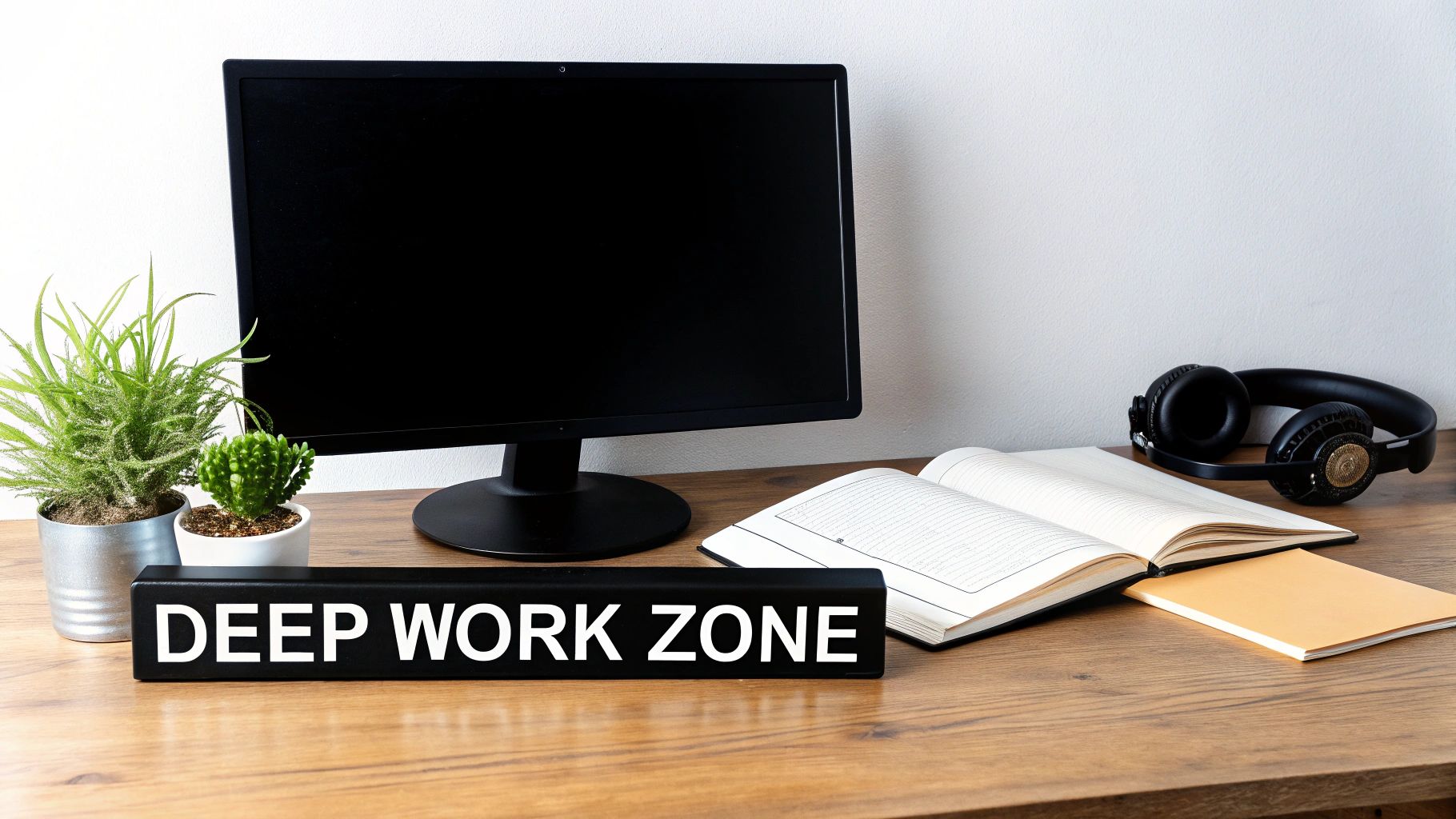
Don't be afraid to use visual signals, either. A simple, polite sign on your monitor that says "Deep Work in Progress" works wonders. It lets colleagues know you're not being rude; you're just focused and will get back to them later. If you work from home, having a dedicated workspace is huge for creating that mental separation between "work life" and "home life."
This decision tree is a great way to troubleshoot focus issues by starting with the fundamentals.
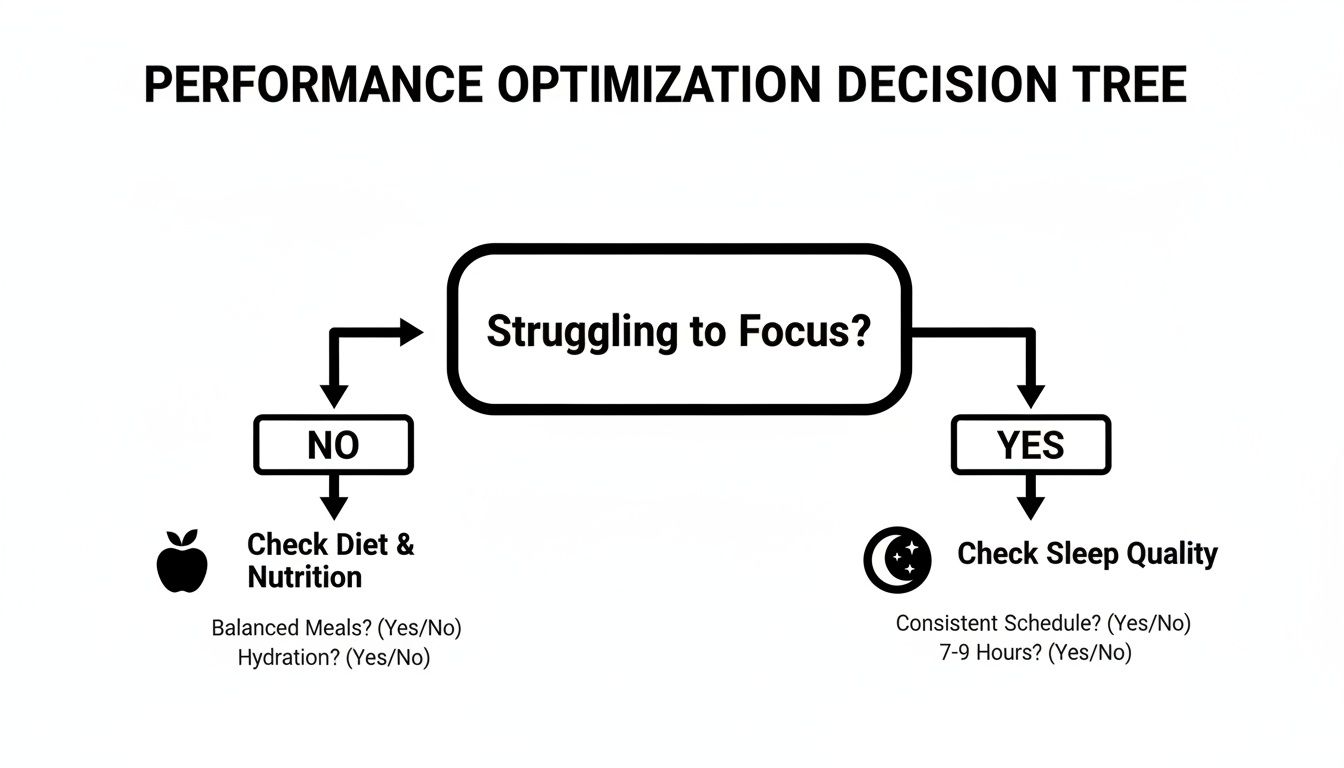
As you can see, before you blame your chatty coworkers or the Slack notifications, it's worth checking in on your own biology. Things like sleep and nutrition are the true bedrock of your ability to concentrate.
What if I Try These Strategies and Still Can’t Focus?
If you've organized your schedule, decluttered your desk, blocked out distractions, and still find yourself staring into space with persistent brain fog, it's time to look deeper. No productivity app in the world can fix a depleted body and mind.
It's time for an honest check-in. Ask yourself:
- Am I really getting 7-8 hours of quality sleep most nights?
- Is my diet fueling my brain, or am I just running on sugar and caffeine fumes?
- Am I moving my body at all during the day to reset my mind?
A constant struggle to concentrate can be a symptom of burnout or other underlying wellness issues. It's also worth asking if you feel connected to what you're doing. Sometimes, a chronic lack of motivation isn't a productivity problem—it's a sign that you might be misaligned with your career.
If you’ve nailed the fundamentals—sleep, nutrition, environment—and still feel like your drive is stuck in first gear, it might be time to consider extra support. Focus is a biological process, not just a matter of willpower.
For those looking for an additional edge, natural supplements like standardized Mucuna pruriens (with 20% L-Dopa) can help support the dopamine pathways tied to motivation and drive. However, it is absolutely crucial to consult with a healthcare professional first. They can help you determine if a new supplement is a safe and appropriate choice for your unique health profile.
At Keter Wellness, we believe true productivity is an outcome of holistic well-being. Our standardized Mucuna L-Dopa 20% is crafted to support your natural motivation and drive, helping you feel engaged and ready to tackle your most important work. We're committed to purity and potency in everything we do.
Leave a Reply