
If you feel like your workday is a constant battle against interruptions, you’re not imagining it. The real secret to staying focused isn’t about finding a single magic trick; it’s about building a solid system. This involves designing a workspace that shields you from distractions, mastering a few powerful mental techniques, and learning to work with your natural energy cycles, not against them. To truly excel, you must learn to Stay Focused at Work.
By incorporating strategies to Stay Focused at Work, you can enhance your productivity and overall job satisfaction.
Forget the quick fixes. This is about creating a sustainable way to get back to deep, meaningful work.
Why Your Ability to Focus at Work is Disappearing
That struggle to stay on task? It’s not a personal failure. It’s a completely normal response to a work environment that’s practically designed for distraction. Between the constant pings, open-plan offices, and the unspoken rule that you should be available right now, it’s a perfect storm for a fractured attention span.
The numbers paint a pretty grim picture. The average office worker only gets about 2 hours and 53 minutes of truly productive work done each day. That means over 60% of an eight-hour workday is lost.
Even worse, research shows that workers get interrupted, on average, every three minutes. And after each disruption, it takes a staggering 23 minutes to get your head fully back in the game. Do the math, and you’re looking at hours of your day completely vanishing into thin air.
The core issue isn’t a lack of willpower. It’s that our brains are not wired for the constant context-switching that modern work demands. We’re fighting an uphill battle against an environment designed for interruption.
Shifting from Blame to Strategy
Too often, the advice for staying focused puts all the pressure on you. “Just try harder.” “Go for a walk.” While a short break can certainly help, it does nothing to fix the underlying issues that shattered your concentration in the first place.
Instead of just patching up the symptoms, a much better approach is to build a robust framework for focus. This means taking back control where you can. The real wins come from understanding three key areas:
- Environmental Control: How to shape your physical and digital spaces to keep distractions out.
- Mental Frameworks: Using proven techniques to intentionally direct your attention where you want it to go.
- Personal Rhythms: Aligning your toughest, most important tasks with your natural peaks in energy.
Here’s a quick-glance table of the most common workplace distractions and a simple, actionable strategy you can use today to combat each one.
Top Focus Killers and Immediate Counter-Strategies
| Common Distraction | Impact on Focus | Quick Strategy |
|---|---|---|
| Digital Notifications | Constant pings from email, Slack, and apps create a reactive state, pulling you out of deep work. | Turn off all non-essential notifications. Use a tool like Freedom to block distracting sites during focus blocks. |
| Loud Office/Home Noise | Background chatter, phone calls, or household sounds make it impossible to maintain a train of thought. | Invest in noise-canceling headphones. Play ambient sounds or instrumental music to create a “sound bubble.” |
| Unplanned Interruptions | Colleagues or family members stopping by “for a quick question” completely derail your workflow. | Block “focus time” on your calendar. Use a visual cue (like a sign or headphones on) to signal you’re unavailable. |
| Multitasking Urge | Juggling multiple tasks at once feels productive but actually fragments attention and increases errors. | Practice single-tasking. Choose one priority task and commit to working on only that for a set period (e.g., 25 minutes). |
By tackling the root causes of distraction head-on, you can shift from feeling reactive and overwhelmed to being proactive and in control.
If you’re ready to dig deeper, our guide on natural ways to improve focus and concentration will show you exactly how to regain control over your most valuable asset: your attention.
Designing Your Distraction-Proof Workspace
Your ability to sink into deep, focused work is directly tied to the space you do it in. A cluttered desk or a chaotic digital desktop isn’t just messy—it creates constant, low-level friction that your brain has to fight against, making it that much harder to concentrate.
Engineering a workspace that actually helps you focus is about more than just tidying up. It’s about being intentional and removing distractions before they even get a chance to pull you away from what matters.
Think of your workspace, both the physical and the digital, as your fortress of focus. Every single item should have a purpose. It’s either a tool you need for the task at hand, or it’s actively shielding you from interruptions.
Taming Your Physical Environment
The space around you sends powerful signals to your brain. A messy, disorganized desk screams chaos, while a clean, structured area encourages clear thinking. You’d be surprised how much of an impact a few small adjustments can have.
Start with your line of sight. What do you see when you look up from your screen? If it’s a pile of unrelated papers or random knick-knacks, your brain has to work harder to ignore it all. Keep only the absolute essentials for your current project within arm’s reach.
Here are a few practical tips:
- Desk Zoning: Give different areas of your desk a specific job. You could have an “in-progress” zone, a “to-do” pile, and a completely clear space just for your keyboard and mouse. This simple system brings order to the chaos.
- Noise Control: Even low-level background noise can slowly chip away at your concentration. A good pair of noise-canceling headphones are an absolute game-changer, especially in an open office or a busy home.
- Scent and Focus: Believe it or not, certain scents can subtly influence your mental state. Research has suggested that aromas like rosemary can help maintain focus. You can learn more about the benefits of rosemary oil for mental clarity and see if adding an essential oil diffuser is a good fit for your space.
Conquering Digital Distractions
Let’s be honest: your digital workspace is probably a bigger source of distraction than your physical one. These interruptions are focus’s arch-nemesis, with the average worker getting hit with one every three minutes.
The real cost? It can take up to 23 minutes to fully refocus after each interruption. That lost time adds up fast. Every time you switch contexts between a task and a notification, you can lose 20-40% of your efficiency.
This infographic really drives home the costly cycle of workday attention loss.
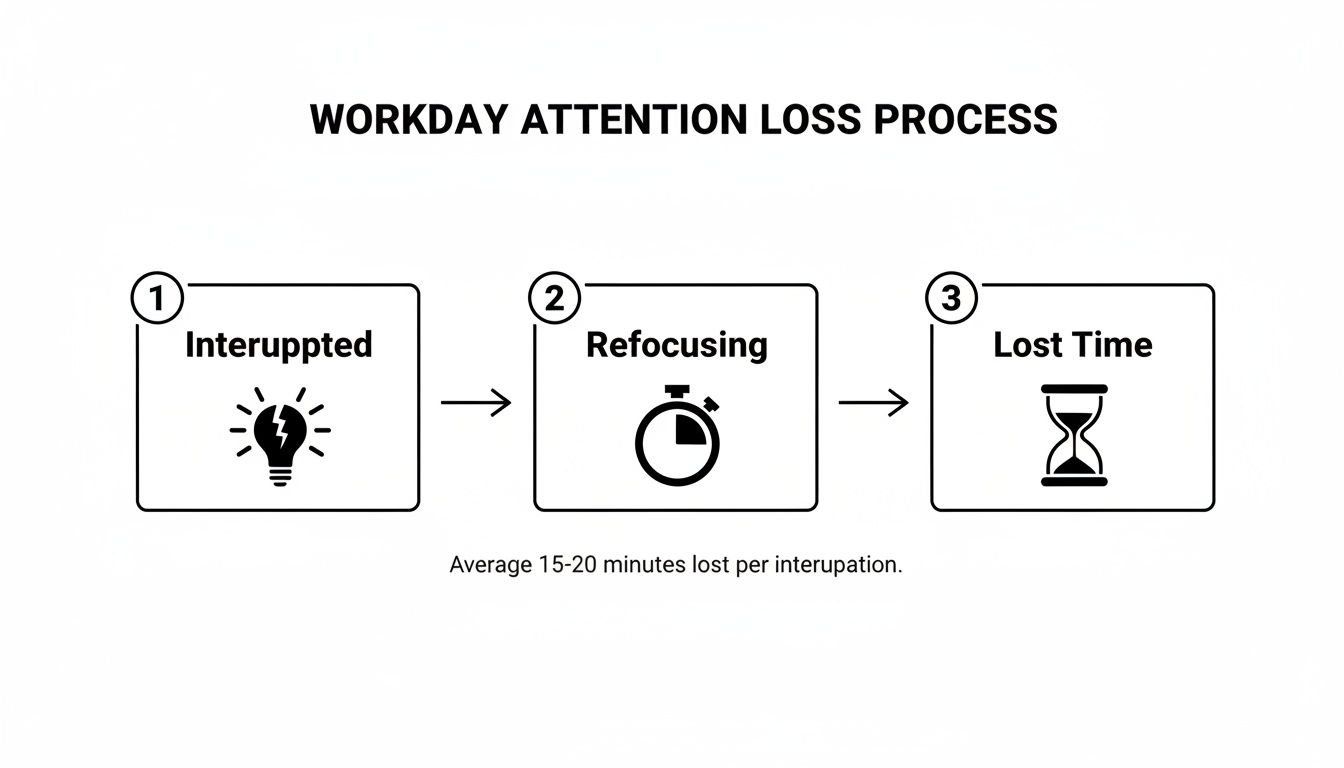
As you can see, a single ping or pop-up triggers a long, resource-draining refocusing period. It makes a powerful case for getting your digital noise under control.
Your digital tools are designed by default for interruption, not concentration. Taking back control requires a deliberate, one-time effort to reconfigure your apps and devices to serve your focus, not shatter it.
A systematic digital declutter is your best defense. Start by turning off all non-essential notifications on your computer and phone. Then, organize your desktop into a clean slate. This isn’t just about being neat; it’s about reducing the mental energy you waste navigating digital chaos every single day.
Adopting Mental Models for Deep Concentration
Once you’ve sorted out your physical workspace, the next frontier in the battle for focus is your own mind. It’s time to adopt a few powerful mental models that can completely change how you approach your tasks. Think of these not as complicated theories but as practical tools for directing and sustaining your attention where it needs to go.

The goal here is to create a structure for your workday that encourages your brain to sink into a state of flow, rather than constantly switching gears. This is where techniques designed for deep concentration truly shine.
Embrace the Power of Single-Tasking
The biggest myth of modern productivity is that multitasking makes you more efficient. It doesn’t. In reality, it does the exact opposite. Constantly bouncing between your inbox, a report, and a Slack message fragments your attention and torpedoes the quality of your work.
Single-tasking is the antidote. It’s the simple, almost radical, practice of dedicating your full attention to one specific thing for a set period.
- For a Creative Project: Instead of writing a proposal while keeping an eye on your email, commit to only working on the proposal document. Close all the other tabs and apps. You’ll be amazed at how the clarity and depth of your ideas improve.
- For Data Analysis: When you’re pulling numbers for a report, that’s all you do. Resist the urge to fire off a quick message. One misplaced decimal point caused by a momentary distraction can derail the entire analysis.
By committing to one thing at a time, you let your brain build momentum. This almost always leads to higher-quality results in less time.
Implement the Pomodoro Technique
The Pomodoro Technique is a classic for a reason. It’s a time management method that uses a timer to break your work into focused, 25-minute sprints, separated by short breaks. It’s remarkably effective because it works with your brain’s natural limitations, not against them.
The psychology behind it is simple: a 25-minute sprint feels totally manageable, which helps shut down the urge to procrastinate on big, intimidating projects. The built-in breaks are key—they prevent mental fatigue and burnout before they can even start.
A Practical Pomodoro Session:
- Choose one—and only one—task to work on.
- Set a timer for 25 minutes.
- Work on that single task without any interruptions until the timer rings.
- Take a real 5-minute break. Stand up, stretch, grab some water, or just look out the window.
- After four of these “Pomodoros,” take a longer, more substantial break of 15-30 minutes.
This method essentially gamifies your focus, turning a long workday into a series of small, achievable wins. It’s a perfect system if you’re struggling to stay on track with an overwhelming to-do list.
Practice a Two-Minute Mindfulness Reset
Even with the best intentions, your mind is going to wander. It happens. When you feel your focus slipping or mental clutter building up, a quick mindfulness exercise can act as a powerful reset button. You don’t need a quiet room or a yoga mat; you can do this right at your desk.
Just close your eyes and focus entirely on your breath for two minutes. That’s it. Notice the sensation of the air moving in and out of your body. When your mind inevitably wanders—and it will—just gently guide your attention back to your breath.
This small act of redirection strengthens your “focus muscle” and can instantly clear away mental noise, preparing you to dive back into your work with renewed clarity.
Fueling Your Brain for Peak Performance
We often think of focus as a purely mental game, but it’s deeply rooted in our physical well-being. What you eat, how much water you drink, and the quality of your sleep directly dictate your brain’s ability to concentrate.
Think of your body as the power station for your mind. If you’re feeding it low-grade fuel, you can’t expect high-performance cognitive output.

This is why any real strategy for staying focused at work has to include a hard look at your daily wellness habits. Ignoring them is like trying to drive a car on an empty tank—you just won’t get very far.
The Non-Negotiables for Cognitive Energy
Your brain is an incredibly demanding organ. Despite making up just 2% of your body weight, it burns through about 20% of your body’s total calories. Keeping it properly fueled means getting back to the basics—the very things that tend to slide when life gets busy.
Let’s start with sleep. Getting a solid 7-9 hours of quality sleep isn’t a luxury; it’s a non-negotiable for memory consolidation, emotional regulation, and attention control. Just one night of bad sleep can torpedo your cognitive performance, making complex problems feel utterly insurmountable the next day.
Hydration is just as critical. Even mild dehydration can quickly bring on brain fog, headaches, and a massive drop in concentration. The fix is simple: keep a water bottle on your desk and sip from it all day long. Don’t wait until you feel thirsty—by then, your performance has already taken a hit.
Smart Fuel for a Sharper Mind
What you put on your plate has a massive impact on your mental clarity and energy levels. The right foods can help you sidestep that dreaded afternoon slump and maintain steady, reliable focus all day.
To keep your brain running smoothly, build your meals around these food groups:
- Complex Carbohydrates: Think oatmeal, quinoa, and whole-grain bread. These provide a slow, steady release of glucose—your brain’s primary fuel—preventing the sharp energy spikes and crashes you get from sugar.
- Lean Proteins: Chicken, fish, beans, and nuts are fantastic. They help regulate your blood sugar and are essential for producing the neurotransmitters that govern mood and motivation.
- Healthy Fats: Omega-3 fatty acids are king. You’ll find them in fatty fish like salmon, as well as in walnuts and flaxseeds. They are absolutely crucial for long-term brain health and function.
Low engagement is a silent killer of workplace focus. Gallup research found that a staggering 79% of the global workforce feels disengaged. While corporate culture is a huge piece of that puzzle, you can take control of your own wellness. Simple practices like mindfulness can make a real difference; one study showed that just 10 minutes of meditation improved attention by 16%. You can dig deeper into workplace engagement statistics at Cake.com.
Your diet, sleep, and hydration aren’t separate from your professional performance—they are the very foundation of it. Neglecting your physical well-being is a direct path to burnout and decreased productivity.
For those looking to give their cognitive health an extra edge, understanding the science behind certain compounds can be a game-changer. If you want to learn how specific ingredients work to support the brain, our guide on the best supplements for cognitive function is a great place to start. A well-rounded approach that combines foundational health habits with informed choices gives your brain the best possible advantage.
Using Productivity Tools and Supplements Wisely
While the foundational habits are your best defense against distraction, the right tools and supplements can act as powerful reinforcements. When you choose them carefully, they can sharpen your focus and support your brain’s natural chemistry. The key is to use them wisely—making sure they solve problems instead of creating new ones.
Productivity apps promise to organize your life, but they can quickly become another source of digital clutter if you’re not intentional. Instead of trying to adopt some massive, complex system, pick one or two tools that solve a specific weakness in your workflow.
Got a bad habit of falling down digital rabbit holes? A distraction blocker like Freedom is a direct, no-nonsense solution. Does your to-do list feel like an unstructured mess? A simple task manager like Todoist can bring instant clarity. The goal is to simplify, not to add another app you have to manage.
A Responsible Look at Nootropics and Focus Supplements
Beyond digital tools, the world of nootropics—often called “smart drugs” or cognitive enhancers—offers another avenue for support. These substances range from everyday compounds like caffeine to more targeted herbal extracts. Often, the most effective approach combines common ingredients known to work well together.
A classic and well-researched combination is caffeine and L-theanine. While caffeine gives you that jolt of alertness, L-theanine (an amino acid found in green tea) promotes a state of calm, focused attention. This pairing is great for smoothing out the jittery edge of caffeine, leading to more productive energy without the eventual crash.
Another supplement that’s gained a lot of attention is Mucuna Pruriens, a natural source of L-Dopa. L-Dopa is a direct precursor to dopamine, which is the critical neurotransmitter tied to motivation, reward, and your ability to just get started on a task. For anyone looking to support their natural drive and engagement, a standardized extract can be really helpful.
Important Note on Supplementation Supplements are not a substitute for healthy lifestyle habits. Always consult with a healthcare professional before starting any new regimen, especially one that affects neurotransmitters. They can help you make an informed and safe choice based on your individual health needs.
Keter Wellness Mucuna L‑Dopa, for instance, is standardized to 20% L-Dopa, which ensures a consistent and reliable dose in each capsule. This level of standardization is important because it delivers predictable results. When you’re thinking about supplements like this, it’s crucial to understand their role: they are meant to support your body’s existing systems, not override them.
Ultimately, whether you’re using a distraction-blocking app or a supplement to support motivation, the principle is the same. Start with a clear purpose, choose high-quality options, and integrate them into a solid foundation of healthy habits. That’s the path to sustainable focus.
Common Focus Questions, Answered
Even with the best game plan, the real world has a funny way of throwing curveballs. Staying focused isn’t just about following steps; it’s about knowing how to troubleshoot when things go sideways. Here are a few practical answers to the questions I hear most often from people trying to sharpen their concentration.
What’s the Best Way to Get Back on Track After an Interruption?
The trick isn’t to fight the frustration—it’s to have a simple “reset” routine ready to go. The moment you’re pulled away, just jot down a quick note about exactly where you left off. This tiny action tells your brain the thought is safe and you can let it go for a moment.
Then, take three slow, deep breaths to clear out the mental noise. Glance at the last sentence you wrote or the last task you checked off. If you’re still feeling scattered, do something small to ease back in, like formatting a paragraph or renaming a file. It’s a low-effort way to get the momentum going again.
The goal is gentle redirection, not brute force. Acknowledging the interruption and having a quick ritual to return to your work is far more effective than trying to muscle your brain back into focus.
How Can I Possibly Concentrate in a Noisy, Open Office?
An open office is a battle for your attention, so you need a multi-layered defense. Your number one tool? A good pair of noise-canceling headphones. They do more than just block out chatter; they’re a universal “do not disturb” sign.
But don’t stop there. Get smart about your space and time.
- Find a Hideout: If your office has quiet rooms or phone booths, book them for blocks of deep-focus work. Don’t just wait for them to be free—claim your territory.
- Work Off-Hours: Got a flexible schedule? Coming in an hour early or staying an hour late can give you some of the most productive, uninterrupted time of your day.
- Just Say It: It’s okay to communicate your needs. A simple, “Hey, I really need to go heads-down on this for the next 60 minutes” works wonders and prevents people from accidentally derailing you.
My Focus Completely Tanks Every Afternoon. What Can I Do?
That 2 PM slump is real. It’s a biological dip driven by your natural circadian rhythm, made worse by whatever you ate for lunch. Instead of hammering it with more coffee, try working with your body’s energy.
This is the perfect time for low-brainpower tasks. Clear out your inbox, organize your desktop, or handle some administrative work. Then, re-energize with a quick “movement snack.” A brisk 15-minute walk outside is a game-changer. The mix of movement and natural light is a proven antidote to that groggy feeling. And watch your lunch—heavy carbs will guarantee a crash. Go for lean protein and veggies for more stable energy.
Are Focus Supplements Like Mucuna L‑Dopa Actually Safe?
When you’re looking at supplements that affect brain chemistry, like Mucuna Pruriens (which contains L-Dopa), caution is key. These are designed to support your body’s natural systems, not replace the fundamentals like good sleep, a solid diet, and managing stress.
Jumping in without professional guidance can lead to side effects or create imbalances down the road. It is absolutely critical to talk with a healthcare provider before you start any new supplement. They can look at your personal health history, check for any potential conflicts with medications, and help you figure out a safe approach that’s actually right for you.
At Keter Wellness, we focus on high-quality, standardized herbal solutions to support your body’s natural vitality. Our Mucuna L‑Dopa 20% is formulated to provide consistent, reliable support for your dopamine system, helping you feel engaged and motivated.
Leave a Reply