
Feeling bogged down by brain fog? When your mind feels sluggish, certain herbs for mental clarity can help clear the haze. Plants like Ginkgo biloba, Rosemary, and Bacopa monnieri are well-known adaptogens and nootropics that have been used for centuries to bring back sharpness, improve memory, and fight off mental fatigue.
The Natural Path to a Sharper Mind

If you’ve ever struggled to focus, you know the feeling. That persistent mental cloudiness can make even the simplest tasks feel like climbing a mountain. It’s more than just frustrating—it drains your productivity, creativity, and overall sense of well-being.
The culprits are often hiding in plain sight. Chronic stress, a bad night’s sleep, or nutritional gaps can all leave you feeling mentally fuzzy. While your morning coffee might give you a temporary kick, many of us are looking for something more sustainable—a solution that gets to the root of the problem instead of just papering over the cracks.
Ancient Wisdom Meets Modern Science
This is where herbal nootropics come into the picture. These are plants and fungi that support cognitive function, helping to sharpen memory, improve focus, and build mental stamina. Think of them less as a quick fix and more as natural partners that help your brain run more efficiently.
Many of these herbs have deep roots in traditional medicine systems like Ayurveda and Traditional Chinese Medicine. Now, modern science is starting to confirm what ancient healers have known all along: certain plants contain compounds that can genuinely boost brain performance.
The goal of using herbs for cognition isn’t just stimulation; it’s about building resilience. These botanicals work by protecting brain cells, improving blood flow, and balancing the body’s stress response system to create lasting mental clarity.
What You Will Discover
In this guide, we’ll cut through the hype and look at the most effective, well-researched herbs for clearing your head. You’ll get a straightforward, evidence-based roadmap, learning:
- How specific herbs work to cut through mental cobwebs and restore focus.
- The scientific evidence backing their use for cognitive support.
- Practical tips for safely adding them to your daily routine.
Take Rosemary, for example, historically known as the ‘herb of remembrance.’ The Greek physician Pedanius Dioscorides documented its use for memory way back in the first century CE. The connection was so strong that students in ancient Greece would burn rosemary while studying—a tradition that continued for centuries to stay alert. You can find more insights about the historical uses of memory-enhancing herbs.
This guide offers a practical path toward achieving the clear thinking you’ve been missing, giving you the knowledge to make smart choices for your cognitive health.
How Herbal Nootropics Actually Work
To really get what makes these herbs so effective for mental clarity, you have to look under the hood. This isn’t about a temporary jolt like you get from caffeine. These plants are working with your brain’s own systems to tune up performance from the inside out.
Imagine your brain’s communication network is like a city’s traffic grid. For everything to run smoothly, you need clear roads, managed traffic flow, and solid infrastructure. Herbal nootropics act like the expert city planners and traffic controllers for your mind.
They do this through a few key pathways, each one tackling a different piece of the cognitive puzzle. Let’s break them down.
Widening the Information Highways
One of the most direct ways certain herbs sharpen your mind is by improving cerebral circulation—which is just a fancy way of saying they get more blood flowing to your brain. This is a huge deal. Your brain is an energy hog, using about 20% of your body’s oxygen and calories even though it only makes up 2% of your weight.
Boosting that blood flow is like upgrading a two-lane road into a superhighway. It means your brain cells get a steady, reliable supply of oxygen and key nutrients. When your neurons are well-fed, they fire faster, communicate better, and clear out waste more efficiently. The result? You think quicker, remember more easily, and shake off that sluggish, foggy feeling.
Managing Stress Overload
Your brain simply does not perform at its best when it’s chronically stressed. When you’re stuck in “fight-or-flight” mode, your system gets flooded with the stress hormone cortisol, which can mess with your memory, kill your focus, and just leave you feeling mentally drained.
This is where adaptogens shine. Think of these incredible herbs as a sophisticated cruise control system for your stress response. They don’t get rid of stress—that’s impossible—but they help your body adapt to it without going into complete overdrive.
Adaptogens fine-tune your body’s reaction to stressors, helping you stay calm and focused under pressure instead of feeling overwhelmed. This preserves precious mental energy for critical thinking and problem-solving.
Balancing Brain Chemistry
Your mood, motivation, and ability to focus are all governed by chemical messengers called neurotransmitters. The big players here are dopamine (motivation and reward), serotonin (mood), and acetylcholine (learning and memory). The right herbs can gently nudge these systems to promote a state of clear, focused attention.
Some botanicals give your body the raw materials it needs to make more neurotransmitters, while others help manage their activity between neurons. By supporting a healthy balance of these crucial chemicals, herbs can directly improve your ability to lock into a task and maintain a positive, driven mindset. If you want to go deeper, you can also explore other ways to increase dopamine naturally to complement your herbal routine.
Protecting Your Cognitive Hardware
Finally, many of these herbs offer powerful neuroprotective benefits. Just through normal, everyday function, your brain is exposed to oxidative stress, which creates unstable molecules called free radicals. Over time, these can damage brain cells, a lot like how rust corrodes metal.
Herbs packed with antioxidants act like a cleanup crew, neutralizing these free radicals before they can cause any trouble. They essentially shield your brain’s hardware from long-term wear and tear, supporting brain health and helping preserve your mental sharpness as you age.
Five Powerful Herbs for Mental Clarity
Now that we’ve covered how herbal nootropics work, let’s get into the specifics. Think of your brain as a high-performance engine—sometimes it needs a specific type of fuel to run at its best. Each of the five herbs below acts like a specialist, fine-tuning a different aspect of your cognitive performance, from memory and learning to stress resilience and motivation.
We’ll look at what ancient traditions knew and what modern science has confirmed, giving you a clear picture of what makes each one unique. This way, you can figure out which natural ally might be the right fit for your personal goals.
The illustration below gives you a bird’s-eye view of the three main ways these herbs support a sharp, clear mind: improving circulation, managing stress, and protecting your brain’s hardware.
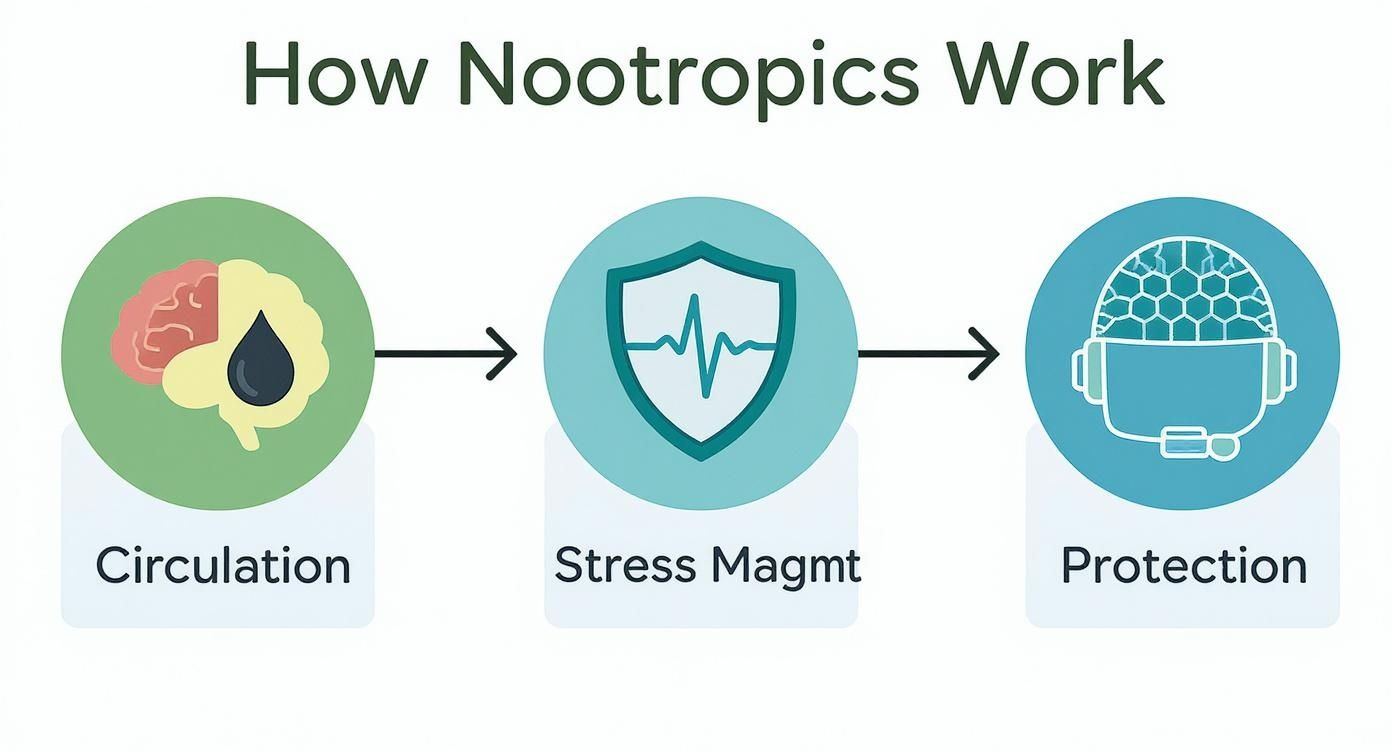
As you can see, it’s not about a single, temporary jolt. These botanicals work together to build a more resilient and efficient mental environment from the ground up.
Ginkgo Biloba: The Memory Enhancer
Ginkgo biloba is one of the oldest tree species on the planet and a true veteran in the world of cognitive health. Its biggest claim to fame is its ability to boost blood flow to the brain, ensuring your brain cells get the steady stream of oxygen and nutrients they need to thrive. Think of it as upgrading the plumbing to ensure every part of your brain is well-nourished.
This improved circulation is directly linked to better memory recall and faster thinking. On top of that, ginkgo is packed with antioxidants that act as a neuroprotective shield, helping defend your brain against the wear and tear that comes with aging.
Ginkgo has been a staple in traditional Chinese medicine for over 2,000 years for a reason. Modern clinical trials have even shown it can help stabilize cognition in people with mild dementia. It’s so effective that German health authorities have approved it for circulatory issues that impact memory.
Bacopa Monnieri: The Learning Accelerator
Known as Brahmi in Ayurvedic medicine, Bacopa monnieri is the go-to herb for anyone looking to learn faster and remember more. Unlike stimulants that offer a quick buzz, bacopa works its magic over time by fundamentally changing how your brain processes and stores information.
It does this by encouraging the growth of dendrites—the tiny, branch-like connectors on your neurons. A denser network of dendrites means your brain cells can communicate more effectively, which translates directly into a greater capacity for learning and stronger memory consolidation. It’s like adding more lanes to your brain’s information highway.
Bacopa is perfect for students cramming for exams or professionals who need to absorb new skills quickly. Just remember, it’s a long-game herb. You’ll need to take it consistently for several weeks to really feel the benefits.
Rhodiola Rosea: The Fatigue Fighter
If you feel like you’re constantly running on fumes, Rhodiola rosea is the adaptogen you need to know. This tough little plant grows in the harsh climates of Europe and Asia, and it passes that resilience on to you, helping your mind and body push back against mental and physical stress.
Rhodiola works by balancing key neurotransmitters like dopamine and serotonin and regulating the stress hormone cortisol. This one-two punch helps you stay sharp and energized under pressure, fighting off that drained, foggy feeling that kills productivity.
Rhodiola is especially great for:
- Students during finals week to power through long study sessions.
- Professionals on a tight deadline to maintain performance without burning out.
- Anyone needing a quick mental lift, as its effects can often be felt within a few hours.
Ashwagandha: The Stress Clearer
Chronic stress is the enemy of clear thinking. It creates a mental static that makes it impossible to focus. Ashwagandha, another Ayurvedic powerhouse, excels at cutting through that noise. As a potent adaptogen, it helps your body manage its stress response by reining in cortisol levels.
When cortisol is constantly high, it can mess with your memory and decision-making. By bringing that hormone back into balance, ashwagandha fosters a calmer mental state where your brain can finally operate without interference. The result is sharper focus, better judgment, and a welcome sense of calm.
Many people also find that taking ashwagandha regularly improves their sleep quality—a non-negotiable for anyone serious about restoring mental clarity.
Mucuna Pruriens: The Motivation Booster
Sometimes, brain fog isn’t about memory or stress; it’s just a flat-out lack of drive. Mucuna pruriens, or velvet bean, tackles this head-on. It’s one of nature’s richest sources of L-Dopa, the direct precursor to the neurotransmitter dopamine.
Dopamine is the engine of your brain’s reward and motivation system. It’s what makes you feel focused, engaged, and ready to tackle your to-do list. When your dopamine levels are where they should be, procrastination fades, and your ability to lock onto goals improves dramatically.
This makes Mucuna an excellent tool for getting your spark back. By supplying the raw material for dopamine, it helps restore the brain chemistry you need for a proactive mindset. If you want to learn more, our guide to the benefits and mechanisms of Mucuna pruriens L-Dopa covers it all.
To help you sort through these options, the table below gives a quick snapshot of what each herb does best.
Comparing Key Herbs for Mental Clarity
This table offers a quick-glance comparison of the five featured nootropic herbs, highlighting their primary benefits, how they work, and who they’re best suited for.
| Herb | Primary Benefit | How It Works | Best For |
|---|---|---|---|
| Ginkgo Biloba | Memory Recall | Enhances cerebral blood flow and provides antioxidant protection. | Improving memory and protecting against age-related cognitive decline. |
| Bacopa Monnieri | Learning Capacity | Promotes dendrite growth for better neural communication. | Students and professionals needing to learn and retain new information. |
| Rhodiola Rosea | Mental Stamina | Modulates neurotransmitters and cortisol to fight fatigue. | Overcoming short-term mental exhaustion and staying focused under pressure. |
| Ashwagandha | Stress Reduction | Lowers cortisol levels to clear stress-related brain fog. | Individuals dealing with chronic stress that impacts cognitive function. |
| Mucuna Pruriens | Motivation & Drive | Provides L-Dopa to support healthy dopamine production. | Boosting focus, overcoming procrastination, and enhancing motivation. |
Each of these herbs offers a distinct path toward a clearer, sharper mind. By understanding their unique strengths, you can choose the one that aligns best with the specific cognitive support you’re looking for.
Using Herbal Supplements Safely and Effectively
Knowing which herbs can sharpen your mind is one thing, but using them correctly is what actually gets you results. This is where we move from theory to practice, and it requires a sharp focus on quality, dosage, and safety. Getting this right turns these powerful botanicals into reliable allies for your brain.
The world of herbal supplements can feel like a maze of countless brands and confusing labels. But you don’t need to be an expert to cut through the noise. A few key principles will help you pick products that are both safe and effective, starting with what’s actually inside the capsule.
Choosing High-Quality Supplements
Here’s the honest truth: not all herbal products are created equal. A supplement’s power is directly tied to its quality and potency, which can vary wildly from one brand to the next. The single most important concept to understand here is standardization.
Think of it like baking a cake. If a recipe just says “add a pinch of spice,” the flavor will be different every time. But if it specifies “one teaspoon,” you get a consistent, predictable result. Standardized herbal extracts work exactly the same way.
A standardized extract guarantees that each dose contains a specific, verified amount of the herb’s key active compounds—like the bacosides in Bacopa or the L-Dopa in Mucuna. This ensures consistency and potency, which is why clinical studies almost always use standardized forms.
When you’re shopping, keep an eye out for these markers of a quality product:
- Standardized Extracts: The label should clearly state the percentage of active compounds (e.g., “Standardized to 24% bacosides”). This is your sign that the company is serious about potency.
- Third-Party Testing: Seals from organizations like NSF or USP are a good indicator that a product has been independently tested for purity and potency. They’ve done the vetting for you.
- Good Manufacturing Practices (GMP): This certification ensures the supplement was produced in a clean, controlled, and professional environment. To understand why this is non-negotiable, learn more about choosing supplements that are GMP certified to guarantee safety.
Understanding Dosing and Forms
Herbs for mental clarity come in several forms, each with its own pros and cons. The most common are capsules, tinctures, and teas. Capsules are great because they offer precise, pre-measured doses, making them convenient and easy to track. Tinctures, which are liquid extracts, are absorbed quickly, while teas offer a gentler, more ritualistic way to take your herbs.
Dosage is critical and you should always start with the guidance on the product’s label or from a healthcare professional. That said, clinical research gives us a solid starting point for the herbs we’ve discussed:
- Bacopa Monnieri: Typically 300-600 mg of an extract standardized to 55% bacosides daily.
- Rhodiola Rosea: Doses often range from 100-600 mg per day of an extract containing 3% rosavins and 1% salidrosides.
- Ginkgo Biloba: A common dose is 120-240 mg daily.
Always start with the lowest effective dose. See how your body responds before you even think about increasing it. With adaptogens especially, consistency over several weeks is often far more important than a high dose.
Navigating Potential Side Effects and Interactions
While these herbs are generally safe for most healthy adults, they are potent substances and demand respect. Being aware of potential side effects and drug interactions is a non-negotiable part of using supplements responsibly.
For instance, Ginkgo biloba has mild blood-thinning properties, so you should be cautious if you’re already taking anticoagulant medications like warfarin. Bacopa monnieri can sometimes cause an upset stomach, which is why it’s usually best to take it with food. And Ashwagandha may interact with thyroid, sedative, or immunosuppressant medications.
Before adding any new herb to your daily routine, it is essential to consult with your doctor or a qualified healthcare provider. This is especially important if you:
- Are pregnant or breastfeeding.
- Have a pre-existing medical condition.
- Are taking any prescription medications.
This simple conversation ensures your journey toward better mental clarity is both effective and, most importantly, safe.
Building a Brain-Boosting Daily Routine

Herbal supplements aren’t magic pills; they work best as part of a bigger wellness strategy. Think of these botanicals as powerful amplifiers for your existing brain-healthy habits. Their true potential is unlocked only when you pair them with a lifestyle that actively supports cognitive function.
While an herb can certainly help cut through the mental fog, its effects become far more profound and lasting when combined with consistent, positive daily actions. To see real, sustainable improvements in your focus and memory, you need to build a holistic routine where every piece works in harmony.
The Foundation of Mental Clarity
Before you even think about supplements, your foundational habits have to be solid. The herbs we’ve discussed are powerful, but they can’t outrun a lifestyle that’s working against your brain. The goal is to create an environment where your mind can truly thrive.
Start by focusing on these non-negotiable pillars of cognitive health:
- Nourishing Diet: Your brain demands high-quality fuel. Make sure your diet is rich in omega-3 fatty acids from sources like fish and flaxseeds, alongside plenty of antioxidant-packed fruits and vegetables.
- Consistent Sleep: This is non-negotiable. Aim for 7-9 hours of quality sleep every night. It’s during sleep that your brain clears out metabolic junk and consolidates memories—a process absolutely essential for next-day focus.
- Regular Exercise: Moving your body increases blood flow to the brain and even stimulates the growth of new neurons. You don’t have to run a marathon; even a brisk daily walk can make a noticeable difference in your mental sharpness.
- Mindfulness Practices: Chronic stress is a primary driver of brain fog. Simple practices like meditation or deep breathing exercises can lower cortisol levels, creating a calmer, more focused mental state.
Strategic Supplement Integration
Once your foundational habits are in place, you can strategically add herbs to enhance your results. Two of the most effective strategies for long-term success are “stacking” and “cycling.”
Stacking is just what it sounds like: combining two or more complementary herbs that work through different biological pathways. For instance, you could pair Ginkgo biloba (for better circulation) with Ashwagandha (for stress reduction). This creates a synergistic effect where the whole becomes greater than the sum of its parts.
Cycling, on the other hand, involves taking planned breaks from your supplements. A common approach is to take an herb for six weeks, followed by a one-week break. This simple practice can help maintain your body’s sensitivity to the herb’s active compounds, ensuring it stays effective over the long haul.
Think of your daily routine as a symphony. Diet, sleep, and exercise are the core instruments, providing the main melody. Herbal supplements are the specialized sections that add depth, richness, and power to the overall performance.
Ultimately, integrating herbs for mental clarity into your life is about building a complete system. When you combine the right supplements with a brain-healthy lifestyle, you create a powerful and sustainable routine. This holistic approach is your best strategy for achieving lasting improvements in focus, memory, and overall mental resilience.
Your Questions Answered
When you start exploring herbs for mental clarity, a few practical questions always come up. Getting straight answers helps you feel confident and make smart choices. Think of this as your quick-reference guide to timing, combining herbs, and what to expect.
How Long Does It Take for Nootropic Herbs to Work?
The answer really depends on the herb you’re taking. Some give you a noticeable lift pretty quickly, while others work more slowly, building up your cognitive resilience over time.
For example, an adaptogen like Rhodiola rosea is known for its more immediate feel. Many people report a clean boost in energy and focus within a few hours of their first dose. This makes it a great choice for tackling a demanding project or getting through a patch of short-term mental fatigue.
On the other hand, an herb like Bacopa monnieri is playing the long game. Its benefits, like better memory retention and learning ability, come from gradual changes in how your brain is structured.
You’ll generally need to take Bacopa consistently for 4 to 12 weeks before you feel its full effects. With herbs like this, consistency is everything—it’s not about a single high dose.
Can I Combine Different Nootropic Herbs?
Yes, you absolutely can. This practice is often called “stacking,” and it can be a highly effective way to target multiple cognitive pathways at once. For instance, you could pair a circulation-booster like Ginkgo biloba with a stress-reducer like Ashwagandha. The combination creates a synergistic effect, enhancing both blood flow to the brain and your resilience to stress.
That said, it’s important to approach stacking with a bit of strategy.
- Start One at a Time: Always introduce just one new herb at a time. This is the only way to know for sure how your body is responding and to pinpoint which herb is causing which effect.
- Do a Little Research: Before you combine herbs, look into any potential interactions. While most of the common nootropics play well together, it’s always smart to be informed.
- Talk to a Pro: For the best results, consider consulting with a qualified herbalist or a healthcare provider who understands botanicals. They can help you build a personalized stack that truly matches your goals.
Are There Any Big Side Effects to Worry About?
The herbs we’ve discussed are generally considered safe for most healthy adults, as long as you stick to the recommended doses. But they are potent botanicals, and side effects can happen. Most are mild and often related to taking too high a dose, but it’s still good to be aware.
For example, Ginkgo biloba can sometimes cause a mild headache or an upset stomach and has a slight blood-thinning effect. Some people find that Bacopa monnieri causes stomach cramps or nausea, which is why it’s almost always recommended to take it with food.
The golden rule is to always start with the lowest recommended dose to see how you react. And make sure to read product labels for any specific warnings, especially if you have a pre-existing medical condition or take prescription medications.
At Keter Wellness, we believe in pure, potent, and transparent herbal solutions. Our premium Mucuna L-Dopa 20% is standardized to ensure you get a consistent and effective dose every time, supporting your motivation and mental drive. To see how our carefully formulated supplements can fit into your routine, visit us at /.
Leave a Reply