
When you see a "GMP Certified" seal on a supplement bottle, what does that actually mean?
It’s your guarantee that the product was made under a strict set of rules for safety and quality called Good Manufacturing Practices. These aren't just suggestions—they are the mandatory standards the FDA enforces to make sure what's on the label is exactly what's in the bottle.
What GMP Certified Really Means for Your Supplements
Think of GMP certification like the health and safety code for a professional restaurant kitchen. A chef can’t just guess at measurements or use a dirty countertop. They have to follow precise recipes, keep the environment sterile, and ensure every plate of food that goes out is consistent and safe.
GMPs apply that same strict logic to making supplements. It's the system that guarantees your product has the right identity, purity, strength, and composition.
This is your baseline assurance against the most common problems in manufacturing. Without it, you have no real way of knowing if a product is free from contaminants, contains the right dose, or was even made in a clean facility.
The Non-Negotiable Rules of Quality
GMP isn't a fancy award or a premium bonus; it's the fundamental ticket to entry for any supplement brand you can trust. These regulations are all about preventing errors and making sure every single batch of a product is identical to the one before it. That consistency is key, because even small variations in non-certified products could change how they work—or if they're even safe.
You can learn more about how precise nutrient levels impact your health by exploring the benefits of vitamins and minerals.
Here are the cornerstones of GMP certification:
- Facility and Equipment Standards: The manufacturing site must be clean, organized, and designed to prevent any cross-contamination between ingredients.
- Raw Material Verification: Every single ingredient that comes through the door has to be tested for its identity and purity before it can be used in a formula.
- Standard Operating Procedures (SOPs): There must be detailed, step-by-step instructions for every part of the process, from weighing raw materials to sealing the final bottle.
- Meticulous Record Keeping: Every stage of production is documented. This creates a clear trail for traceability and accountability if anything goes wrong.
In the United States, the dietary supplement industry is a massive market, valued at around USD 60 billion. To keep consumers safe, the FDA requires every manufacturer to follow these Good Manufacturing Practices. It’s a start-to-finish system of quality control.
A Look Inside a GMP Compliant Facility
Ever wondered what a top-tier supplement facility actually looks like? Forget a simple factory floor. Instead, picture the meticulously organized kitchen of a Michelin-starred restaurant during dinner service. Everything has a designated place, every person has a specific role, and every single step is controlled to guarantee a perfect outcome.
That same level of obsessive precision is what defines a GMP-compliant facility, but it's all aimed at protecting your health. It's a system built on preventing mistakes before they ever have a chance to happen. We're not just talking about a quick quality check at the end; quality is engineered into the process from the moment raw ingredients arrive at the door.
Every detail is intentional, from the specialized air filtration systems that keep the environment pure to the specific uniforms staff must wear. The entire operation is designed around one goal: preventing contamination, ingredient mix-ups, and any deviation from the master formula. It's this deep commitment to process that makes supplements gmp certified the gold standard.
The Core Pillars of a GMP Operation
If you were to step inside, the first thing you’d notice is the people. Staff are held to incredibly strict hygiene protocols, wearing gowns, hair nets, and gloves to eliminate any risk of contamination. Their training is continuous and covers everything from how to operate sensitive machinery to the scientific principles behind the formulas they’re creating.
Next, you'd notice the building's clever design. The layout creates a one-way flow for materials, ensuring raw ingredients and finished products never cross paths. This is a simple but critical strategy to prevent cross-contamination—making sure what's supposed to be in your bottle of Vitamin D doesn't accidentally get a trace of something else.
"When a potential client approaches [us] with a product idea, the first step involves determining whether the client's vision can actually be manufactured—a crucial reality check that saves time and money for both parties."
This quote really gets to the heart of it. High-quality manufacturing isn't just about following rules; it's about applying GMP principles from the very first conversation to ensure the final product is both safe and effective.
This infographic breaks down the three core promises of GMP: Purity, Strength, and Identity.
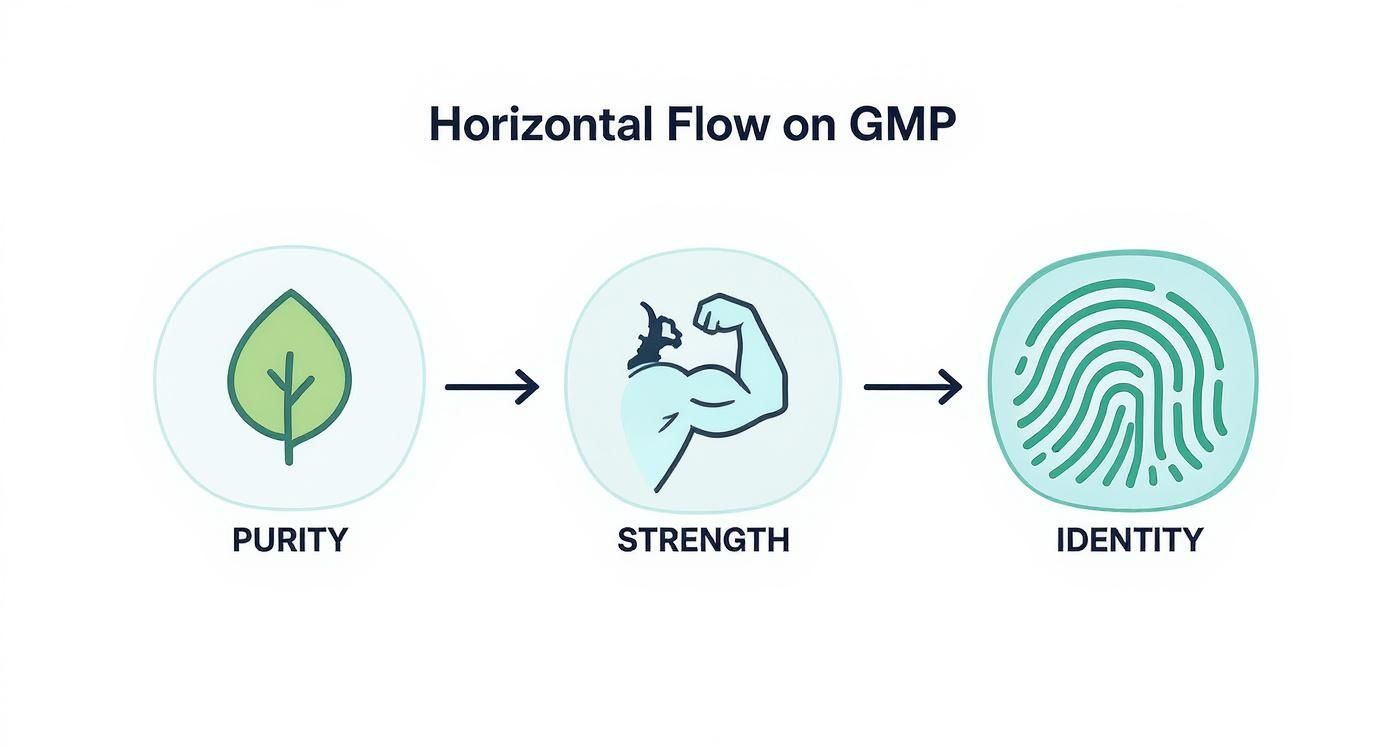
Think of these as non-negotiable checks. Each one guarantees the product is exactly what the label says it is, is free from unwanted contaminants, and contains the correct dosage.
Documenting Every Step for Safety
The most powerful part of a GMP facility is something you can't even see: its obsession with documentation. Everything is guided by Standard Operating Procedures (SOPs). These are incredibly detailed, written instructions for every single action performed in the facility. It's like a master recipe book that everyone must follow to the letter, every single time.
This meticulous documentation covers everything:
- Receiving Raw Materials: How ingredients are logged, quarantined, and tested for purity and identity before they're even allowed into the production area.
- Weighing and Blending: Many facilities use a two-person verification system. One person weighs an ingredient, and a second person independently confirms the measurement before it goes into the batch.
- Bottling and Labeling: Strict procedures are in place to make sure the right labels go on the right bottles, which prevents potentially dangerous mix-ups.
This exhaustive paper trail creates a complete birth certificate for every batch. If an issue ever arises, the manufacturer can trace it back to the exact person, machine, and moment it happened. This protects consumers and helps ensure the mistake is never repeated. It’s this fanatical commitment to process that truly separates a GMP-certified supplement from everything else on the shelf.
How GMP Certification Protects You From Health Risks
Choosing a GMP-certified supplement is your most direct line of defense against the hidden dangers that can lurk in unregulated products. Without these rigorous standards, you're essentially just trusting a manufacturer's word—and that trust can sometimes be misplaced, leading to real health consequences.
The risks aren't just theoretical. Uncertified supplements can be contaminated with everything from heavy metals like lead and mercury to harmful microbes such as E. coli or Salmonella. These contaminants can easily find their way into the supply chain through tainted raw materials or an unclean manufacturing environment.
GMP protocols are specifically designed to stop these threats in their tracks. They mandate strict testing of all incoming raw materials and enforce sanitation procedures that prevent microbial growth, making sure the final product is pure and safe for you to take.
From Cross-Contamination to Incorrect Dosages
Another major risk is cross-contamination with undeclared allergens. For someone with a severe allergy to soy, gluten, or peanuts, an accidental exposure from a poorly cleaned production line can be dangerous. GMP facilities prevent this by using dedicated equipment and meticulous cleaning protocols between different product runs.
Beyond contaminants, there’s the issue of what’s actually in the capsule. Imagine taking a supplement for mood support, but the uncertified product contains double the advertised dose of a potent herb. That could lead to unexpected and serious side effects. On the flip side, a product with far less than the labeled amount simply won't work, wasting your money and time.
GMP certification isn't just a quality seal; it's a safety system. It verifies that a company has invested in the processes and controls needed to produce a consistent, pure, and accurately dosed product every single time.
The table below breaks down exactly how GMP standards directly address some of the most common—and concerning—risks in the supplement industry.
How GMP Standards Mitigate Common Supplement Risks
| Common Supplement Risk | How GMP Certification Addresses It |
|---|---|
| Heavy Metal Contamination | Mandates testing of raw ingredients for heavy metals like lead, mercury, and arsenic before they enter production. |
| Microbial Growth (E. coli, Salmonella) | Requires strict sanitation procedures for all equipment and facilities, plus finished product testing to ensure purity. |
| Allergen Cross-Contamination | Enforces documented cleaning procedures and equipment separation to prevent undeclared allergens like soy, gluten, or nuts. |
| Incorrect Dosage (Too High or Too Low) | Specifies precise formulation and blending processes to ensure every batch meets label claims for potency and consistency. |
| Mislabeled Ingredients | Requires identity testing of all raw materials to confirm that what’s on the label is exactly what’s in the bottle. |
This commitment to quality is crucial. Internationally, GMP standards have become vital for building consumer confidence by tackling contamination, mislabeling, and formulation errors head-on. As the global supplement market expands, these standards are recognized by both manufacturers and regulators as essential for public safety. You can learn more about these global standards on the World Health Organization's site.
When you choose supplements gmp certified, you are sidestepping a world of potential issues. You’re not just buying a product; you’re investing in the assurance that it was made correctly, safely, and with your health as the top priority.
How to Verify GMP Claims on Supplement Labels
Walking through the supplement aisle can feel like navigating a minefield. With so many labels making bold claims, how do you know who to trust? When a brand says its products are GMP compliant, it’s time to put on your detective hat and look for proof.
The most reliable evidence doesn’t come from the brand itself, but from independent, third-party organizations that have audited their facility.
A simple "GMP Compliant" statement on a bottle means the company claims it follows FDA guidelines. It's a bit like a student grading their own homework—you have to take their word for it. In contrast, supplements gmp certified by an outside agency have been put through the wringer by an impartial expert who has verified everything.
Decoding the Seals on the Bottle
The quickest way to check a brand's commitment to quality is to look for official certification seals right on the packaging. These small logos are powerful symbols of trust. They tell you that an independent body has confirmed the manufacturer is sticking to incredibly strict standards.
Here are the most respected seals to look for:
- NSF (National Sanitation Foundation): This is one of the toughest certifications to get. An NSF seal means the facility was audited, the product was tested for contaminants, and its contents were verified to match what's on the label. No surprises.
- USP (United States Pharmacopeia): The USP Verified Mark is another gold standard. It confirms the supplement has the ingredients listed on the label in the right amounts, doesn’t have harmful levels of contaminants, and will actually break down in your body to be used effectively.
- UL (Underwriters Laboratories): While you might know them from electronics, UL also certifies dietary supplements. They audit facilities to make sure they meet all GMP requirements from top to bottom.
Here's an example of what these seals often look like, so you know what you’re searching for.
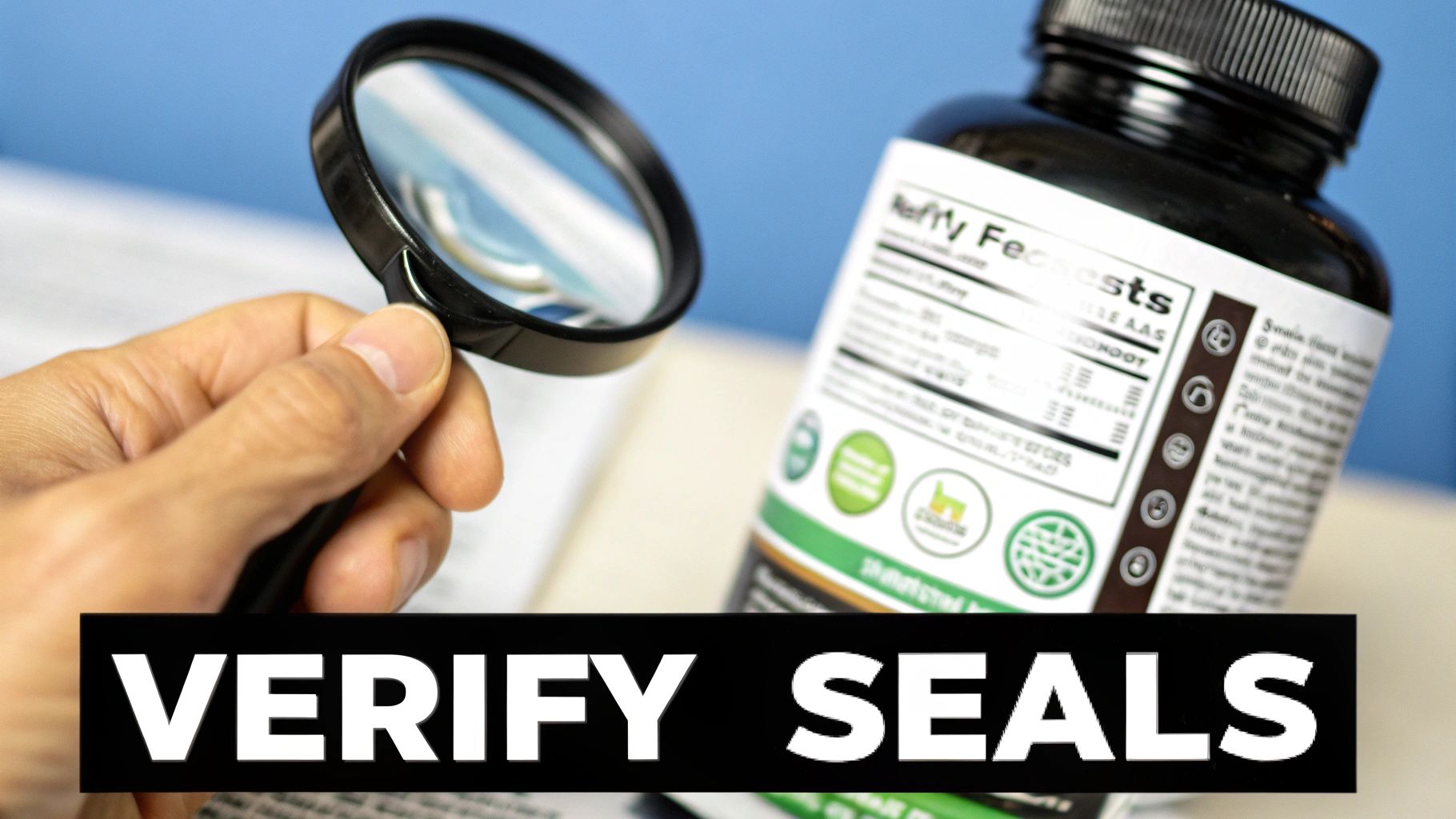
This simple visual from NSF helps you spot the marks of a product that has gone the extra mile for quality and safety.
Beyond the Label: Digital Verification
Don’t stop your investigation at the physical bottle. A truly trustworthy brand will be completely open about its quality control on its website.
A company that’s serious about excellence will proudly show off its certifications and give you all the details about its manufacturing standards. If you have to dig for this information—or can't find it at all—that’s a huge red flag.
When you land on a brand's website, look for a "Quality" or "Manufacturing" page. You want to see clear statements about their GMP status and any third-party certifications they hold. The best companies will even provide links to their listings on the certifier’s website, so you can verify their claims directly.
This level of transparency is a key sign of a brand you can trust. For instance, when searching for the best Mucuna Pruriens supplement, checking for these quality markers is what ensures you get a pure and potent product. Taking these few extra steps gives you the confidence to choose supplements that are not just effective, but most importantly, safe.
Understanding GMP on a Global Scale
When you grab a supplement bottle, it’s easy to assume quality standards are a local affair. But Good Manufacturing Practices (GMP) aren't just an American benchmark—they're the universal language of safety and quality in the supplement world. That global consistency is what makes today’s interconnected market work.
Major international bodies, like the World Health Organization (WHO), recognize and push for GMP standards. In fact, well over 100 countries have woven these core principles into their own regulatory DNA. It means a trustworthy brand, whether it’s based in the U.S., Europe, or Asia, is held to the very same foundational expectations for quality control.
Why Global Standards Matter for Online Shoppers
These days, we can buy products from anywhere in the world with just a few clicks. This wide-open marketplace makes a shared understanding of quality more critical than ever. When a brand sticks to global GMP, you get a reliable guarantee that its products were made with the same rigor you’d expect from a manufacturer down the street.
This alignment is your safety net, ensuring essential measures are in place, no matter where a product comes from. These include:
- Consistent Raw Material Sourcing: Verifying the purity and identity of every ingredient, even if it’s sourced from an international supplier.
- Standardized Production Protocols: Following exact manufacturing steps to prevent contamination or dosage mistakes.
- Traceability and Accountability: Keeping meticulous records for every single batch, creating a clear history from raw ingredient to finished bottle.
A shared commitment to GMP means a certified facility in another country operates with the same core dedication to safety as one down the street. It levels the playing field, making quality the priority, not geography.
This global standard is especially important as the industry continues to boom. The global dietary supplement market is on a steep climb, projected to hit USD 414.52 billion by 2033. This growth is fueled by people like you demanding safer, more transparent products, making global GMP a non-negotiable for any brand worth your trust. You can dig into more market trends in this Grand View Research report.
Ultimately, understanding the global picture empowers you. When you see a product is supplements gmp certified, you can feel confident it meets a respected international benchmark for both safety and effectiveness.
Our Commitment to Quality Beyond the Seal

Here at Keter Wellness, a GMP seal on our bottles isn't the finish line—it’s the mandatory starting block. While those regulations provide an essential framework for safety, we believe true quality is born from a much deeper, more intentional process. Our real work begins where the baseline requirements end.
It all starts with our raw ingredients. We don’t just accept the first batch of botanicals that passes a basic check. We practice selective sourcing, building relationships with trusted growers who share our obsession with purity and sustainable cultivation.
From Meticulous Sourcing to Radical Transparency
Once those premium materials arrive, they enter a multi-stage testing protocol that goes far beyond the standard checks. We screen for a wide spectrum of potential contaminants, but just as importantly, we verify the potency of the active compounds in every single batch.
This is how we ensure that the 20% L-Dopa in our Mucuna pruriens isn’t just an average or an estimate, but a consistent guarantee.
Of course, a rigorous process only creates a product you can trust if you're willing to prove it. We don't think you should have to take our word for it. That's why we're committed to radical transparency.
We see quality not as a department, but as our core philosophy. It's built into every decision, from sourcing a single herb to making our final lab results accessible to you. True wellness is built on trust, and trust is earned through transparency.
This means making our third-party lab results readily available for you to see. You can review the data for yourself and confirm the purity and potency of the exact product you hold in your hand.
Our view is simple: when you choose supplements gmp certified from Keter Wellness, you're not just buying a product. You are investing in a promise—a promise of unwavering quality, proven potency, and complete transparency that we proudly deliver in every single bottle.
Common Questions About GMP Certified Supplements
Even after getting a handle on GMP, a few questions usually pop up. Let's walk through the most common ones so you can feel completely confident when picking out your supplements.
Think of it as a quick chat to clear up any lingering confusion. The goal is to turn all that regulatory jargon into practical, real-world knowledge you can actually use.
Is GMP the Same as Organic or Non-GMO?
No, they’re completely different things, and it's a common point of confusion. Each label addresses a separate part of the product’s journey.
GMP certification is all about the manufacturing process. It’s the rulebook for safety, consistency, and quality control inside the facility. It ensures the product was made correctly, in a clean environment, and that what’s in the bottle matches the label.
On the other hand, certifications like "Organic" or "Non-GMO Project Verified" are about where the ingredients came from before they ever reached the factory.
- GMP Certified: Guarantees how the product was made.
- Organic: Guarantees the ingredients were farmed without synthetic pesticides or fertilizers.
- Non-GMO: Guarantees the ingredients weren't genetically modified.
The best products often carry both types of assurance. GMP tells you it was made right, and the other labels tell you the raw ingredients were sourced right.
Are All GMP Claims Created Equal?
Absolutely not. This is a big one. You’ll see companies claim they are "GMP compliant," which sounds official, but it’s a world away from being third-party GMP certified.
"Compliant" is just a self-declaration. The company is basically saying, "Trust us, we follow the rules." You’re just taking their word for it.
Third-party certification from an organization like NSF or USP is your proof. It means an independent, unbiased inspector has walked through the facility, checked the records, and verified that every single standard is being met. It’s the difference between a student grading their own homework and the teacher grading it.
Always look for that official seal from a respected certifier. That independent validation is what gives the term supplements gmp certified its real meaning and power. This level of rigor is especially crucial for herbal products, something we explore in our article on whether black seed oil lives up to its claims.
Can a Product Be GMP Certified but Still Ineffective?
Yes, and this is a critical distinction to understand. GMP certification is a guarantee of safety and accuracy, not therapeutic effectiveness.
It confirms that a product has the right purity, identity, and strength. It tells you that you're getting the correct dose of the ingredients on the label, and that it's free from contaminants. That’s a huge deal.
However, GMP doesn't say anything about whether the formula itself actually works or if the ingredients will produce a specific health benefit for you. That part comes down to good science. This is why it’s so important to find brands that not only follow strict GMP standards but also build their formulas on solid scientific research and use clinically relevant doses.
At Keter Wellness, we see GMP certification not as the finish line, but as the starting block. It's the absolute baseline for trust. From there, we build with scientifically backed formulations and total transparency, making sure every product is not just safe, but also effective.
Leave a Reply