
When you're trying to find the best Mucuna pruriens supplement, it really boils down to three non-negotiables: a standardized L-Dopa content for consistent effects, proof of purity from third-party testing, and a clean formula that’s free of junk fillers. If you stick to these markers, you're choosing a product based on real quality and safety, not just clever marketing.
How to Choose the Best Mucuna Pruriens Supplement
Walking through the supplement aisle (or scrolling online) can feel like a guessing game, with countless brands all making big promises. But picking out a high-quality Mucuna pruriens supplement gets a whole lot easier once you know what to look for.
The goal isn't just to grab any Mucuna product. It’s to find one that delivers a predictable, safe, and effective dose of its main active compound, L-Dopa. This means shifting your focus away from the flashy labels and onto the hard facts—the verifiable metrics that prove what's actually inside the bottle. The best brands are always transparent about potency, purity, and ingredients.
Key Quality Markers for Mucuna Supplements
To make a smart choice, you need a simple checklist. The top-tier supplements all hit specific quality standards that guarantee what you're taking is both effective and safe. Think of these as the must-haves for any product you’re considering.
Here’s exactly what to verify on the label:
- Standardized L-Dopa Content: This is the most important number. It tells you exactly how much of the active ingredient you’re getting in each serving. Without standardization, the potency could be all over the place from one batch to the next.
- Third-Party Lab Testing: This is your proof. An independent lab test confirms two things: that the supplement is free from contaminants like heavy metals, and that it actually contains the amount of L-Dopa the label claims.
- Clean Formula (No Fillers): A good supplement doesn’t need a bunch of junk. Look for products that skip unnecessary additives like magnesium stearate, silicon dioxide, or artificial colors, which do nothing for you.
- Clear Dosage Information: The label should be crystal clear about the amount of Mucuna pruriens extract and the corresponding L-Dopa dose per capsule. This allows you to manage your intake precisely.
The global market for natural supplements is booming, and the Mucuna pruriens corner of it is expected to hit around USD 367.9 million by 2033. While this growth is driven by people becoming more health-conscious, it also means quality control can be a real issue. Inconsistent active ingredient levels are a risk you don't want to take. Understanding the core benefits of Mucuna L-Dopa 20% extract is the first step to making a safe and effective choice.
A truly effective supplement doesn’t need flashy marketing. Its quality is proven by objective, verifiable data—like a certificate of analysis from a third-party lab and a clearly stated percentage of standardized L-Dopa.
By sticking to these criteria, you can cut through the noise and find a product that’s built on solid science and quality manufacturing.
Quick Guide for Evaluating Mucuna Pruriens Supplements
To make it even easier, use this table as a quick reference to size up any Mucuna pruriens supplement you come across.
| Quality Factor | Why It's Essential | What to Verify on the Label |
|---|---|---|
| Standardization to L-Dopa | Guarantees a consistent and predictable dose in every capsule. | Look for a specific percentage, like "Standardized to 20% L-Dopa." |
| Third-Party Testing | Independently verifies purity (no heavy metals) and potency (L-Dopa content). | Check for seals from labs like NSF, USP, or a brand's mention of it. |
| Clean Ingredients | Ensures you're only consuming the active ingredient, not unnecessary fillers or binders. | Scan the "Other Ingredients" list for magnesium stearate, silica, etc. |
| Clear Dosage | Allows for safe, controlled, and effective use. | The label should clearly state mg of Mucuna and mg of L-Dopa per cap. |
This simple checklist empowers you to look past the marketing and choose a supplement that truly delivers on its promise of quality and efficacy.
What Mucuna Pruriens Actually Does in Your Brain
To find the best Mucuna pruriens supplement, it helps to first understand what this unique bean actually does once it’s in your system. Instead of getting bogged down in scientific jargon, let’s use a simple analogy.
Imagine your brain is a high-tech car factory. Its most prized creation? A sleek, fast vehicle called Dopamine.
Dopamine is the neurotransmitter that powers your feelings of motivation, drive, focus, and reward. To build these "cars," your factory needs a steady supply of high-quality raw materials. Mucuna pruriens, also known as the velvet bean, is a potent natural source of one of the most vital raw materials your brain needs—a compound called L-Dopa.
The L-Dopa Key and the Dopamine Lock
So, what makes L-Dopa so special? It's a direct precursor to dopamine.
This means that once L-Dopa crosses the highly selective blood-brain barrier, your brain can convert it into dopamine in a single, efficient step. It’s like delivering a perfectly assembled engine straight to the production line. The factory doesn't have to build it from scratch; it just needs to install it.
This direct conversion is what makes Mucuna pruriens so effective. Your brain gets exactly what it needs, in a form it can use almost immediately, to support the natural production of this vital brain chemical.
This straightforward mechanism is why L-Dopa from Mucuna is often discussed for its ability to support mood and cognitive function. It provides the essential building block for the brain chemical that helps you feel driven and engaged.
This is a more direct pathway compared to other dopamine precursors like L-Tyrosine, which requires multiple conversion steps before becoming dopamine. While both are valuable, Mucuna's L-Dopa offers a more immediate raw material. To explore this comparison further, you can learn more about Mucuna versus L-Tyrosine for dopamine support in our detailed guide.
From Ancient Bean to Modern Brain Support
The velvet bean isn't some new discovery. It has been used for centuries in traditional Ayurvedic practices for its wide-ranging benefits. Ancient practitioners recognized its effects on vitality and well-being long before we could pinpoint the biochemical pathways.
Today, we understand that the feelings of enhanced motivation and a brighter mood associated with Mucuna are directly linked to this L-Dopa-to-dopamine conversion process. The plant acts as a powerful botanical tool, working with your body’s existing systems rather than introducing something entirely foreign.
Why This Process Matters for Your Supplement Choice
Understanding this simple mechanism—L-Dopa becomes dopamine—is crucial. It highlights why the quality and consistency of your supplement are so important.
If the supplement doesn’t contain a reliable, standardized amount of L-Dopa, you’re essentially sending inconsistent shipments of parts to your brain's factory. One day you get what you need, the next day you don’t.
Here’s a quick breakdown of what happens on a neurological level:
- Ingestion: You take a capsule containing Mucuna pruriens extract.
- Absorption: The L-Dopa is absorbed into your bloodstream.
- Conversion: It crosses the blood-brain barrier and is converted directly into dopamine by specialized neurons.
- Result: This newly synthesized dopamine can then be used by your brain to regulate mood, focus, and motivation.
This entire process hinges on getting a precise dose of L-Dopa. Too little, and the factory won't have enough material to work with. Too much, and you risk oversupplying the system, which can lead to unwanted side effects.
This foundational knowledge sets the stage for our next sections, where we’ll dive into why standardization and purity are non-negotiable for achieving safe and predictable results.
Why Standardization and Purity Are Non-Negotiable
When you're looking for the right Mucuna pruriens supplement, two words matter more than anything else: standardization and purity. These aren’t just technical jargon; they’re your guarantee against a product that’s inconsistent, ineffective, or even unsafe. Without them, you're rolling the dice with every capsule you take.
Think of it like brewing coffee. You count on a certain amount of caffeine to get you going. But what if one cup had virtually no kick, and the next had ten times the normal dose? That's the wild west of unstandardized supplements. An unstandardized Mucuna product gives you a completely random amount of L-Dopa, making it impossible to get predictable results.
Standardization fixes this. It’s a careful manufacturing process that guarantees a specific, consistent percentage of the active ingredient—in this case, L-Dopa—in every single batch. When a label says "Standardized to 20% L-Dopa," you know you're getting a reliable dose, every time.
This chart shows the simple but vital path from the raw velvet bean to the dopamine support your brain gets.
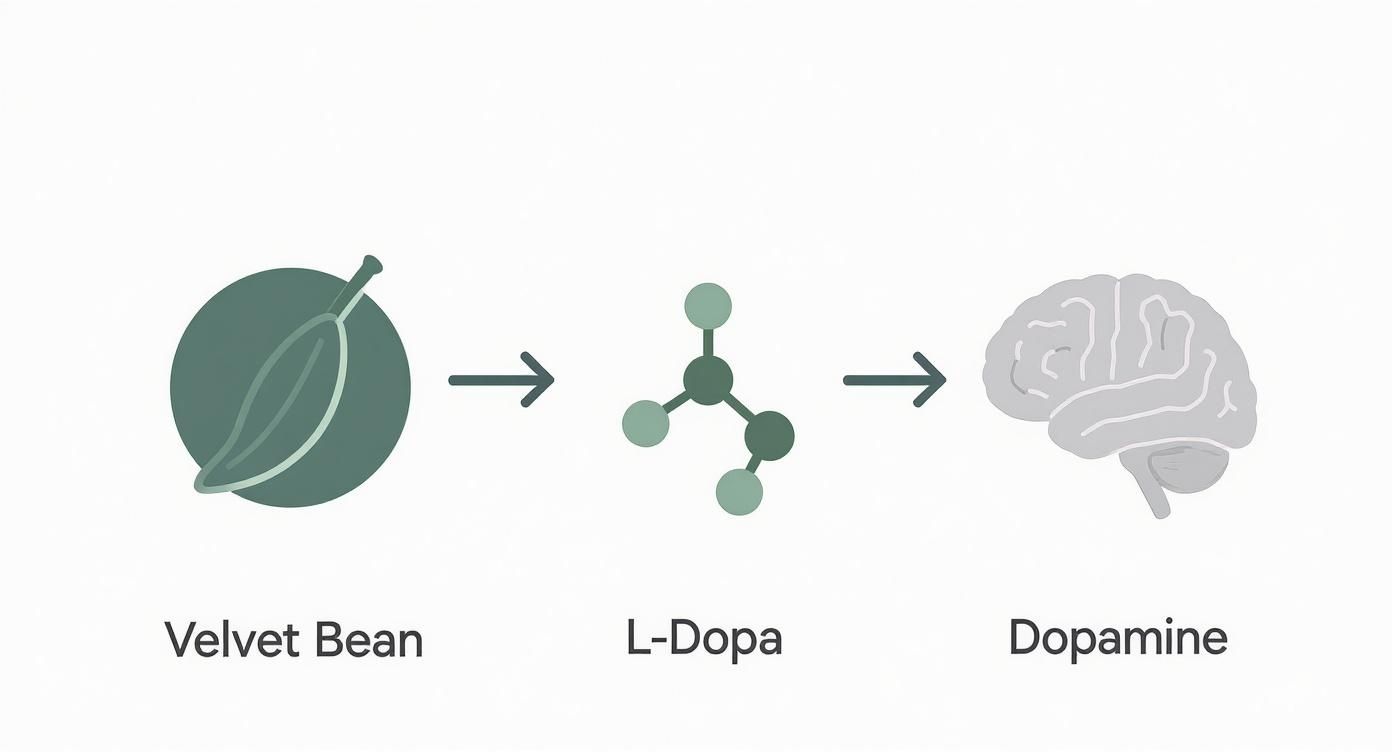
As you can see, the natural L-Dopa from the bean is converted into dopamine. This highlights why a consistent starting dose is the only way to achieve reliable support.
The Dangers of Inconsistency
This isn't just a hypothetical problem. Because the supplement industry is so loosely regulated, potency can swing wildly from one brand to another—and even between two bottles from the same brand. That kind of inconsistency can make a supplement useless at best, and downright dangerous at worst.
A shocking 2022 study in JAMA Neurology put this problem under the microscope. Researchers tested various Mucuna pruriens supplements and discovered the actual L-Dopa content ranged from a staggering 228% to 2,186% of what the label claimed. With discrepancies that massive, users could be taking dangerously unpredictable amounts, creating huge clinical risks. You can read more about these concerning findings and see for yourself why verified potency is so critical.
When you choose a non-standardized supplement, you lose control. You’re not just guessing at the effectiveness; you're also risking unpredictable side effects by unknowingly taking excessively high doses of a potent bioactive compound.
This brings us to the second pillar of quality: purity.
Why Third-Party Testing Is Your Only Guarantee
How can you be sure that what’s on the label is what’s actually in the bottle? The only real answer is third-party testing. A trustworthy brand will voluntarily send its products to an independent lab to verify two things:
- Potency: Does the supplement contain the exact amount of standardized L-Dopa promised? The lab confirms that the 20% L-Dopa on the label is accurate.
- Purity: Is the supplement free from nasty contaminants? The lab screens for heavy metals (like lead, mercury, and arsenic), microbes, and other toxins that often show up in raw plant-based ingredients.
Without a Certificate of Analysis (CoA) from a third-party lab, any claim a brand makes is just marketing—an unverified promise. This independent verification is the gold standard for safety and transparency.
Purity Beyond Contaminants
Beyond testing for toxins, purity also means a clean formula. The best Mucuna pruriens supplement will have a short, simple ingredient list, without a bunch of unnecessary additives.
Keep an eye out for these common fillers:
- Magnesium Stearate: Often used as a "flow agent" in manufacturing, but it offers zero health benefits.
- Silicon Dioxide: Another anti-caking agent that adds nothing of value.
- Artificial Colors and Flavors: Purely cosmetic and totally unnecessary in a capsule.
A clean formula ensures you're paying for the active ingredient, not for cheap fillers that just make the manufacturing process easier. By choosing supplements that are both standardized for potency and verified for purity, you move from being a hopeful buyer to an informed one. You’re no longer just buying a product; you’re investing in your well-being with confidence.
How to Read Supplement Labels Like an Expert

Stepping into the world of supplements can feel like trying to learn a new language. Labels are crowded with information, and it's tough to know what actually matters and what’s just marketing noise. But don't worry, once you know where to look, you can evaluate any product with confidence and pick the best Mucuna pruriens supplement for your needs.
Think of a supplement label like a resume. The front is just the flashy introduction. The real qualifications—the stuff that separates the high-quality contenders from the pretenders—are found in the "Supplement Facts" panel and the "Other Ingredients" list.
Decoding the Supplement Facts Panel
The Supplement Facts panel is the most important part of any label. It’s where brands are legally required to tell you what's really inside. For a Mucuna pruriens supplement, you’re looking for a few key numbers to figure out its potency and dose.
Here’s what you need to zero in on:
- Serving Size: This tells you how many capsules make up one dose. It might be one, but some brands require two or more to hit the advertised dosage, so always double-check.
- Amount Per Serving: This shows the total milligrams (mg) of Mucuna pruriens extract in that serving. A common dose is in the 500-1000 mg range.
- Standardization Percentage: This is the game-changer. You need to see a clear statement like "Standardized to contain 20% L-Dopa." This is your guarantee that you're getting a consistent and reliable amount of the active compound in every single capsule.
If a label only says something vague like "Mucuna Pruriens (from 10:1 extract)" without that standardization percentage, you have no real idea how much L-Dopa you’re getting. It's a huge red flag.
Scrutinizing the Other Ingredients List
Once you’ve confirmed the potency, your next stop is the "Other Ingredients" list. This little section reveals everything else that's in the capsule. A top-tier product will always keep this list as short as humanly possible.
You're looking for a clean formula, which means steering clear of:
- Fillers and Binders: Things like magnesium stearate, silicon dioxide, and stearic acid are cheap shortcuts used to speed up manufacturing. They do nothing for your health.
- Artificial Colors and Flavors: These are totally unnecessary in a capsule and can be a source of sensitivities for some people.
- Proprietary Blends: This is a major warning sign. A "proprietary blend" hides the exact amount of each ingredient, making it impossible to know if you're getting an effective dose of anything.
A transparent brand is proud of its simple formula. If you see a long list of chemical-sounding names in the "Other Ingredients" section, it's a clear signal that the product may be full of non-essential additives.
Unfortunately, misleading labels are a real problem in the industry. An Italian research team found that Mucuna supplements sold online often had ambiguous or just plain wrong information about their L-Dopa content. The study highlighted vague dosage details, untraceable manufacturers, and L-Dopa levels that didn't match what the label claimed. You can discover more about these labeling inconsistencies to see just how vital careful label-reading is.
Identifying Meaningful Certifications
The final step is to look for proof of quality manufacturing. The most important certification to find is GMP (Good Manufacturing Practices). This seal means the supplement was made in a facility that follows strict FDA guidelines for quality, purity, and safety.
While other seals like "Non-GMO" or "Gluten-Free" are great for specific dietary needs, GMP certification speaks directly to the manufacturing quality of the product itself. It’s a non-negotiable standard for any reputable brand. By mastering these three areas—Supplement Facts, Other Ingredients, and Certifications—you’re no longer just a consumer. You're an empowered expert, ready to make the best choice for your health.
What a High-Quality Mucuna Supplement Looks Like
Knowing the theory is one thing, but seeing it in practice is what really makes it all click. Let’s shift from concepts to a real-world product to see what a top-tier Mucuna supplement actually looks like on the shelf.
We'll use Keter Wellness' Mucuna L‑Dopa 20% as our example to connect the dots. This isn't just a product plug; it's about showing you the gold standard in action. By breaking down its label, you'll get a clear roadmap for judging any supplement you come across.
The Power of Precise Standardization
The very first thing you'll see on the Keter Wellness label is the specific callout: "Standardized to 20% L‑Dopa." This isn't just a small detail—it's the foundation of the product's reliability. It means every single 700 mg capsule is guaranteed to provide a consistent 140 mg of active L‑Dopa.
This precision is what separates a carefully calibrated tool from a blunt instrument. It removes the guesswork and wild inconsistency that plagues so many other supplements. Whether you open a bottle today or six months from now, the dose is predictable.
For you, this translates to:
- Consistent Effects: You can count on getting the same level of mood and motivation support every time.
- Controlled Intake: You know exactly how much of the active compound you're taking, which is crucial for safe and responsible use.
- Predictable Results: With the guesswork gone, it's far easier to understand how the supplement is working for your unique body over time.
Standardization directly solves the problem of potency variation, ensuring you get an effective dose without the risk of accidentally taking too much or too little.
Verifying Purity with Third-Party Testing
A confident brand doesn’t just tell you its product is pure—it proves it. Keter Wellness sends its Mucuna L‑Dopa 20% to an independent lab for rigorous third-party testing. This unbiased checkup is a critical safety measure that confirms two key things.
First, it validates the potency. The lab certifies that each batch actually contains the 20% L‑Dopa advertised, so you get what you paid for. Second, and just as important, it screens for nasty contaminants. The supplement is tested to be free from heavy metals like lead and mercury, which can sometimes find their way into raw botanicals.
A third-party Certificate of Analysis (CoA) is the ultimate sign of transparency. It moves a product’s claims from marketing hype into the realm of verifiable fact, giving you total peace of mind.
This independent oversight is non-negotiable if you're serious about finding the best mucuna pruriens supplement. It's your guarantee that the product is clean, safe, and potent.
A Commitment to a Clean Formula
Finally, flip the bottle over and read the "Other Ingredients." With a high-quality supplement, this list should be as short and simple as possible. The Keter Wellness formula is a perfect example.
You won't find a long list of unnecessary fillers, binders, or artificial additives. It’s free from common manufacturing agents like magnesium stearate or silicon dioxide. The focus is purely on delivering the active ingredient in a simple vegetable cellulose capsule.
This clean-label approach means every single ingredient serves a purpose. You’re paying for pure, potent Mucuna pruriens extract, not cheap fillers designed to make the manufacturing process faster. It shows a brand that respects its customers and is committed to delivering genuine health value.
Using Mucuna Pruriens Safely and Effectively
Choosing a high-quality Mucuna pruriens supplement is only half the battle. Using it correctly is what truly unlocks its potential while keeping you safe. Because this powerful herb works by directly supplying your brain with L-Dopa, a mindful approach to dosage and timing is key to getting sustainable, long-term benefits.
The golden rule here is to start low and go slow. A single capsule per day is a sensible starting point, usually taken with a meal to help with absorption and prevent any potential stomach issues. This simple step lets you see how your body responds before you think about making any changes.
Smart Dosing and Cycling Strategies
Consistency is good, but strategic breaks are even better. If you use any substance that influences your brain’s chemistry day-in and day-out, your body can adapt, potentially making it less effective over time. This is where cycling comes into play.
Cycling is just a fancy term for taking scheduled breaks from a supplement. It’s a simple but powerful strategy to prevent your body from building a tolerance, keeping it responsive to the supplement’s effects.
A couple of popular cycling schedules include:
- The 5/2 Method: Take your supplement for five days in a row, then take a two-day break (like on the weekend).
- The Monthly Break: Use the supplement daily for three or four weeks straight, followed by a full week off.
This practice helps make sure your system doesn’t get too used to the external L-Dopa, allowing you to keep feeling the full benefits. Timing also matters—when you take it can change the experience. We dive much deeper into this in our guide on when to take Mucuna for optimal results.
Understanding Potential Side Effects and Contraindications
While most people tolerate Mucuna pruriens very well, it can cause minor side effects, especially if the dose is too high. These might include things like nausea, bloating, or a headache. Sticking to a low starting dose is the best way to avoid this.
More importantly, some people should steer clear of Mucuna pruriens entirely. Because of its direct impact on dopamine, it is not recommended for:
- Anyone who is pregnant or nursing.
- People taking MAOI medications, as the combination can cause a dangerous spike in blood pressure.
- Those with a history of melanoma, since L-Dopa is a precursor to the skin pigment melanin.
Your health always comes first. Before adding any new supplement to your routine, it's a smart move to chat with your doctor or a healthcare professional, particularly if you have an existing health condition or are on other medications.
Got Questions About Mucuna? We've Got Answers.
Let's dig into some of the most common questions people have when they're thinking about trying Mucuna. This is where we get practical, covering the details that help you use it safely and get the results you're looking for.
How Long Does It Take to Feel the Effects?
This is a classic "it depends" situation. Some people feel a noticeable shift in their mood or focus within an hour or two of taking their first dose. It can be that quick.
For others, the magic is more in the accumulation. It might take a few days, or even a couple of weeks of steady use, before you feel that sustained lift in motivation and general well-being. Think of it less like a switch and more like topping off a reservoir. Consistency is way more important than waiting for an instant bang.
Can I Mix Mucuna Pruriens and Coffee?
It's smart to be a little careful here. Both Mucuna (thanks to its L-Dopa) and your morning coffee are hitting similar buttons in your central nervous system and nudging your dopamine pathways.
When you combine them, you risk amplifying the stimulant effect. This can lead to feeling jittery, restless, or like your heart is racing—especially if you're already sensitive to caffeine. We always suggest trying Mucuna on its own first. See how your body responds before you think about pairing it with your espresso.
Your body will tell you what you need to know. If you feel overstimulated, that’s your cue to put some space between your supplement and your coffee, or maybe just cut back on the stimulants overall.
Is Cycling Mucuna Really Necessary?
Yes, we're big believers in cycling for responsible, long-term use. When you continuously supply your body with a powerful neurotransmitter precursor like L-Dopa, your system can get a little lazy. It might down-regulate its own natural production or make its receptors less sensitive over time.
Basically, you could find that it stops working as well. Cycling helps prevent that. Here are a couple of popular strategies:
- The 5-2 Split: Take it for five days in a row, then take a two-day break over the weekend.
- The Monthly Reset: Use it consistently for three or four weeks, then take one full week off.
These little breaks are enough to keep the supplement effective and help your body maintain its natural rhythm.
Whole Bean Powder vs. Standardized Extract: What's the Difference?
The difference here is massive. Whole bean powder is just what it sounds like: the raw velvet bean, dried and ground up. The amount of L-Dopa in it is naturally pretty low and, more importantly, it's wildly inconsistent from one batch to the next.
A standardized extract, on the other hand, is a game-changer. It's carefully processed to concentrate the L-Dopa, guaranteeing you get a specific, reliable amount in every single dose. If you're looking for predictable results and targeted dopamine support, a standardized extract is the only way to go.
Ready to feel the difference that a precisely standardized, third-party tested Mucuna supplement can make? Keter Wellness created a clean, potent formula designed for exactly that.
Discover the Keter Wellness Mucuna L-Dopa 20% Supplement Today
Article created using Outrank
Leave a Reply