
Introduction
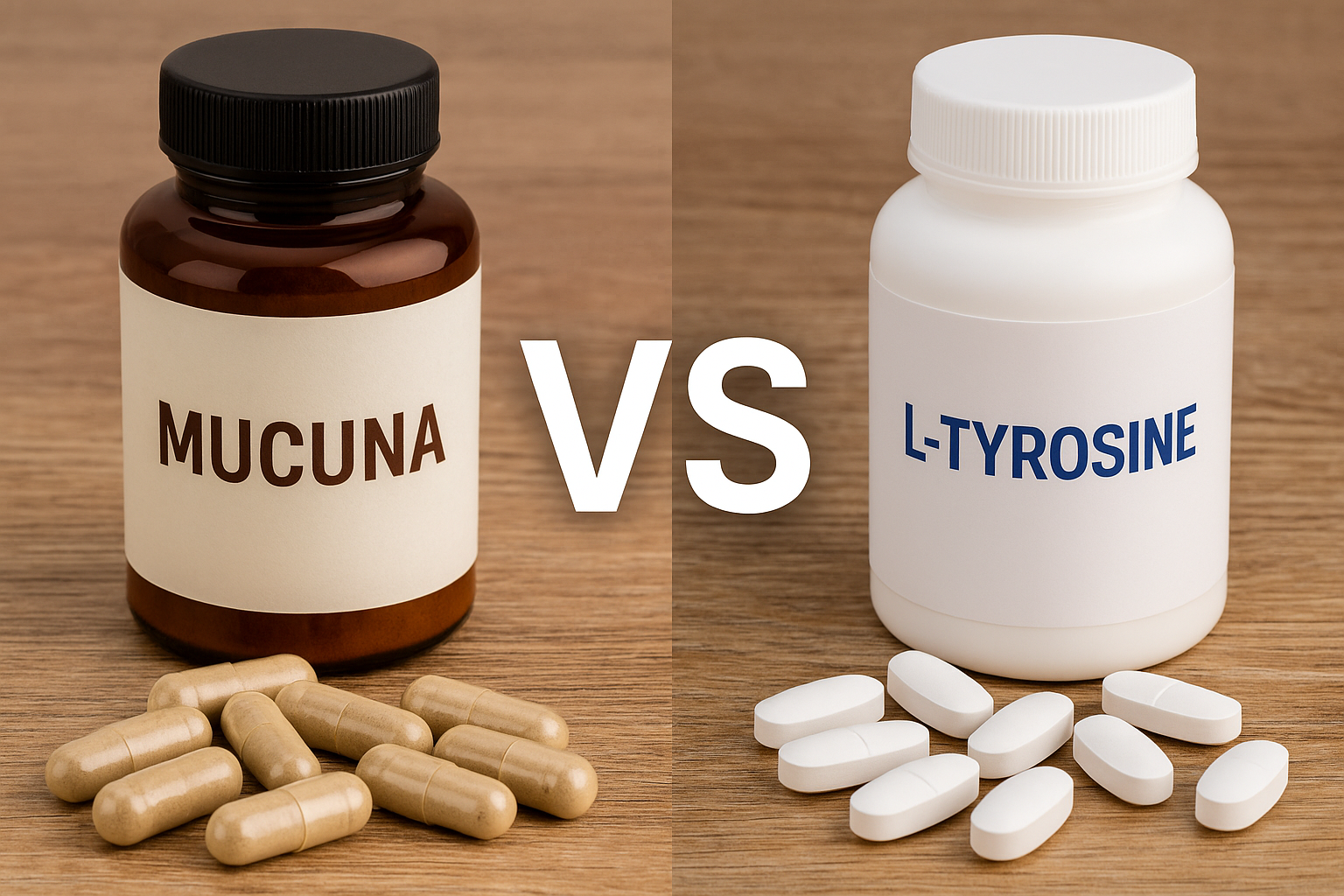
Dopamine plays a central role in motivation, focus, mood, and movement. Two popular supplements often considered for supporting dopamine are Mucuna pruriens (a natural source of L-Dopa) and L-Tyrosine (an amino acid precursor).
At first glance, they may seem interchangeable—but they work differently in the body, and each has distinct advantages depending on your goals and circumstances. This article provides an in-depth comparison of Mucuna vs. L-Tyrosine so you can make an informed choice.
Mechanisms of Action
Mucuna (L-Dopa)
- Source: Extracted from the velvet bean plant.
- How it works: Provides L-Dopa directly, which crosses the blood-brain barrier and converts into dopamine.
- Speed: Fast-acting—effects often felt within 30–60 minutes.
- Key note: Bypasses several enzymatic steps, making it a more immediate but also more intense way to raise dopamine.
L-Tyrosine
- Source: Non-essential amino acid found in protein-rich foods and supplements.
- How it works: Converts into L-Dopa through a multi-step pathway: Tyrosine → L-Dopa → Dopamine.
- Speed: Slower, more gradual support.
- Key note: Works best when the body has adequate enzymes and cofactors (iron, B vitamins).
Use Cases
When Mucuna May Be Preferred
- Need immediate boost in mood, focus, or motivation.
- Supporting dopamine in cases of deficiency (e.g., very low mood, “burnout”).
- Looking for a plant-based natural source of L-Dopa.
When L-Tyrosine May Be Preferred
- Supporting stress resilience (tyrosine is well-studied for reducing cognitive decline during sleep deprivation or stress).
- Wanting gentler, longer-term support without the intensity of direct L-Dopa.
- Already consuming balanced protein intake but needing an extra boost for dopamine precursors.
Side-by-Side Comparison
| Feature | Mucuna (L-Dopa) | L-Tyrosine |
|---|---|---|
| Form | Plant extract (velvet bean) | Amino acid supplement |
| Primary Mechanism | Direct L-Dopa → Dopamine | Precursor amino acid → L-Dopa → Dopamine |
| Onset of Effects | Fast (30–60 min) | Gradual (hours to days) |
| Best For | Immediate motivation, mood, focus | Stress resilience, long-term balance |
| Tolerance Risk | Higher (possible with daily long-term use) | Lower |
| Dietary Considerations | Plant-based, natural extract | Common amino acid, found in protein |
| Synergy | Works well with cofactors (B6, magnesium) | Requires cofactors for conversion (iron, B6, folate) |
| Cautions | Avoid with certain medications (e.g., Parkinson’s meds, MAOIs) | Usually well tolerated, but high doses can cause headaches, nausea |
Safety Basics
- Mucuna: Because it supplies L-Dopa directly, long-term daily use can sometimes reduce the body’s natural regulation of dopamine. Best taken in cycles (e.g., 5 days on, 2 days off) or as needed. Should be avoided with Parkinson’s medications or MAOIs unless guided by a healthcare provider.
- L-Tyrosine: Generally regarded as safe in moderate doses (500 mg–2 g). Overuse can cause restlessness, insomnia, or gastrointestinal discomfort. Should be avoided in individuals with hyperthyroidism or Graves’ disease, since tyrosine is a thyroid hormone precursor.
A Simple Decision Guide
If you’re unsure which to try, here’s a quick flowchart in bullet form:
- Do you want a fast, noticeable boost in focus or motivation? → Start with Mucuna.
- Are you under chronic stress or sleep-deprived? → Try L-Tyrosine.
- Do you want a gentler, daily support option? → Choose L-Tyrosine.
- Do you want a natural plant extract with a strong effect? → Choose Mucuna.
- Still unsure? → Some people combine both, using Tyrosine for daily baseline and Mucuna occasionally for an extra lift.
5 FAQs
1. Can I take Mucuna and L-Tyrosine together?
Yes, some combine them: Tyrosine for baseline support, Mucuna for extra intensity. Start with low doses to monitor response.
2. Which one is better for stress?
L-Tyrosine is better studied for stress resilience, especially during sleep deprivation or multitasking.
3. Which one works faster?
Mucuna. Because it provides L-Dopa directly, it can noticeably boost dopamine within an hour.
4. Are they safe for daily use?
L-Tyrosine is typically safe daily. Mucuna is best cycled to avoid potential tolerance.
5. Which is more natural?
Both are natural—Tyrosine is an amino acid found in food proteins, while Mucuna is a plant extract. “Natural” here depends on whether you prefer an amino acid supplement or an herbal extract.
Conclusion
Mucuna and L-Tyrosine both support dopamine, but they do so in different ways. Mucuna delivers direct L-Dopa, leading to faster and stronger effects—ideal for those seeking an immediate lift. L-Tyrosine works more gently and gradually, making it a better choice for stress resilience and long-term use.
For many, the decision comes down to intensity vs. balance. Mucuna may be the go-to when you need a noticeable shift in motivation, while Tyrosine offers steady, sustainable support. With smart use—and attention to your body’s response—you can choose the right supplement to match your dopamine needs.
Leave a Reply