
Before we can tackle how to recover from burnout, we have to get real about what it is. The first and most important thing to understand is that burnout is not a personal failure. It’s a natural response to being under chronic, unmanageable stress—and it requires a deliberate, thoughtful plan to fix.
What Workplace Burnout Actually Feels Like

Let's be clear: this isn't just feeling tired after a tough week or stressed about a big project. Workplace burnout is a deep, prolonged state of emotional, physical, and mental exhaustion. It's the feeling of running on fumes, every single day, with no relief in sight.
So many of us mistake burnout for laziness or a lack of motivation, which just piles guilt and shame on top of everything else. But the World Health Organization officially calls it an “occupational phenomenon.” That’s a game-changer. It shifts the focus from "what's wrong with me?" to "what's wrong with these circumstances?"
If you feel this way, you are far from alone. The numbers are staggering. A recent study found that 69% of workers felt burnout symptoms in 2023. This isn't a small problem; it's an epidemic with real-world consequences. Of those experiencing it, 71% said it hurt their job performance, and nearly half were already looking for a new job to escape. You can dig into more of these stats over at Supply Chain Brain.
The Three Faces of Burnout
To really get a handle on burnout, it helps to see its three distinct parts. Recognizing these in yourself is the first real step toward getting better.
-
Total Exhaustion: This isn't your average "I need a coffee" tiredness. It’s a bone-deep fatigue that impacts you mentally, emotionally, and physically. You might dread getting out of bed, feel drained by the simplest tasks, and have zero energy left over for your actual life.
-
Cynicism and Disconnection: Remember when you used to be excited about your work? Now, do you feel negative, cynical, or just plain detached? This is a huge red flag. Projects feel like a drag, and you might find yourself feeling irritable or emotionally distant from your coworkers.
-
Feeling Ineffective: This is that nagging sense that you just can't do your job well anymore. You're putting in the hours, but your productivity is in the tank, and it feels like nothing you do matters. This erodes your confidence, creating a vicious cycle of trying harder and feeling worse.
Burnout isn't a sign that you're weak; it's a sign you've been strong for way too long. It’s your body and mind screaming that the demands being placed on you have officially outstripped your resources.
Why You Can't Just 'Push Through It'
Ignoring these signals is a recipe for disaster. Pushing through burnout doesn't work—it only digs a deeper hole. Untreated, it can lead to serious health problems like anxiety, depression, insomnia, and even a higher risk of heart disease. It bleeds into your personal life, straining relationships and sucking the joy out of everything.
The moment you accept that burnout is a systemic problem—often caused by impossible workloads, a lack of real support, and an "always on" work culture—is the moment you can start to heal. It lets you stop blaming yourself and start solving the problem. Once you acknowledge what's really going on, you can finally take the practical steps needed to reclaim your well-being and build a career that doesn't break you.
Recognizing the Subtle Warning Signs of Burnout
Burnout doesn't just show up one Monday morning. It’s a slow burn, creeping in so quietly that you might mistake it for a tough week or just feeling "off." Before you can tackle it, you have to get good at spotting its early, subtle signals. The real skill is learning to tell the difference between the temporary stress of a deadline and the deep, persistent drain of chronic burnout.
A lot of the first warning signs are easy to brush off. You might blame a bad night’s sleep for being irritable, or a packed calendar for feeling disconnected. But when these feelings become your new normal, it’s a red flag that something more serious is going on.
Emotional Red Flags
Often, the first clues are emotional. It’s that nagging feeling that something just isn't right, even if you can't name it. This goes way beyond simple sadness—it’s a fundamental shift in how you feel about your work, your colleagues, and even yourself.
You might notice a cynical edge to your thoughts about projects you used to enjoy. Team meetings that once felt productive now seem like a complete waste of time. This emotional detachment is actually a defense mechanism; your brain is trying to protect you from a job that's become a source of exhaustion instead of satisfaction.
Watch for these common emotional shifts:
- Persistent Cynicism: A growing negativity or detached feeling about your job.
- Increased Irritability: Getting easily frustrated or snappy with people and tasks.
- Apathy or Numbness: Losing interest and feeling zero satisfaction, even when you complete something big.
- Sense of Dread: That sinking feeling in your stomach on Sunday night or when you think about the day ahead.
To help you better distinguish between these two states, let's look at a side-by-side comparison.
Stress vs Burnout: Distinguishing the Key Differences
It's crucial to understand that while related, stress and burnout are not the same. Stress is often characterized by a sense of urgency and hyperactivity, while burnout is defined by disengagement and helplessness. This table breaks down the core differences.
| Symptom/Characteristic | Everyday Stress | Chronic Burnout |
|---|---|---|
| Engagement | Over-engagement, a sense of urgency | Disengagement, a sense of helplessness |
| Emotions | Hyperactive, heightened emotions | Blunted emotions, feeling empty |
| Physical Toll | Leads to urgency, anxiety disorders | Leads to detachment, depression |
| Primary Damage | Primarily physical (fatigue, tension) | Primarily emotional (cynicism, dread) |
| Motivation | Can motivate in the short term | Kills motivation and drive |
Recognizing where you fall on this spectrum is the first step toward getting the right kind of help. While stress management techniques can be helpful, burnout requires a much deeper, more restorative approach.
Physical Symptoms You Can’t Ignore
Burnout isn’t just in your head—it shows up in your body. Your body keeps a running tally of chronic stress, and eventually, it starts sending out loud and clear signals that it's overwhelmed. These physical symptoms are often the most concrete evidence that you need to make a change.
You might feel exhausted all the time, no matter how much you sleep. This isn’t just a 3 PM slump; it’s a profound, bone-deep fatigue that’s there from the moment your alarm goes off. Frequent headaches, tight shoulders, and even stomach problems are all physical cries for help.
Burnout is your body's way of saying it can no longer sustain the high-alert state demanded by chronic stress. Ignoring these physical signs is like driving a car with the check engine light flashing—eventually, a breakdown is inevitable.
This constant state of alert can also hammer your immune system, making you more likely to catch every cold that goes around the office. Another classic sign is brain fog. If you're struggling to think clearly, our guide on how to overcome brain fog has some targeted strategies that can help you cut through the haze.
Changes in Your Behavior
How you act is a direct reflection of how you feel inside. As burnout takes hold, your behavior and work habits often take a nosedive. You might start pulling away from colleagues, skipping the team lunch, or dodging hallway conversations you used to enjoy.
Procrastination can suddenly become your default setting. Simple tasks feel monumental, so you put them off, which only ramps up the pressure and guilt. To get a more detailed look at these behavioral shifts, check out these 10 signs of job burnout to watch for. It’s a great resource that breaks down specific indicators you shouldn't ignore.
By learning to spot these emotional, physical, and behavioral signs early, you give yourself the power to step in and make a change before burnout completely takes over.
Taking Immediate Action When You Feel Overwhelmed
When you're completely buried in burnout, the idea of a long-term fix can feel impossible. Like being told to climb a mountain when you can barely stand. So let's forget the mountain for now.
The goal right now isn’t to solve everything. It’s about finding a pressure release valve—small, simple actions that give you a moment of relief. Think of this as your first-aid kit for those days when it all feels like too much.
Forget vague advice like "just relax." We're talking about tangible micro-steps that don't require much energy but give you an immediate return. When your to-do list is paralyzing and every new email makes your chest tighten, these are the tactics that help you claw back a tiny bit of control.
The Five-Minute Reset
One of the most effective things you can do is physically remove yourself from whatever is causing the stress, even for just five minutes. This isn’t about running away from the problem; it’s about hitting pause on the overwhelm-spiral before it gets worse.
Find a quiet spot. It could be another room, a quick walk around the block, or even just turning your chair away from your computer. Now, focus on your breath.
Simple, mindful breathing can calm your nervous system right down. If this is new to you, you can learn more about how to get started with meditation, which is an incredible tool for managing this kind of acute stress. You're just trying to create a brief, intentional gap in the chaos.
Taming Your Overwhelming To-Do List
A classic sign of burnout is staring at a massive to-do list and feeling completely frozen. When everything screams "urgent," it’s impossible to start anything. The trick is to switch from a "do-everything" mindset to a "what's-one-thing" focus.
Try the Single-Task Focus method:
- Glance at your list: Find just one task. Not the biggest, not the scariest, but one that's both important and actually doable in the next hour. Forget the rest exist for now.
- Kill the distractions: Close all those extra browser tabs. Silence your phone notifications. Let your colleagues know you need to focus.
- Do that one thing: Give it your full attention until it's done. That small hit of accomplishment can be just enough to break the inertia and prove you can still move forward.
This is a great illustration of how burnout shows up—it's not just in your head. It hits you emotionally, physically, and changes how you act.
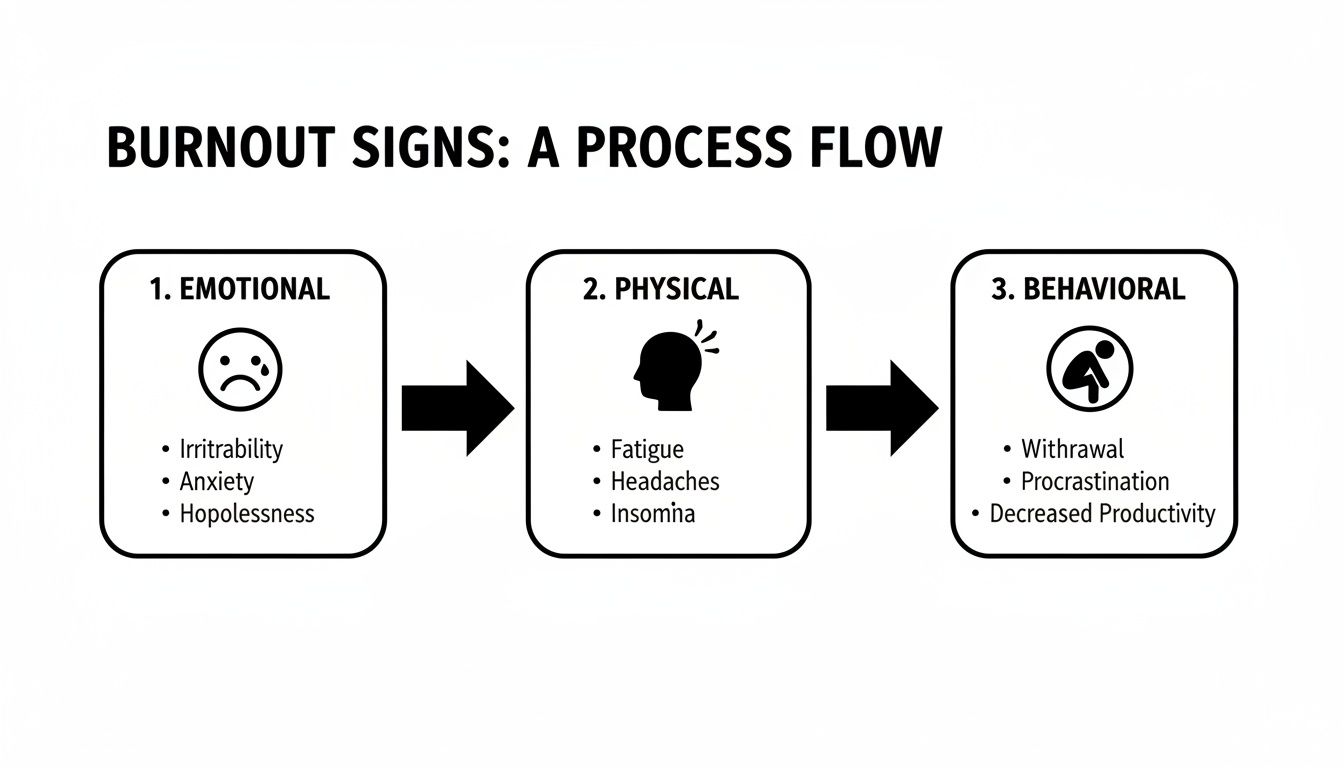
Realizing that burnout affects your emotions, your body, and your behavior helps you see it for what it is: a whole-person problem, not just a case of being tired.
Pushing Back with Confidence
That feeling of being swamped is often directly tied to not being able to set boundaries in the moment. When a "quick question" or a non-urgent request lands on your desk, your gut reaction might be to say "yes," even when you have nothing left to give.
Learning a few simple, polite scripts can be a total game-changer.
You don’t have to be aggressive to be assertive. A simple, polite redirection is often all that’s needed to protect your time and energy without damaging professional relationships.
Here are a few phrases you can borrow:
- "Thanks for thinking of me for this. I'm at capacity right now, but I can take a look next week. Will that work?"
- "To give this the attention it deserves, I'd have to shift focus from [Project X]. Can you help me figure out which one is the priority?"
- "I can't jump on that at the moment, but you might want to check with [colleague/resource]—they might be able to help you out sooner."
These immediate actions won't fix the deep-seated causes of burnout overnight. But they will give you some desperately needed breathing room. They help you survive the acute moments of stress, which is the first step toward building up the energy for bigger, more lasting changes.
Building Sustainable Habits for Long-Term Recovery

While quick coping tactics can feel like a lifeline, true recovery from burnout is a marathon, not a sprint. It’s about building new, sustainable habits that put your well-being first for the long haul. This isn't just about damage control; it's about redesigning your daily routines to build a strong foundation of resilience.
Think of it as moving from reactive survival to proactive self-care. It's about consciously treating your energy as a resource worth protecting. This doesn't require a massive life overhaul overnight. Instead, it’s the small, consistent actions that add up over time, creating a powerful buffer against chronic stress.
Redefining Your Relationship with Work
One of the most powerful moves you can make is creating a hard stop at the end of your workday. Burnout absolutely thrives in that gray area where work bleeds into personal time, leaving you feeling perpetually “on.” Setting a non-negotiable end time is your first step to reclaiming your evenings and your sanity.
This is about more than just shutting your laptop. You need to create a "wind-down" ritual that signals to your brain that the workday is officially over.
- Change your environment: If you work from home, physically leave your workspace. If that’s not possible, tidy your desk and put your work materials out of sight.
- Change your clothes: Swapping work clothes for something comfortable creates a psychological shift from "work mode" to "home mode."
- Engage your senses: Put on some music, listen to a podcast, or take a quick walk outside. The goal is to create a sensory break that pulls your mind away from work.
This deliberate separation is critical. It gives your mind the permission it needs to stop churning through work problems and actually start recharging. It’s a simple boundary that pays huge dividends in mental clarity.
True burnout recovery isn't about finding more energy for work; it's about dedicating more of your energy to your life. The habits you build outside of your job are what will ultimately heal you.
Reclaiming and Prioritizing Restorative Activities
When you're deep in burnout, hobbies can feel like just another chore on an endless to-do list. But here’s the thing: engaging in activities you genuinely enjoy isn't an indulgence—it's a critical part of recovery. These are the things that replenish the emotional and mental reserves that your job drains.
Think back to what you loved doing before you felt this way. Was it reading, hiking, playing an instrument, or just grabbing coffee with a friend? The key is to pick things that are intrinsically motivating, meaning you do them for the pure joy of it, not for some productive outcome.
You have to schedule these activities just like you’d schedule a meeting. Block out time in your calendar for a hobby or social event. Protecting this time sends a powerful message to yourself: your well-being is a priority. For a deeper dive, exploring additional strategies to beat burnout can offer a clear roadmap toward lasting recovery.
Fueling Your Body for Recovery
You can’t overcome burnout without addressing your physical health. Period. Chronic stress puts immense demands on your body, depleting vital nutrients and wrecking essential systems like sleep. Proper nutrition and rest are non-negotiable.
Focus on whole foods that give you sustained energy—think complex carbs, lean proteins, and healthy fats. And don't forget hydration; even mild dehydration can make fatigue and brain fog so much worse. This isn't about a restrictive diet, but about giving your body the high-quality fuel it needs to heal from the inside out.
Sleep is when your body does its most important repair work. Aim for 7-9 hours of quality sleep a night by creating a consistent schedule and a relaxing bedtime routine. This could mean turning off screens an hour before bed, reading a book, or taking a warm bath. Better sleep directly translates to a better mood, sharper focus, and more emotional resilience the next day. Sometimes, nailing your sleep and nutrition is the secret to unlocking the energy you need to be productive. To learn more, check out our guide on how to increase productivity at work.
Building these habits takes time and intention, but they are the bedrock of long-term recovery. Every healthy meal, protected evening, and rediscovered hobby is a step away from exhaustion and toward a more balanced, resilient you.
Navigating Difficult Conversations About Burnout at Work
Let's be honest: talking to your boss about burnout is terrifying. The fear of being seen as lazy, incapable, or just a complainer is real. But trying to push through burnout alone is a losing battle. Real, lasting change almost always requires getting your workplace on board, and that starts with your manager.
The trick is to reframe the conversation. This isn't about venting or listing grievances. It's a strategic, collaborative meeting aimed at solving a business problem: preventing a decline in your work quality and, ultimately, keeping a valuable employee—you.
Preparing for the Conversation
The single biggest mistake you can make is walking in unprepared. If your talking points are just "I'm so burned out," the conversation has nowhere to go. You need to shift from talking about feelings to discussing facts.
Before you even think about sending that meeting invite, do a little homework. Get specific.
- Pinpoint the exact sources of pressure. Is it an impossible workload? Unclear priorities? Constant after-hours pings?
- Gather a few concrete examples. Having data makes your case objective and helps your manager see the root of the problem.
- Define what a successful outcome looks like. Do you need a project reprioritized? Help from a teammate? Clearer boundaries around your evenings?
Coming to the table with a few potential solutions shows you’re a proactive problem-solver, not just a burnt-out employee.
It's also important to remember you're not alone. Workplace stress is a primary driver of burnout, with a staggering 77% of workers admitting they've experienced it in the past month. The culprits are often systemic—things like crushing workloads, murky communication from leadership, and unrealistic deadlines. The American Psychological Association has compelling research on how work environments are impacting our well-being.
Scripts for Framing the Discussion
The words you choose matter. A lot. You want to avoid any language that sounds accusatory. Instead, frame the discussion around your shared goal of producing great work. You're not blaming your manager; you're flagging a risk to your performance and asking for their partnership.
Here are a few ways to phrase it that you can make your own:
-
To tackle an overwhelming workload: "I'm fully committed to hitting our goals for Project X and Project Y. Lately, though, I’ve felt stretched pretty thin and I’m concerned it might start affecting the quality of my work. Could we take a few minutes to review my priorities and make sure I’m putting my energy in the most critical places?"
-
To draw a line on after-hours work: "To make sure I'm staying sharp and productive during the day, I’m trying to be better about fully disconnecting in the evenings to recharge. I'll always make sure my critical tasks are done before I log off, but I won't be checking emails after 6 PM unless we've planned for an emergency."
Pro Tip: Frame your boundaries as a strategy for maintaining peak performance, not as a way to avoid work. This instantly repositions your well-being as a direct asset to the team.
During and After the Conversation
Once you're in the meeting, do your best to stay calm and stick to the facts you prepared. Be open to hearing your manager's perspective, too. They might be dealing with pressures you don't see. The aim here is to find common ground.
Don't let the conversation just fade away. Send a quick follow-up email that summarizes your discussion and any next steps you agreed on. It can be as simple as: "Thanks for the chat today. Just to recap, we agreed I'll focus on [Priority A] this week and we'll push [Task B] to next month. I'll circle back on Friday with a progress update."
This isn't about creating a paper trail to use against your boss. It's about professional clarity and mutual accountability. It shows you're engaged and helps you both track whether the changes are actually making a difference. And if things don't improve, that email becomes a helpful, objective reference for your next conversation—whether it's with your manager or with HR.
Creating Your Personal Burnout Prevention Plan
Getting back on your feet after burnout is a huge win. But the real victory? Making sure you never end up there again.
Now it's time to shift from reactive survival mode to proactive prevention. This means building a personal strategy that’s less about damage control and more about creating a work life you can actually sustain. This isn’t about piling more to-dos onto your already full plate. It’s about creating a simple, sustainable framework to check in with yourself, making burnout prevention an automatic reflex, not another chore.
Identify Your Personal Burnout Triggers
First things first: you need to know what’s causing the problem. Burnout triggers are incredibly personal—what drains you might energize someone else. It’s time to play detective.
Think back to the last time you felt completely exhausted, cynical, and just done. What was going on at work?
- Was it a certain type of project that always sucked the life out of you?
- Was it the constant pings and interruptions that shattered your focus?
- Was it putting in the extra hours without a shred of recognition?
- Was it the vague expectations that left you feeling like you were always guessing?
Grab a notebook and jot down the situations, tasks, or even people that consistently leave you feeling depleted. Recognizing these patterns is the most powerful tool you have. Once you know your triggers, you can build a plan to either sidestep them or change how you respond when they’re unavoidable.
Develop Your Early Warning System
Burnout doesn't just show up unannounced. It sends out quiet signals long before it takes over. Think of your early warning system as your personal smoke detector—it helps you catch the first signs of trouble before the whole house is on fire.
Based on what you’ve learned about yourself, what are your earliest red flags?
- Emotional Clues: Do you get unusually irritable or cynical about work?
- Physical Sensations: Notice more tension headaches? A clenched jaw by 3 p.m.?
- Behavioral Shifts: Find yourself procrastinating on easy tasks or ducking out of team chats?
Your early warning signs are your most valuable data. They’re the undeniable signals that your battery is low and it’s time to pull back and recharge before you hit empty.
Once you can spot these signals, you can take immediate action. That flash of irritability could be your cue to block off a "focus hour" on your calendar. A tension headache might be a sign it's time to get up, walk around, and step away from the screen for ten minutes.
Schedule Regular Well-Being Check-ins
Finally, you need to make this a habit. You schedule project meetings and dentist appointments, so why not schedule a meeting with yourself? A regular "well-being check-in" is a non-negotiable time to pause and get honest about how you're really doing.
Block off 15 minutes every Friday afternoon. It’s not a lot of time. During this quick check-in, ask yourself a few simple questions:
- On a scale of 1-10, what was my energy level this week?
- Did I feel more engaged or more detached from my work?
- Did I protect my evenings and weekends, or did work bleed into my personal time?
This simple ritual keeps you tuned in to your own needs. It helps you spot negative trends early, recalibrate for the week ahead, and make small course corrections before they escalate into major problems. This is how burnout prevention stops being a vague idea and becomes a concrete, powerful habit.
Still Have Questions About Beating Burnout?
Even with the best game plan, the road back from burnout is rarely a straight line. It's totally normal for questions and "what-if" scenarios to pop up along the way. Let's tackle some of the most common hurdles you might run into so you feel ready for anything.
Knowing how to handle these moments is a huge part of the recovery process. A little preparation can make all the difference in keeping you on track toward a healthier relationship with work.
What If My Boss Isn't Listening?
This is a tough one, but you’re definitely not alone. If you've had a direct conversation about your workload or burnout and nothing has changed, it’s time to escalate. Your next move could be to connect with HR or a senior leader you trust.
When you have that conversation, try to frame it around business outcomes. Instead of focusing solely on your personal feelings, talk about workload sustainability, its impact on the team's performance, and the risk of losing good people.
It’s also smart to keep a private log of these conversations and the solutions you’ve suggested. Honestly, this is also a moment for a gut check: is this company culture ever going to be a good fit for you? While you’re trying to make it work internally, it never hurts to quietly start looking at what else is out there. Having an exit strategy is empowering, even if you never use it.
How Long Does It Actually Take to Recover from Burnout?
There's no magic timeline here—recovering from burnout is a marathon, not a sprint. How long it takes really depends on how deep in it you are, how long it's been going on, and how consistently you can make positive changes.
If you've just started feeling the edges of burnout, you might feel a real difference within a few weeks of dedicated effort. But for severe, long-term burnout, we're often talking several months, or even a year or more, to truly heal.
The goal isn't a fast recovery; it's a sustainable one. Focus on making small, steady progress and celebrate those little wins. Be patient with yourself—you're unlearning habits that took a long time to build.
Can Supplements Actually Help Me with Burnout?
Let's be clear: supplements are not a cure for a toxic workplace or an impossible workload. Burnout is a systemic issue. However, they can be a fantastic ally in your recovery toolkit.
Think of it this way: chronic stress absolutely torches your body's resources, especially key neurotransmitters like dopamine. Dopamine is your "get up and go" molecule—it governs motivation, mood, and your ability to feel pleasure. When it's depleted, everything feels like an uphill battle, making it almost impossible to do the things you know will help, like exercising or setting a tough boundary.
Certain evidence-based supplements can help support your body's natural systems for maintaining healthy dopamine levels. They aren’t a replacement for the hard work, but they can give you the neurochemical foundation you need to do the hard work. They provide the support that makes those bigger, more difficult steps feel a little more possible. Of course, always talk to a healthcare professional before starting anything new to make sure it's the right choice for you.
At Keter Wellness, we know that what happens on the inside directly impacts your resilience on the outside. Our high-quality, plant-based supplements are designed to give your body consistent, reliable support, helping you feel your best as you navigate the path to recovery. Learn more at /.
Leave a Reply