

Trying to boost workplace productivity by just telling people to work faster is like trying to fix a leaky pipe with tape. It misses the point entirely. The real key is creating an environment where people actually feel motivated, focused, and supported. When you get that right, higher output and better quality work just naturally follow.
Beyond Burnout: The Real Cost of Low Productivity
The modern conversation around productivity is obsessed with apps, hacks, and the relentless grind. But that whole "hustle culture" narrative is a dead end. You don't find sustainable efficiency in a new to-do list app; you find it in the well-being and genuine engagement of your team. When morale tanks and burnout takes over, the damage goes far beyond one person's performance.
The Tangible Costs of Disengagement
Low productivity isn't some fuzzy, abstract idea—it has a very real, measurable price tag. When employees are disengaged, they’re often just going through the motions. This is called "presenteeism"—they’re physically at work, but their minds and hearts are somewhere else.
This quiet drain on your resources shows up in a few predictable ways:
- Missed Deadlines: Projects start to lag, pushing timelines back and leaving clients frustrated.
- Increased Errors: A simple lack of focus leads to mistakes that someone else has to spend time and money fixing.
- Higher Turnover: Eventually, burned-out employees just leave. Now you're stuck with hiring and training costs all over again.
The scale of this problem is huge. It’s estimated that by 2025, only 21% of employees worldwide will feel genuinely engaged at work. This collective slump is costing the global economy a staggering $438 billion every year in lost productivity.
The greatest productivity gains don't come from making people work longer hours. They come from creating an environment where people can work smarter and feel like their contribution matters. It's a shift from managing time to managing energy and focus.
Moving Past the Surface-Level Fixes
Too many leaders think a few office perks can solve deep-rooted productivity problems. But a new coffee machine or a casual Friday policy won't fix a culture of overwork or a total lack of clear direction. They're temporary morale boosters, not real solutions.
The real issues are usually buried a little deeper:
- Mental Fatigue: Constant multitasking and a flood of digital notifications lead to serious cognitive overload. This "brain fog" makes it nearly impossible to concentrate on important work. If your team is hitting a wall, it’s worth understanding how to overcome brain fog to get some clarity back.
- Lack of Motivation: When people can't see how their day-to-day tasks connect to the company's bigger goals, their drive just fizzles out.
- Poor Well-being: High stress, anxiety, and zero work-life balance are direct roadblocks to cognitive function and peak performance.
Tackling these foundational elements—motivation, focus, and team vitality—is the only way forward. When we connect the dots between employee well-being and actual, measurable output, we can finally move beyond the burnout cycle and build a system for lasting success.
Diagnosing Your Team's Productivity Bottlenecks
Before you can fix workplace productivity, you have to know what’s actually broken. Jumping straight to solutions without a clear diagnosis is like trying to fix a car engine by randomly tightening bolts—you'll probably make things worse. A proper diagnosis isn't about micromanaging; it’s about finding the hidden friction that drains your team's energy and focus day after day.
The goal here is to move past assumptions and get some honest, data-backed insights. More often than not, the biggest productivity killers aren't the obvious culprits. They're the small, nagging frustrations that pile up until they become major roadblocks.
Look at the Data First
The best place to start your diagnosis is with the quantitative data you probably already have. This gives you an objective baseline before you bring feelings and opinions into the mix. You're looking for patterns in your project management software, team calendars, and communication tools.
- Project Completion Rates: Are certain types of projects always late? Do specific phases consistently run over schedule? This could signal anything from skill gaps and resource shortages to vague project briefs.
- Meeting Calendars: Just look at the sheer number of recurring meetings. A University of North Carolina study found that 65% of senior managers feel meetings keep them from doing their own work. A calendar packed with back-to-back meetings is a classic sign that something’s inefficient.
- Communication Overload: Check the volume of emails and instant messages flying around. If your team is constantly buried under a stream of notifications, they simply don't have the uninterrupted time needed for deep, focused work.
This data is your non-confrontational entry point. It’s not about pointing fingers at people; it’s about spotting systemic flaws in your workflows. The numbers tell a story about where everyone's time and energy are really going.
Uncover the Qualitative Story
Once you have the hard data, it's time to find out the human experience behind the numbers. This is where you uncover the "why" behind those bottlenecks. Your best tools for this are anonymous surveys and carefully structured one-on-one conversations.
The most important thing is to create psychological safety. Your team won't give you honest feedback if they're worried about blowback. Make it clear that the goal is to fix frustrating processes, not to single anyone out.
A team's productivity is often limited by the most frustrating part of their day. If you can identify and solve that one recurring annoyance, you unlock a disproportionate amount of motivation and forward momentum.
For instance, a project manager might see that marketing campaigns are always getting stuck in the final approval stage. The project data shows the bottleneck plain as day. But it's only through an anonymous survey that she learns the legal review process is confusing, and the team is afraid to ask for clarification, causing them to procrastinate. The data showed what was happening; the feedback revealed why.
Combine Data with Dialogue
Now, it's time to bring everything together. Use the quantitative data to frame your conversations and the qualitative feedback to add the crucial context. This one-two punch is incredibly powerful for getting team buy-in for whatever changes come next.
Here are a few practical methods to try:
- Run a "Start, Stop, Continue" Exercise: In a team meeting, ask everyone to anonymously contribute ideas for each category. What should the team start doing? What should it stop doing? What should it continue doing because it's working well?
- Conduct an Anonymous Frustration Survey: A simple, two-question survey can be a goldmine. Just ask: "What is the single biggest thing that slows you down or wastes your time each week?" and "If you could change one process to make your job easier, what would it be?"
- Map a Critical Workflow: Pick one common process—like onboarding a new client or launching a new feature—and visually map out every single step with your team. This exercise almost always reveals redundant steps, communication gaps, and unnecessary handoffs you never knew existed.
This diagnostic phase is the foundation for everything else. When you truly understand the root causes of inefficiency—whether it’s a broken process, the wrong tech, or a pervasive lack of motivation—you can finally start implementing targeted, effective solutions.
If your diagnosis points to a deep-seated motivation issue, you might find our guide on how to overcome a lack of motivation useful for tackling that specific challenge. By taking the time to diagnose the problem correctly, you ensure your efforts to boost productivity are strategic and actually make a difference.
Streamlining Workflows With Smart Automation
Once you've identified the bottlenecks holding your team back, the next step is to get practical and streamline how the work actually gets done. This isn't about pushing people to work harder. It's about removing the friction that makes their jobs more difficult than they need to be. By optimizing your processes and thoughtfully bringing in the right tech, you can reclaim a massive amount of time and mental energy for everyone.
A fantastic place to start is the recurring meeting. So many teams run on autopilot with calendars full of standing appointments that have long since lost their purpose. Take a hard look at every single one and ask the tough questions: Could this be an email? A shared document? A quick async update? Just cutting one unnecessary hour-long meeting each week saves 52 hours per employee every year.
This is where adopting a more agile mindset can be a game-changer. You don't have to implement some rigid, by-the-book framework. Just borrow the core principles—things like short feedback loops, ruthlessly prioritizing high-impact tasks, and adapting on the fly. This simple shift helps teams stay laser-focused on what moves the needle, instead of getting bogged down by outdated plans.
Unleashing the Power of Intelligent Automation
The real secret weapon for boosting workplace productivity is the smart application of AI and automation. These aren't futuristic concepts anymore; they're accessible tools ready to take over the tedious, repetitive tasks that drain your team's creative and strategic firepower. The goal is simple: let the robots do the robotic work so your people can focus on the human work.
To really get this right, understanding what is workflow automation and what it can do is the essential first step. It’s all about creating systems where software can handle things like data entry, sending follow-up emails, generating standard reports, or even routing customer support tickets. This is how you free your team from the soul-crushing drudgery of copy-paste tasks.
The chart below shows a common way teams find these opportunities—by looking at where time is consistently lost.
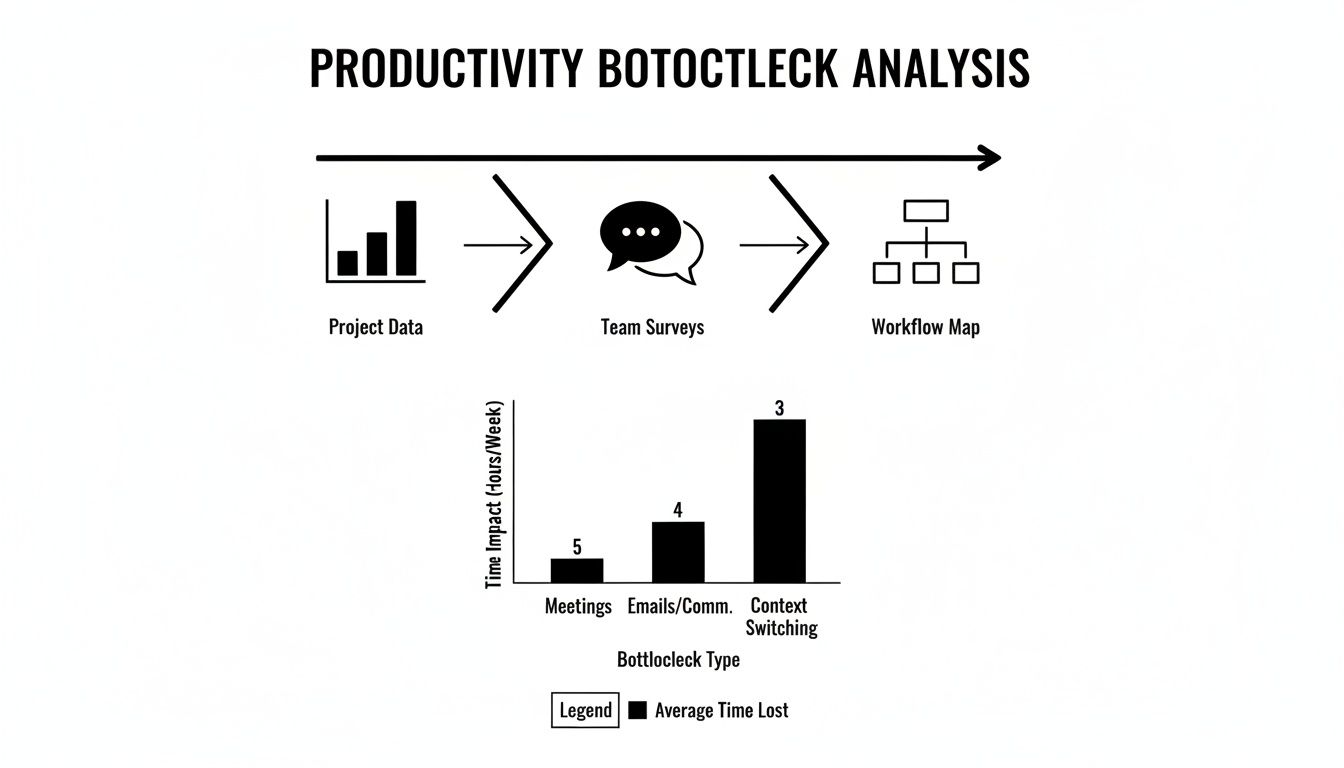
As you can see, combining the hard data with direct feedback from your team is the most effective way to pinpoint exactly which repetitive tasks are ripe for automation.
Practical Scenarios for AI and Automation
Let’s get out of the clouds and into the real world. Here’s how you can start using these tools in your daily operations to see an immediate difference:
- Automated Meeting Summaries: Instead of making someone the designated notetaker, use an AI tool that joins your calls, records the conversation, and spits out a concise summary with key takeaways and action items. Everyone stays aligned without the manual slog.
- Intelligent Report Generation: A sales team might burn hours every week pulling data from the CRM to build performance reports. An automation tool can be set up to do this on its own, delivering a perfectly formatted report to stakeholders every Monday morning.
- Streamlined Client Onboarding: When a new client signs on, a predictable sequence of tasks always follows. An automated workflow can create their project folder, send a welcome packet, assign initial tasks to the team, and schedule a kickoff call—all triggered by a single click.
The most productive organizations don't just bolt on new tools; they fundamentally redesign their processes around them. Technology should amplify human talent, clearing the path for innovation rather than just speeding up old, inefficient habits.
High-Impact vs. Low-Impact Productivity Strategies
Not all productivity initiatives are created equal. Some offer massive returns, while others are little more than busywork. This table helps you distinguish between the two so you can focus your efforts where they'll count the most.
| Strategy | Potential Impact | Implementation Effort | Example |
|---|---|---|---|
| Automating Repetitive Tasks | High | Medium | Using software to automatically generate weekly sales reports instead of manual data entry. |
| Optimizing Meeting Cadence | High | Low | Auditing all recurring meetings and converting status updates to async channels like Slack. |
| Centralizing Knowledge | High | Medium | Creating a single, searchable wiki for all company processes and information (e.g., Notion, Confluence). |
| Implementing New Email Rules | Low | Low | Asking the team to use specific subject line formats. A minor tweak, but not a game-changer. |
| Switching to a New Chat App | Low | High | Migrating the entire company from Slack to Teams without a clear process-improvement goal. |
| Encouraging "Inbox Zero" | Low | Medium | Pushing an inbox management technique that can create more stress than it solves. |
Focusing on high-impact, low-to-medium-effort strategies like automating reports or fixing your meeting culture is the fastest way to see tangible gains. Avoid getting distracted by low-impact changes that create a lot of noise but little real value.
Ensuring Successful Adoption of New Tools
Rolling out new tech can easily backfire if it's not handled with care. People are naturally resistant to change, so you have to manage it well. Frame automation not as a way to replace people, but as a way to liberate them from boring work.
Clearly communicate the "what's in it for me" for every person on the team. For a designer, it might mean no more manually resizing dozens of assets. For a marketer, it could be automated social media scheduling. Focus on how it makes their actual day-to-day work better.
Provide solid training, start with a small pilot group to build momentum, and celebrate the early wins. The impact is undeniable when people embrace it. According to Slack, the most productive people are 242% more likely to use AI, with 77% of employees saying automation boosts their output and saves them an average of 3.6 hours per week. That’s time they can reinvest in work that truly matters.
Fostering a Culture of Focus and Well-Being
Automating tasks and streamlining workflows is great, but that's only half the battle. The biggest, most sustainable productivity gains come from building a culture that fiercely protects focus and genuinely cares about people's well-being. A team can have the best software in the world and still underperform if they’re constantly distracted, overwhelmed, and just plain tired.
This means we need to stop thinking about productivity as a set of rules to enforce. Instead, it’s about creating an environment where deep, meaningful work can actually happen. It's about designing a workplace that respects our cognitive limits and supports the mental and physical health needed for great work.
Architecting an Environment for Deep Work
Let's be honest: the modern office is often a minefield of distractions. Ping after ping, constant shoulder taps, and the unspoken rule that you have to reply now. This constant fragmentation of our attention makes real concentration almost impossible.
To fix this, we have to intentionally create space for "deep work"—that state of distraction-free focus where we solve hard problems. If you haven't already, digging into Cal Newport's influential work on Deep Work is a fantastic starting point. This isn’t about individual habits; it's a team strategy.
Here are a few practical ways to get started:
- Establish 'Focus Blocks' on Calendars: Encourage everyone to block out 90-minute to two-hour chunks on their shared calendars for heads-down work. When it’s visible, it becomes respected.
- Implement 'No-Meeting' Days: Pick one or two days a week where recurring meetings are banned. This simple change can free up massive blocks of uninterrupted time.
- Clarify Communication Channels: Set clear ground rules. Maybe Slack is for quick, non-urgent chats, while email is for detailed updates that don’t need an instant reply. This kills the anxiety of having to monitor everything at once.
Making these structural shifts sends a clear signal: we value your concentration, and we respect your time.
Prioritizing Mindful Breaks and Mental Well-Being
A high-performance culture is not a non-stop grind. Pushing through mental exhaustion is a fast track to burnout and sloppy work. Study after study confirms that strategic breaks are crucial for staying sharp, avoiding decision fatigue, and sparking creativity.
True productivity isn't about working more hours; it's about getting more done in the hours you work. This requires a culture where rest is seen as a vital part of the work process, not a sign of weakness.
Promoting well-being is more than just telling people to take breaks. It's about creating psychological safety—an atmosphere where people can talk about their workload or stress without fear of being judged. When employees feel their well-being is a genuine priority, their engagement and loyalty skyrocket.
Even simple things like team walks, yoga, or brief meditation breaks can make a huge difference. For anyone new to this, learning the basics of how to meditate can be a great starting point.
Supporting Cognitive Function and Natural Motivation
At the end of the day, productivity comes down to our cognitive function—our ability to focus, solve problems, and stay motivated. A truly modern approach to performance has to include supporting the biological systems that drive these abilities. This means acknowledging the role of neurotransmitters like dopamine, which is tied directly to our sense of motivation, reward, and focus.
A complete strategy can tackle this from multiple angles, from encouraging better nutrition and exercise to making the work itself more rewarding. For those looking to support these natural pathways, certain high-quality, plant-based supplements can be a helpful addition.
For instance, a standardized extract like Keter Wellness Mucuna L-Dopa 20% is designed to support the body's natural systems involved in dopamine production. It's not a harsh stimulant that leaves you with jitters and a crash. Instead, it works with your body's own chemistry to support motivation and mental clarity. Weaving this into a broader wellness conversation acknowledges a simple truth: peak performance is an inside-out job, built on a supportive environment and a well-supported mind.
How To Measure and Sustain Your Productivity Gains
Putting new habits and tools into place is a great start, but it’s just that—a start. The real test of any productivity overhaul is making the changes last. Without a clear way to track your progress, even the most brilliant new workflows can fizzle out as old, comfortable habits sneak back in.
This is where you shift from a one-time project to an ongoing practice. The goal is to weave a culture of smart, sustainable work into your team’s DNA, making sure these improvements become the new normal, not just a temporary spike.
Define What Success Actually Looks Like
You can’t improve what you don’t measure. But it’s even more important to measure what actually matters. Steer clear of "vanity metrics" like hours logged or emails sent—these often just measure busyness, not effectiveness.
Instead, zero in on Key Performance Indicators (KPIs) that directly reflect the quality and efficiency of your team's output. These need to be specific to what your team does.
For instance:
- A software team could track the reduction in project cycle times or a drop in bugs reported after a launch.
- A customer support team might measure a faster average resolution time or a jump in customer satisfaction (CSAT) scores.
- A marketing team could focus on how quickly they can launch a campaign or a lower cost-per-lead.
When you choose the right KPIs, you change the conversation from, "Are we busy?" to "Are we making an impact?" This gives you an honest, data-backed look at whether your new systems are really working.
The real magic happens when you create a feedback loop where data drives decisions. When your team sees a direct line between a new process and a better outcome—like fewer support tickets—they become invested in keeping that change alive.
Build Momentum with Feedback and Recognition
Numbers are crucial, but they don't tell the full story. To make your gains stick, you need to mix quantitative data with qualitative feedback. Regular check-ins and one-on-one chats give you the context behind the metrics and help you see how these changes are landing on a human level.
During these conversations, ask direct questions:
- Is that new automation tool actually saving you time, or is it just creating different problems?
- Are the "deep work" blocks helping you concentrate, or are they still getting interrupted?
- What’s one small thing we could adjust next week to make your workflow even better?
This kind of dialogue turns productivity improvement into a team sport, not just a top-down order. It proves you value their experience and that the goal is to clear hurdles, not just enforce rules. When people see their suggestions put into action, their buy-in goes through the roof.
Establish a Cadence of Continuous Improvement
Sustained productivity isn’t a finish line you cross; it’s a continuous cycle of refinement. The most effective teams build a regular rhythm for reviewing what's working and identifying the next small, high-impact tweak they can make. This keeps everyone sharp and prevents backsliding.
A simple way to do this is with a quarterly "Productivity Retrospective." In this meeting, the team looks at the KPIs, talks honestly about what went well and what didn't, and decides what to try next. This simple, structured habit makes continuous improvement feel natural.
Ultimately, this whole process is about building an environment where efficiency and well-being aren’t competing priorities—they’re two sides of the same coin. By measuring what matters, listening to your team, and always looking for the next small win, you create a resilient, high-performing culture that doesn't just find productivity gains but keeps them for good.
Common Questions About Workplace Productivity
Improving productivity isn't a one-size-fits-all process, and it often brings up some very practical, real-world questions. While every team's situation is unique, a lot of the challenges leaders and employees run into are surprisingly similar.
Here are a few of the most common questions, with straightforward answers to help you apply the right strategies.
What Are The First Steps For A Small Team?
When you’re a small team, the best thing you can do is start with a conversation. Don't try to boil the ocean. Just get everyone together and identify the single biggest bottleneck that’s slowing everyone down.
Maybe it's a messy shared drive, a calendar packed with useless meetings, or unclear project priorities. Whatever it is, focus on fixing that one thing first. Solving a shared frustration together builds incredible momentum and gets everyone invested in making things better.
Next, do a quick and informal tool audit. The question is simple: "Are our tools actually helping us, or are they just creating more work?" You'd be surprised how often a simpler tool is far more effective than a bloated, feature-packed one nobody uses correctly.
Finally, start a brief daily huddle. This isn't another status meeting. It's a 10-minute alignment to make sure everyone is clear on the day's top priorities. These small, consistent habits create real change without overwhelming the team.
How Can I Improve My Personal Productivity in an Inefficient Company Culture?
You can't change an entire company's culture overnight, but you can create your own "bubble of efficiency." The key is to stop worrying about what you can't control and start mastering what you can.
First, take command of your schedule. Time blocking is a game-changer. By assigning a specific task to every block of time in your day—including your breaks—you shift from being reactive to proactive.
Next, get ruthless about protecting your focus. This means turning off all non-essential notifications on your computer and phone. Instead of letting email derail your day, schedule 2-3 specific times to process your inbox. This simple habit alone can free up hours of deep work time every week.
It also helps to over-communicate with your manager about your progress and any roadblocks. This isn't about covering your bases; it's about managing expectations and making your organized workflow visible. More often than not, this level of personal ownership inspires the people you work with most.
How Do You Measure Productivity Without Micromanaging?
This is a big one. The secret is to measure outcomes, not activity. Forget about tracking hours logged, emails sent, or keystrokes. Those metrics just encourage people to look busy, breeding resentment and burnout.
Instead, focus on results that actually matter to the business and the team.
- For project-based teams: Look at milestone completion rates or how much rework is needed.
- For client-facing teams: Track improvements in customer satisfaction or how quickly issues are resolved.
- For creative teams: Focus on the number of campaigns launched on time or the quality of the work based on clear standards.
The most critical step? Involve your team in deciding what these metrics should be. When people have a say in how their success is measured, they feel a sense of ownership. Frame it as a way to find and remove obstacles, not as a tool to watch their every move.
When your team sees that data is being used to make their jobs easier and more fulfilling, they stop seeing it as a threat. It becomes a resource for their own success.
Are Natural Supplements Like Mucuna L Dopa a Good Idea For Work?
For anyone looking for a more holistic way to support performance, high-quality supplements can be a great addition. They work by supporting the body’s own systems for drive and focus. A standardized product like Keter Wellness Mucuna L-Dopa 20%, for example, is specifically formulated to support the dopamine pathways that are crucial for motivation and mental clarity.
That said, safety and personal suitability come first. Always stick to reputable brands that guarantee their products' potency and purity and are free from unnecessary fillers. When you start any new supplement, begin with the recommended dose and pay close attention to how you feel.
Most importantly, it's essential to talk to a healthcare professional before adding anything new to your routine. This is especially true if you have any existing health conditions, are pregnant or nursing, or are on other medications. A professional can help you make an informed choice that aligns with your specific health needs.
At Keter Wellness, we believe that true productivity is built on a foundation of well-being. Our high-potency, standardized supplements are designed to support your body's natural systems for motivation and focus, helping you perform at your best.
Discover how our Mucuna L-Dopa can be part of your holistic approach to success. Visit Keter Wellness to learn more.
Leave a Reply