

When you feel your motivation slipping away, the path back isn't about brute force. It's about taking small, deliberate actions to find your footing and slowly build momentum again. It starts with getting clear on your goals, breaking down intimidating tasks into bite-sized pieces, and creating a space that actually helps you focus instead of draining your energy.
Why You Feel Unmotivated and How to Fix It
That feeling of being drained, stuck, and totally uninspired? It’s a common human experience. It's so easy to just label it "laziness" and beat yourself up, but the truth is usually much more complicated. Low motivation is often a symptom of deeper issues, and figuring out what's really going on in your head and body is the first real step toward getting your drive back.
Think of it this way: a lack of motivation is often a signal. It could be a sign of burnout from sprinting for far too long, or the mental paralysis that sets in when your goals are too big or too vague. It might even be a dip in brain chemicals like dopamine, which plays a huge role in your internal reward system. Simply "pushing harder" won't fix it; you need a smarter, more compassionate approach.
The Real Reasons You Lack Motivation
That feeling isn't just in your head—it’s your mind’s way of telling you something important. Maybe it's saying you're completely exhausted. Maybe it's pointing out that the path you're on doesn't align with what you truly value. Or maybe it's just letting you know you aren't getting enough positive feedback to make all the effort feel worthwhile. Ignoring these signals is like ignoring a warning light on your car's dashboard; it only makes the problem worse down the road.
This isn't just a personal struggle; it’s a massive issue, especially at work. There's a huge gap between the handful of people who feel genuinely energized by their jobs and the vast majority who are just going through the motions. This graphic really puts the scale of workplace disengagement into perspective.
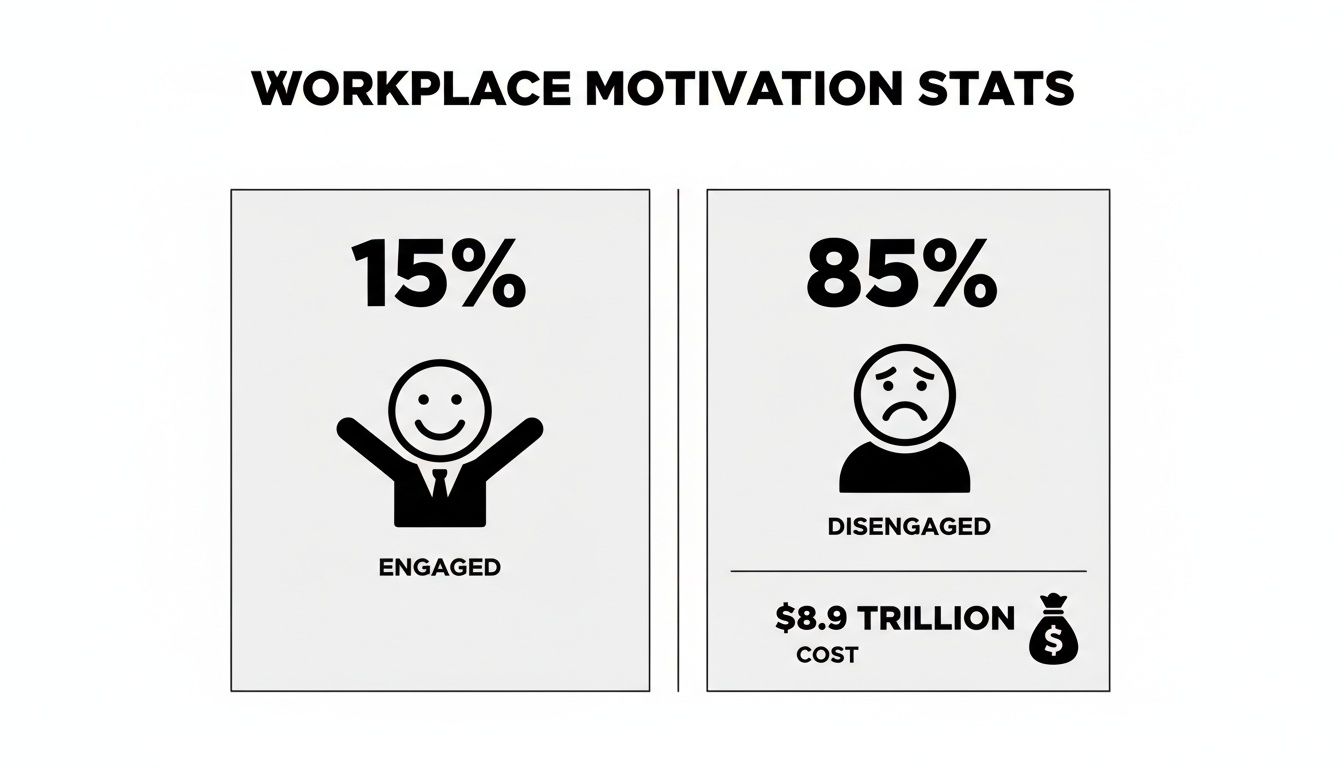
As you can see, what feels like a personal motivation problem is tied into a much bigger economic and cultural story. Widespread disengagement doesn't just hurt individual well-being; it has a real impact on global productivity.
First Steps to Rebuilding Your Drive
To truly get a handle on how to overcome a lack of motivation, it helps to see it as the global challenge it is. According to Gallup's State of the Global Workplace 2024 Report, an unbelievable 85% of employees worldwide are either not engaged or are actively disengaged at work. That collective slump costs the global economy an estimated $8.9 trillion every year.
On the flip side, companies that figure out how to boost engagement see 21% greater profitability. That's proof that motivation isn't just a "nice-to-have"—it directly fuels success. You can find more details in these employee motivation statistics.
The key is to shift from forcing yourself to do things to creating an environment where motivation can arise naturally. It starts with small, intentional actions that build momentum over time.
So, instead of just sitting around and waiting for a magical burst of inspiration, you can start taking action right now. Here are a few immediate strategies to get the ball rolling and begin reigniting that fire.
The table below summarizes some high-impact strategies you can implement immediately to start rebuilding your drive. These aren't long-term projects; they're quick wins designed to create momentum.
Immediate Actions to Reclaim Your Motivation
| Strategy | Why It Works | Example Action |
|---|---|---|
| Clarify Your 'Why' | Reconnects you to the purpose behind the work, which is a powerful internal driver. | Before starting, write one sentence about who this task helps or what positive outcome it creates. |
| Shrink the Task | Overcomes the paralysis of feeling overwhelmed by focusing on just starting, not finishing. | Set a timer for 15 minutes and work on one tiny piece of the project. That's it. |
| Change Your Environment | A new physical setting can disrupt mental ruts and provide a fresh perspective. | Take your laptop to a coffee shop, work from a different room, or simply go for a quick walk outside. |
Taking these small steps helps you move beyond the "just try harder" mindset. You're not just fighting against low motivation; you're building a smarter, more sustainable system for staying driven.
Build a Foundation of Sustainable Motivation

Real, lasting drive isn't something you just find. It’s something you build, piece by piece, day after day. If you're always waiting for random bursts of inspiration to strike, you're going to spend a lot of time waiting. It’s a frustrating and unreliable way to operate.
A much smarter approach to overcoming a lack of motivation is to create a lifestyle that generates energy and focus on its own.
This starts with the fundamentals: sleep, nutrition, and movement. These aren't just "nice-to-have" healthy habits; they are the bedrock of your mental and emotional resilience. When these key areas are out of whack, your brain simply doesn't have the fuel it needs to feel driven or engaged.
Think of it like trying to build a house on sand. You can't expect to sustain high levels of motivation and performance if your most basic physiological needs are constantly being ignored.
Get Your Energy Systems in Order
Your body and brain run on energy, and your daily habits are the levers that control the supply. Skimping on sleep, for instance, torpedoes your cognitive function and emotional regulation, which is why even tiny tasks can feel like climbing a mountain when you're tired. A diet loaded with processed foods sends your energy levels on a rollercoaster, leaving you sluggish right when you need to be sharp.
On the flip side, getting consistent, quality sleep literally cleans your brain, clearing out metabolic waste and setting you up for a clear-headed day. Simple food swaps, like choosing protein over sugary snacks, can stabilize your blood sugar and give you a steady stream of fuel.
Motivation isn't some mystical force you either have or you don't. It's a direct output of your physical and mental energy. Protect your energy, and you protect your drive.
You don’t need a massive overhaul. Small, smart changes can make a huge difference.
- Implement a "Digital Sunset": Shut down all screens at least an hour before you plan to sleep. That blue light wreaks havoc on your melatonin production, the hormone you need for deep, restorative rest.
- Eat for Focus, Not Fatigue: Instead of a carb-heavy lunch that guarantees an afternoon slump, try a meal centered on lean protein and healthy fats. You'll get sustained energy without the crash.
- Take a Reset Walk: When your focus starts to wander, get up and take a brisk 15-minute walk. A little movement and fresh air can boost blood flow to the brain and reset your mental state far better than another cup of coffee.
Engineer a Motivating Environment
Your surroundings—both physical and social—have a massive impact on your internal drive. Think about your workspace, but also think about the people you interact with every day. A sense of connection and shared purpose is an incredibly powerful motivator.
For example, PwC's Global Workforce Hopes and Fears Survey 2025 uncovered a fascinating link: employees who have a high level of trust in their managers are 72% more motivated. What's more, seeing how your personal tasks connect to bigger company goals can boost motivation by a whopping 78%. That data, which you can read about in the full PWC Hopes and Fears report, proves just how much a clear sense of direction and supportive relationships really matter.
When you build this foundation, you stop fighting an uphill battle against exhaustion and brain fog. Instead, you're creating the conditions for motivation to show up naturally, making your goals feel less like a chore and more like a challenge you’re ready to take on.
Set Goals That Actually Inspire Action

Let's be honest—sometimes the reason you can’t get moving has nothing to do with being lazy. The problem might actually be your goals. If an objective is too vague, too massive, or totally disconnected from what you genuinely care about, it’s going to feel like a chore, not a challenge.
The real trick is to design goals that pull you forward, rather than ones you have to constantly push yourself toward. This goes beyond the classic "SMART" acronym; it’s about crafting goals that spark a little bit of excitement instead of a wave of dread.
When you get this right, progress feels both rewarding and inevitable, creating a powerful feedback loop that fuels itself.
From Overwhelm to Action
Staring down a monster goal like "write a book" is a surefire way to kill your motivation. It's just too big. Your brain sees the enormous gap between here and there, gets overwhelmed, and promptly hits the brakes. The solution? Break it down into almost ridiculously small pieces.
This isn't just a neat trick; it's a strategy rooted in a powerful therapeutic technique called behavioral activation. The entire focus is just on starting an action, no matter how small. So, "write a book" becomes "open the document and write one single sentence." That's it. Anyone can do that, and once you’ve started, momentum often carries you further than you'd expect.
The most powerful way to generate motivation is to experience progress. Small wins aren't just feel-good moments; they are neurological signals that tell your brain, "This is working. Keep going."
Each tiny win delivers a little hit of dopamine, the brain's reward chemical, which reinforces the behavior. You’re essentially training your mind to associate taking action with feeling good, making it that much easier to show up again tomorrow.
Design Your Micro-Goals
Think of micro-goals as the individual Lego bricks you use to build your masterpiece. They need to be specific, actionable, and so tiny that it feels almost silly not to do them.
Here’s how this looks in the real world:
- For a massive work project: Instead of staring at "complete the quarterly report," your micro-goal is "gather the sales data from the spreadsheet" or "draft the bullet points for the introduction."
- For learning a new skill: Forget "become fluent in Spanish." Just focus on "spend 10 minutes on a flashcard app learning five new words."
- For getting back in shape: "Go to the gym for an hour" is intimidating. A much better starting point is "put on your workout clothes and do five push-ups at home."
By focusing only on the very next step, you sidestep your brain’s natural instinct to procrastinate when faced with a huge task. You're not trying to climb the whole mountain today; you're just taking that first, easy step. This simple shift is often all you need to get unstuck and start building momentum.
Master Your Mindset to Reclaim Focus

Often, the biggest obstacle to getting things done isn’t the task itself. It's the story we tell ourselves about it. That running commentary in your head—your internal dialogue—has a huge influence on your energy and drive. Learning to manage it is the first real step toward getting your focus back.
This isn't about slapping a layer of fake positivity on top of real problems. It's about recognizing that our thoughts aren't always true. When you catch your brain saying, "I'll never finish this," or "I'm just too exhausted," you have the power to question that narrative instead of just accepting it.
The first move is simply to pay attention. When you feel that familiar pull of procrastination, just pause for a second and listen. What are you actually telling yourself? More often than not, that inner critic is loud, dramatic, and not very helpful.
Break Through Procrastination Now
One of the best ways I've found to shut down that inner critic is to make the first step ridiculously small. It's a simple but incredibly effective mental hack called the 5-Minute Rule.
The idea is simple: commit to working on something for just five minutes. That’s it. Give yourself full permission to walk away after those 300 seconds are up. Anyone can do almost anything—clean the kitchen, tackle that dreaded email, start a report—for just five minutes.
What's amazing is what usually happens next. You've cleared the biggest hurdle: starting. Once you’re in motion, you build a little momentum, and that makes it a whole lot easier to keep going.
The goal isn't to trick yourself into a marathon work session. It's to prove to yourself that the mental wall you built up was the biggest obstacle. Taking that one tiny action shatters the cycle of avoidance.
This trick works because it dramatically lowers the stakes. It shifts your focus from the massive, intimidating final goal to a single, bite-sized action you can do right now.
Practice Self-Compassion After Setbacks
Look, even with the best intentions, you’re going to have off days. You’ll miss a workout. You’ll blow a deadline. The most important moment is what you do next. For most of us, the instinct is to beat ourselves up, which just makes us feel worse and drains even more energy.
Instead, try practicing a little self-compassion. It's about treating yourself with the same kindness you'd give to a friend who was having a tough time. Acknowledge that it was hard, but do it without the harsh judgment.
A simple mental script can help reframe these moments:
- Acknowledge how you feel: "I'm really frustrated that I didn't get that done."
- Remember you're human: "It's okay. Everyone feels unmotivated sometimes; it's a normal part of life."
- Offer yourself some kindness: "I'm going to take a quick break, and then I'll figure out one small thing I can do to get back on track."
This small shift in thinking stops one bad day from spiraling into a bad week. By choosing compassion over criticism, you hang onto your mental energy, making it much, much easier to bounce back.
The Role of Natural Support in Sustaining Drive
Let's be clear: the bedrock of motivation is built on strong habits and a resilient mindset. But sometimes, you can do all the right things—set goals, manage your time, get enough sleep—and still feel like you're running on empty. That’s when it can be helpful to look at the whole picture, which includes your body's own biochemistry.
For some people, natural supplements can provide that extra bit of support, helping to create a biological foundation where drive and focus can actually take root. Think of it as working with your body, not trying to force it.
The link between our internal chemistry and our get-up-and-go is undeniable. The modern world seems designed to drain our mental batteries, a fact that shows up in some pretty stark numbers. Globally, only 23% of the workforce reports feeling highly engaged. That massive motivation gap isn't just a personal problem; it costs the global economy an estimated $8.9 trillion every year. A huge piece of this puzzle is a sense of purpose—in fact, 42% of Gen Z says it's a top motivator. Supporting your internal reward systems can make it that much easier to connect with your "why." You can dig deeper into these trends in the Gallup’s State of the Global Workplace 2025 Report insights.
Supporting Your Brain’s Reward System
When we talk about motivation from a biological standpoint, we have to talk about dopamine. It's the neurotransmitter that’s directly tied to feelings of reward, pleasure, and the drive to go after things. When your dopamine levels are where they should be, you're more likely to start tasks and get that satisfying hit of accomplishment afterward.
Interestingly, certain plants have a long history of being used to support the body’s natural production of these vital brain chemicals.
A prime example is Mucuna pruriens, a plant that just so happens to be a natural source of L-Dopa—the direct precursor your brain uses to make dopamine. Now, if you're considering a Mucuna supplement, the two most important words are potency and purity. It’s not just about having the ingredient; it's about how it's prepared and what you're actually getting in each dose.
The real power of an herbal supplement often lies in its standardization. This process guarantees a consistent, reliable amount of the active compound in every single dose, which takes all the guesswork out of it for you.
For example, a product like Keter Wellness's Mucuna L-Dopa 20% is standardized to contain a minimum of 20% L-Dopa. That means each 700 mg capsule is formulated to deliver a precise, potent dose aimed squarely at supporting your dopamine pathways. Opting for a high-purity product free of junk fillers ensures you’re getting targeted help for your mood and drive.
How to Use Natural Supplements Responsibly
Look, supplements aren't a magic fix for a lack of motivation. They are a tool, and like any tool, they need to be used thoughtfully and with a bit of professional oversight.
If you decide to explore this route, here’s how to do it right:
- Start low and go slow. Begin with the recommended serving (like one capsule a day) and just pay attention to how your body feels.
- Consistency is key. Try to take it at the same time each day, usually with a meal, to build it into your routine.
- Talk to a pro. ALWAYS. Before you start any new supplement, have a conversation with your healthcare provider. This is non-negotiable, especially if you're pregnant, nursing, on prescription medications, or have an existing health condition.
By pairing this kind of natural support with the mindset shifts and lifestyle changes we’ve already covered, you’re building a much more robust system for reclaiming your motivation from the inside out.
Frequently Asked Questions About Motivation
Trying to understand the ups and downs of motivation can feel like a puzzle. Let's tackle some of the most common questions that come up when you're working to get your drive back.
How Can I Get Motivated After a Major Setback?
Getting knocked down by a setback is tough. The urge to just stay down is real, and the thought of starting over can feel completely overwhelming. The very first thing to do is give yourself a little grace. Acknowledge the frustration and disappointment, but don't let it become a story about failure.
From there, shift your focus to rebuilding momentum with tiny, almost ridiculously small wins. Don't even think about getting back to where you were before. Just ask yourself: What’s the absolute smallest step I can take right now? Completing that one small thing can be the spark you need to regain your footing.
Remember that self-compassion isn't an excuse; it's a strategy. Treating yourself with kindness after a failure preserves your mental energy, making it easier to regroup and try again.
What Is the Difference Between Burnout and Laziness?
This is a really important one to get right. It’s easy to beat yourself up for being "lazy" when something much deeper is going on. Laziness is usually a temporary reluctance to do something. It's often a choice—maybe you’re procrastinating on a task you find boring, but you could still muster the energy if you had to.
Burnout, however, is a whole different beast. It’s a state of deep emotional, physical, and mental exhaustion that builds up from long-term, unmanaged stress. You don't choose burnout; it happens to you. Laziness feels like you don't want to do it. Burnout feels like you physically and mentally can't.
Can My Physical Health Really Affect My Motivation?
Yes, absolutely. Thinking of your mind and body as separate is one of the biggest mistakes you can make when trying to rebuild motivation. They are completely intertwined. When your body is running on empty, your brain simply doesn't have the resources to fire on all cylinders.
Think about it this way:
- Poor sleep: A sleep-deprived brain is a foggy, indecisive brain. It struggles to focus and regulate emotions, making everything feel ten times harder.
- Unhealthy diet: Foods that cause blood sugar spikes and crashes will do the same to your energy and mood. You can't feel driven when you're in a constant state of brain fog.
- Lack of movement: Exercise isn’t just for your body. It releases endorphins and neurotransmitters that directly boost your mood and sharpen your focus.
Making your physical health a priority isn’t a detour from your goals—it's the very foundation you need to build sustainable motivation. You're giving your mind the fuel it needs to feel engaged and ready to go.
At Keter Wellness, we believe in supporting your drive from the inside out. Our high-purity, standardized herbal supplements are designed to complement your lifestyle and help you reclaim your focus and vitality. Discover natural support for your motivation journey at keterwellness.com.
Leave a Reply