
That dip in motivation at work? We’ve all been there. It’s a completely universal feeling, but the good news is that it’s not a permanent state of being.
To really sustain your drive, it comes down to a few key things: connecting your daily grind to a bigger picture, setting up your environment to help you win, and mastering your own mindset. Think of this guide as a practical playbook—a way to build a drive that actually lasts.
How to Get Your Drive Back at Work
Losing that professional spark can feel pretty demoralizing. Suddenly, you're just counting down the hours until Friday. A lot of people think motivation is this magical thing that just shows up—or doesn't. But I've learned it’s much more of a skill than a fleeting emotion. You can build it, nurture it, and keep it going with the right game plan.
The real problem usually isn't a lack of ambition. It’s the gap between what you do every day and why you're doing it. When your tasks just feel like a long checklist instead of steps toward a meaningful goal, your energy is bound to fade. This guide is all about bridging that gap.
The Pillars of Sustainable Motivation
We're going to break this down into a framework built on three essential pillars. This infographic gives you a quick snapshot of the key areas we'll be digging into.
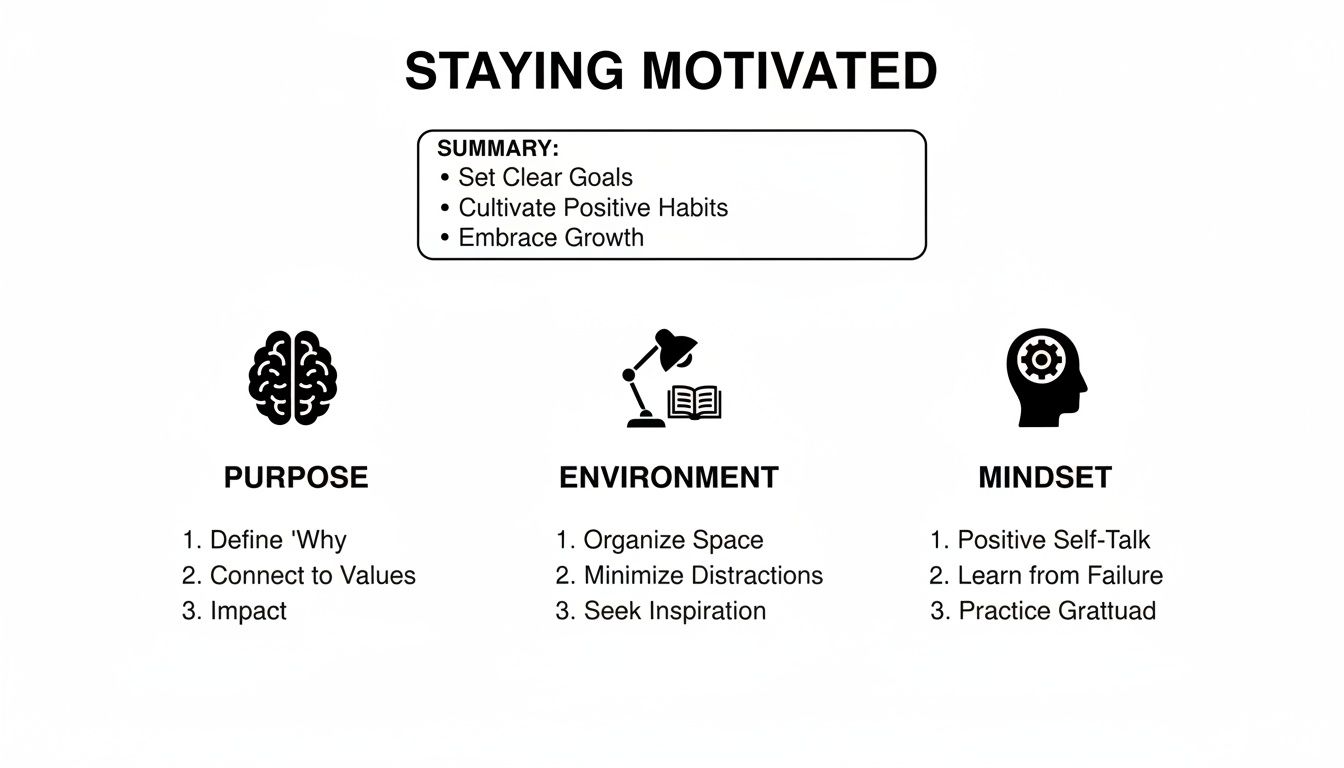
This visual shows how your inner purpose, your physical space, and your mental game all have to work together. When you get these three areas dialed in, you create a powerful system that keeps you going, even on the tough days. You'll learn how to turn your workspace into a productivity machine and your mindset into your biggest ally.
The secret to lasting motivation isn't some magic bullet; it's about building a reliable system. When your environment, mindset, and purpose are all aligned, you stop having to rely on sheer willpower just to get things done.
Ultimately, figuring out how to stay motivated at work is about taking back control. While outside factors definitely play a part, the systems you build for yourself have the biggest impact.
To help you get started, here's a quick summary of the core strategies we'll cover in this guide. You can use it to find the approach that feels right for you right now.
Quick Guide to Workplace Motivation
| Strategy Area | Key Action | Primary Benefit |
|---|---|---|
| Purpose & Goals | Set clear, meaningful short-term and long-term goals. | Connects daily work to a bigger, motivating picture. |
| Daily Routines | Create a structured start-of-day and end-of-day ritual. | Builds momentum and reduces decision fatigue. |
| Time Management | Use techniques like the Pomodoro to focus in sprints. | Prevents burnout and improves deep work capacity. |
| Environment Design | Optimize your physical and digital workspace for focus. | Reduces distractions and makes work feel easier. |
| Mindset & Cognition | Reframe negative thoughts and practice self-compassion. | Builds mental resilience and emotional control. |
| Accountability Systems | Share goals with a colleague or use tracking apps. | Creates external commitment and social support. |
| Recovery & Breaks | Schedule intentional downtime away from your screen. | Restores energy and prevents cognitive overload. |
| Progress Tracking | Keep a "done list" or use visual progress charts. | Makes achievements visible, boosting satisfaction. |
By focusing on these areas, you can build a comprehensive system that makes motivation a natural part of your workday instead of something you have to constantly chase.
Of course, if you're dealing with persistent low energy that feels more physical than mental, it might be worth exploring some natural remedies for low energy as a way to complement these strategies. Throughout this guide, we’ll give you the tools you need to build that resilience and drive from the inside out.
Connect Your Work to What You Value Most

Often, motivation doesn't just evaporate because the work is hard. It fades because we lose the plot. When your day dissolves into a string of tasks, it's easy to feel like you're just spinning your wheels, going nowhere fast.
The secret to reigniting that fire is finding the "why" behind the "what."
Real, lasting motivation isn't about hype or hustle. It comes from drawing a straight line between what you do every day and something bigger that matters to you. This isn't about needing to save the world before lunch, but it is about seeing how your contributions add up. It’s a shift in perspective—from a to-do list to an impact list.
Uncover Your Personal Drivers
Before you can link your work to a bigger picture, you have to know what that picture looks like for you. Your core values are the principles that guide your life, the things you find truly meaningful. When your job lines up with those values, it stops feeling like work and starts feeling like a purpose.
So, ask yourself a simple but profound question: What truly matters to me?
Is it creativity? Stability? Helping other people? Continuous learning? Take a minute and jot down your top three to five. No overthinking.
Once you have your list, it's time to build a bridge. Here's a quick reframing exercise I use all the time:
- If you value: Helping Others
- The task becomes: Answering a customer email isn't just clearing an inbox. It's solving a real problem for a real person, making their day a little better.
- If you value: Learning & Growth
- The task becomes: That difficult new project isn't a burden. It’s a chance to master new software or sharpen your project management skills.
This simple mental flip helps you find the purpose hiding in plain sight. It’s one of the most powerful ways to stay motivated at work, simply by making your daily actions count for something more.
Align with the Broader Mission
Beyond your personal "why," feeling connected to your company's mission is a massive motivational lever. When you actually understand and believe in what the organization is trying to achieve, your job stops being an isolated role and becomes part of a team effort. You finally see how your piece of the puzzle fits.
This isn't just a feel-good idea; it's a well-documented driver of engagement. A study from PwC’s Global Workforce Hopes and Fears Survey found that workers who feel a strong connection with their company’s leadership are 78% more motivated than those who feel disconnected.
Interestingly, while only 64% of workers overall feel they clearly understand their company's goals, that number climbs to 73% in the tech sector. This might help explain why that industry often reports higher levels of optimism. You can dig into more of the workforce hopes and fears research yourself.
When you can clearly explain how your weekly tasks help hit a company objective, your motivation gets a powerful external anchor. It’s no longer just about your performance; it’s about collective success.
If the company mission feels vague or distant, don't wait for someone to explain it. Be proactive. In your next one-on-one, ask your manager how your team's projects directly support the bigger business goals. Getting that clarity can completely change how you feel about your work.
Build an Environment That Fuels Focus

Think of your workspace as an active partner in your day. It’s more than just a place to put your laptop—it’s a powerful force that can either drain your willpower with constant distractions or actively support your drive to get things done.
The trick is to make the right thing the easy thing.
This starts by engineering your space to add friction to bad habits and remove it from good ones. If your phone is your biggest time-waster, get it out of arm’s reach—maybe even charge it in another room. Want to drink more water? Don’t hide the bottle in your bag; put a huge one right on your desk where you can’t miss it.
These simple environmental tweaks are about designing your space to cue the behaviors you want. You stop relying on sheer discipline and let your environment do some of the heavy lifting for you.
Design Your Digital Workspace
In our world, digital clutter is just as draining as a messy desk. A desktop choked with random files or a browser with 30 tabs open creates a sense of overwhelm before you’ve even typed a single word. Taking control of this digital chaos is a game-changer for staying motivated.
A clean, organized digital space makes it easier to find what you need and, just as importantly, harder to get sidetracked. This isn't about achieving digital perfection. It’s about building a simple system that reduces mental strain and keeps you aimed at your most important work.
And if you're looking for more ways to sharpen your concentration, our guide on how to stay focused at work is packed with complementary strategies.
Here are a few practical ways to tidy up your digital life:
- Embrace the One-Tab Rule: When you’re working on a specific task, try to keep only that single, relevant tab open. If you stumble upon an interesting article, toss it into a "read later" app instead of letting it derail you.
- Organize Your Desktop: Create a ridiculously simple folder system like "Current Projects," "Archive," and "To Sort." Then, take five minutes at the end of each day to drag and drop files where they belong.
- Kill the Notifications: This might be the single most powerful change you can make. Turn off every non-essential notification on your computer and phone. Those constant pings are absolute motivation killers.
Conduct a Motivation Audit
Pause for a moment and look around your physical and digital workspaces. Ask yourself: is this space designed for the focused, productive person I want to be? A quick "motivation audit" can shine a light on the hidden obstacles quietly draining your energy all day long.
Your environment is a silent partner in your work. Make sure it's a supportive one. Every object on your desk should either be useful or bring you joy—everything else is a potential distraction.
Use this checklist to spot areas for a quick upgrade:
- Physical Space: Is my chair actually comfortable? Is my desk clear of anything unrelated to my current task? Is the lighting good enough to prevent eye strain?
- Digital Space: Is my desktop clean? Are my browser bookmarks organized for efficiency, not distraction? Have I blocked time-wasting apps or sites during my core work hours?
- Team Culture: Do we use clear communication channels, or is it chaos? Is it easy to signal when I need uninterrupted deep focus time? Do we actually take a moment to celebrate small wins as a team?
By intentionally shaping your surroundings, you create an ecosystem that doesn't just allow for productivity—it actively encourages it.
Use Growth and Recognition to Fuel Your Drive
Stagnation is motivation's worst enemy. Nothing drains your professional drive faster than feeling like you're stuck on a hamster wheel, doing the same things day in and day out without learning anything new. It's a recipe for burnout.
To break that cycle, you need to tap into two of the most powerful drivers we have: continuous growth and genuine recognition.
These two work hand-in-hand. When you learn new skills, you become more capable and more valuable, which naturally leads to better results. And when those results get noticed, it validates all your hard work and makes you hungry to learn even more. That positive feedback loop is the secret to staying motivated for the long haul.
Take Ownership of Your Professional Growth
Sitting around waiting for your manager to assign you a training course is a surefire way to stay stuck. Real, lasting motivation comes from grabbing the reins of your own development. It’s about actively hunting for opportunities that not only help the company but also get you one step closer to your own career goals.
Think of it this way: what’s one skill that, if you learned it today, would make your job more interesting or open up a new career path a year from now? That’s not a chore; that’s an investment in your future self.
Here are a few practical ways to get the ball rolling:
- Find a High-Impact Skill: Look at your current workflow. Is there a clunky process that could be smoothed out with better Excel skills or a new project management tool? Mastering something that directly reduces friction in your day is a huge win.
- Volunteer for a "Stretch" Project: See a project that’s a bit outside your comfort zone but sounds fascinating? Put your hand up. It shows initiative and throws you into a real-world learning environment where you’re forced to adapt and grow.
- Embrace Micro-Learning: You don’t need a six-month certification. Just dedicate 15-20 minutes a day to something small. Watch a quick tutorial on YouTube, read an article from an industry leader, or listen to a relevant podcast on your commute.
The link between building new skills and staying engaged at work is undeniable. In a recent study on employee engagement by DHR Global, a massive 80% of employees said that having skill-building opportunities significantly boosted their engagement. Even more telling, 93% said their motivation would jump if their employers offered more relevant development programs.
This chart from their report really drives the point home.
As you can see, opportunities for growth and getting recognized for good work are right up there with compensation and work-life balance. They aren't just "nice-to-haves"—they're fundamental needs.
Make Recognition a Two-Way Street
Recognition is the fuel that tells you your hard work actually matters. It’s a basic human need to feel seen and valued. But just like with professional growth, you can't always wait for a pat on the back to come from someone else. You have to learn to celebrate your own wins and become a champion for the people around you.
Acknowledging your own progress isn't arrogant—it's a critical part of self-motivation. It trains your brain to connect effort with a positive reward, which makes it that much easier to dive into the next big challenge.
Start small. Keep a "done list" or a "win folder." At the end of every week, take five minutes and jot down what you accomplished. Solved a tricky problem for a client? Finally cleaned up that messy shared drive? Wrote a great email? Write it down. This simple habit makes your progress tangible and gives you a concrete list of achievements to look back on when your motivation is running low.
Just as important, make it a point to give recognition to your teammates. When you publicly thank a colleague for their help or praise them for a job well done, you’re not just making their day—you’re helping build a culture where everyone feels valued. That kind of positive, supportive environment lifts everybody up, including you.
Master the Mental Game of Staying Motivated

While your goals and your workspace are a big part of the equation, the most reliable source of drive comes from within. Long-term motivation is an inside job—a mental game you can learn to win. It all comes down to building psychological habits that keep you going long after the initial buzz wears off.
This isn’t about plastering on a fake smile or ignoring real challenges. It’s about building the mental resilience to see bumps in the road as temporary and manageable. Cultivating the right mindset is what separates those who give up at the first hurdle from those who find a way to push through.
One of the most powerful shifts you can make is reframing your internal dialogue. The way you talk to yourself during a tough project or after a mistake pretty much determines your next move.
Practice Self-Compassion, Not Self-Criticism
What’s your immediate reaction when you miss a deadline or a project doesn’t land quite right? For a lot of us, it’s a harsh inner critic that starts listing off every single failure. That approach doesn’t inspire better work—it just drains your emotional battery and makes you terrified to try again.
Practicing self-compassion simply means treating yourself with the same kindness you'd give a coworker. Acknowledge the setback, recognize the effort you put in, and then focus on what you can learn from it. This isn't a get-out-of-jail-free card for poor work; it’s a strategy for sustainable growth.
Self-compassion is the engine of resilience. It allows you to bounce back from failure without the heavy burden of self-judgment, freeing up mental space to focus on solutions instead of shame.
When you adopt this mindset, setbacks become data points, not personal failings. Your motivation stays intact because you’re not burning it all on unnecessary negativity.
Turn Obstacles into Opportunities
Your perspective shapes your reality. A difficult project can be seen as either an overwhelming burden or a chance to sharpen a new skill. This mental reframing is the very foundation of a growth mindset—the belief that your abilities aren't fixed but can be developed through dedication and hard work.
Next time you hit a roadblock, try asking yourself a different set of questions:
- Instead of "Why is this so hard?" ask, "What is this situation teaching me?"
- Instead of "I can't do this," ask, "What's the very next step I can take?"
- Instead of "This is a failure," ask, "What did I learn that will help me next time?"
This simple switch moves you from being a passive victim of your circumstances to an active, engaged problem-solver.
Celebrate the Smallest Wins
Your brain is wired to respond to rewards. If you only celebrate the massive, long-term goals, you're missing out on countless chances to build positive momentum along the way. Celebrating small wins creates a steady stream of dopamine, reinforcing your efforts and making the work itself feel more rewarding.
Acknowledge your progress every day. Did you finally get your inbox to zero? That’s a win. Did you solve a minor but ridiculously annoying bug? That’s a win, too. These small acknowledgments build a powerful feedback loop that keeps you going.
And don't forget how powerful recognition from others can be. In fact, research shows that 78% of employees feel more driven when managers acknowledge their contributions. You can dive deeper into the stats on recognition and employee motivation to highlight this connection.
If you find your mind is often racing or stuck in negative thought loops, mindfulness practices can be a huge help in regaining control. To get started, you can explore our resources about meditation. Building this mental toolkit is your ultimate strategy for staying motivated at work for the long haul.
Common Questions About Workplace Dips in Motivation
Even the best strategies can’t make you immune to the occasional motivational slump. Some days you feel unstoppable, and other days, just opening your inbox feels like a monumental task. It’s completely normal.
Let's dig into a few of the most common scenarios that throw even the most driven people off their game. Think of this as your practical playbook for getting back on track when your drive takes a nosedive.
What Can I Do When My Motivation Suddenly Disappears?
When your motivation vanishes out of thin air, the worst thing you can do is try to force your way through it. That feeling is a signal from your brain to pause, not a personal failure.
The best first move? Step away from your desk. Seriously. Just five minutes of looking out a window, walking around the room, or stretching can be enough to hit the reset button.
Next, find the smallest, easiest thing on your to-do list. I’m talking about a true “two-minute win.” This could be as simple as answering one email, labeling a file, or tidying your desk. Completing it delivers a tiny dopamine hit that can be just enough to restart your engine.
If the slump feels deeper, take sixty seconds to reconnect with your “why.” Why did you start this project in the first place? Who does it help? Briefly looking at your bigger goals reminds your brain that the effort is worthwhile, and that’s often enough to reignite your focus.
A sudden loss of motivation isn't a problem to be bulldozed. It's usually your brain asking for a quick break or a reminder of your purpose. Answering that call is far more effective than trying to win a battle of willpower.
This approach is about working with your brain's natural reward system, not against it.
How Do I Stay Motivated in a Job I Do Not Love?
Let’s be honest: when you’re not passionate about your job, motivation has to come from somewhere else. You can’t fake enthusiasm, so don’t even try. Instead, shift your focus from the job itself to what you can gain from the experience.
It’s about playing the long game.
- Become a Skill Collector: Identify skills you can build right where you are that will serve your future career. Volunteer to lead a small project to get management experience. Take an online course paid for by your company. Every task becomes an opportunity for growth.
- Create Mini-Games: Turn mundane tasks into personal challenges. Can you finish that weekly report 10% faster this time? Can you find a clever new way to streamline a process nobody else has bothered to fix? This makes the day-to-day more engaging.
Most importantly, build a rich and fulfilling life outside the office. When your hobbies, relationships, and personal goals are thriving, your job becomes just one part of your life—not your entire identity. This resilience is what will carry you through while you plan your next big move.
How Can I Keep Myself Motivated When Working From Home?
When you work from home, you’re not just an employee; you’re the CEO, the office manager, and the motivational speaker all rolled into one. Without the built-in structure of an office, you have to create it yourself. Structure is your best friend.
Start with clear boundaries—both physical and mental. A dedicated workspace, even if it's just a corner of a room, tells your brain, "this is where work happens." Set firm start and end times to protect your personal life and prevent burnout.
Isolation is the silent killer of remote motivation. Be intentional about connecting with your team. Schedule a few virtual coffee chats or quick, informal check-ins throughout the week. You’d be surprised how much a five-minute non-work conversation can boost your spirits.
Finally, accountability is non-negotiable. Share your top three priorities for the day with a teammate on Slack. Use a shared project management tool like Asana or Trello where your progress is visible. Just knowing someone else is aware of your commitments can be an incredibly powerful push.
At Keter Wellness, we understand that supporting your mental drive sometimes involves more than just mindset shifts. Our high-potency Mucuna L‑Dopa is formulated to help support the dopamine levels essential for mood and motivation. Learn more at /.
Leave a Reply