
When you’re weighing Mucuna pruriens vs. L-tyrosine for Dopamine Support, the real difference comes down to how they support dopamine. Think of it this way: Mucuna pruriens provides a direct path by supplying L-Dopa, dopamine’s immediate precursor, for a more noticeable impact on mood and motivation. L-tyrosine offers foundational support, acting as a raw building block for multiple neurotransmitters to boost your cognitive resilience, especially under stress.
Understanding Direct vs Foundational Support
Choosing between these two popular nootropics means understanding how they plug into your brain’s dopamine production line. One is like a high-speed delivery service, while the other simply stocks the warehouse with raw materials. That distinction is everything when it comes to matching a supplement to your specific goals.
Many people are looking for an edge in cognitive function, and you’ll often find both Mucuna and L-tyrosine listed among nootropic supplements for enhanced cognitive performance. But their best-use cases are quite different because of their unique biochemical roles.
The Direct Pathway of Mucuna Pruriens
Mucuna pruriens contains L-Dopa, which gets a VIP pass into the brain and bypasses the slow, rate-limiting conversion step that L-tyrosine has to go through. This makes it a more direct and potent way to quickly elevate dopamine levels. It’s the better choice for situations where you need a tangible boost in drive, focus, and mood.
The Foundational Role of L-Tyrosine
L-tyrosine is an amino acid that serves as the starting point not just for L-Dopa but also for other crucial catecholamines like norepinephrine and epinephrine (adrenaline). This broader role makes it perfect for shoring up your mental reserves and helping you maintain performance during stressful periods that drain these vital brain chemicals.
Key Takeaway: Think of Mucuna pruriens as a specialist for targeted dopamine elevation. L-tyrosine is more of a generalist that supports the entire catecholamine system, enhancing your overall resilience to mental fatigue. This is the fundamental difference to keep in mind.
Research even shows just how efficient Mucuna’s pathway is. A 2021 study found that the plant’s own enzymatic processes are incredibly effective at converting tyrosine to L-Dopa, with activity 6.5-fold higher than the standard metabolic pathway our bodies use.
To put their distinct functions into a clear, side-by-side view, here’s a quick-glance table.
Mucuna Pruriens vs L-Tyrosine At a Glance
This table breaks down the core differences so you can see exactly where each one shines.
| Feature | Mucuna Pruriens (Direct L-Dopa) | L-Tyrosine (Precursor Amino Acid) |
|---|---|---|
| Primary Role | Direct dopamine precursor | Foundational building block |
| Mechanism | Bypasses rate-limiting enzyme | Requires conversion by an enzyme |
| Speed of Action | Faster, more noticeable onset | Slower, more subtle build-up |
| Ideal Use Case | Enhancing motivation, mood, and drive | Improving cognitive endurance under stress |
In the end, your choice really depends on your objective. Are you looking for immediate support to get through a demanding task, or are you playing the long game and building cognitive endurance? Answering that question will point you straight to the right supplement. To dive deeper, check out our comprehensive guide on /natural-dopamine-supplements/.
Understanding the Biochemical Journey to Dopamine
To really get the difference between Mucuna pruriens vs. L-tyrosine, we have to look at how the brain actually makes dopamine. Think of it like a factory’s assembly line. Dopamine is the finished product, but the amount you get—and how fast you get it—depends entirely on the raw materials and how efficiently that line is running.
L-tyrosine and Mucuna pruriens enter this production process at completely different stations.
L-tyrosine is the foundational raw material. It’s the very first ingredient on the line. As an essential amino acid, your body gets it from the food you eat or from supplements. Once it’s available, it has to be converted into the next compound in the chain: L-Dopa.
But this conversion isn’t automatic. It requires a specific enzyme called tyrosine hydroxylase (TH). This is where things get tricky. The activity of this enzyme is the rate-limiting step for the entire dopamine production process. That means the whole assembly line can only move as fast as this single enzyme allows. Things like stress, nutrient deficiencies, or even your genetics can jam up the works and slow it down.
Mucuna Pruriens Bypasses the Bottleneck
This is where Mucuna pruriens completely changes the game. Instead of supplying the starting material like L-tyrosine, Mucuna delivers L-Dopa directly to your system. It’s like skipping the first half of the assembly line and jumping straight to the final steps.
By providing a direct source of L-Dopa, Mucuna effectively sidesteps that tyrosine hydroxylase bottleneck. Your body no longer has to wait on the slow, often inefficient conversion of L-tyrosine. This direct supply leads to a far more reliable and immediate increase in dopamine synthesis, which is why its effects on mood and motivation often feel so much more tangible.
This image shows you exactly what I mean—L-Tyrosine is the foundational start, while Mucuna offers a direct route.
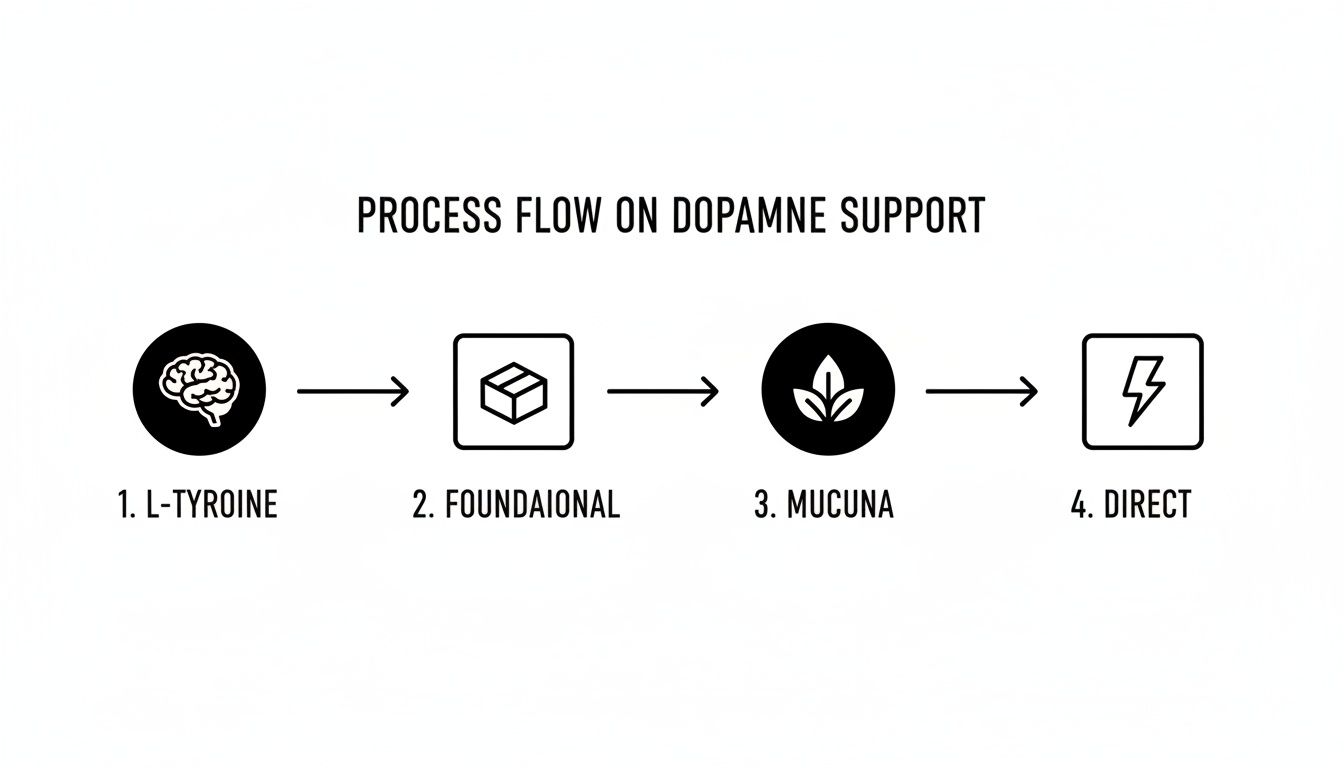
As the flowchart makes clear, Mucuna’s L-Dopa is a more direct precursor, setting the stage for a much more straightforward impact on your dopamine levels.
The Genetic Advantage of Mucuna Pruriens
Mucuna’s incredible efficiency isn’t a fluke; it’s the product of millions of years of evolution. Recent genomic research explains why the velvet bean plant is such a powerhouse of L-Dopa. A 2022 chromosome-level genome assembly found that M. pruriens contains 13 distinct polyphenol oxidase (PPO) genes that are key to L-Dopa biosynthesis.
Having speciated around 29 million years ago, the plant evolved to become nature’s premier source of this compound, which explains its 4,500-year history in Ayurvedic practices. This unique genetic blueprint is exactly what makes Mucuna so special. It’s not just another plant; it’s a highly specialized L-Dopa factory, perfected by nature over millennia.
Understanding this biochemical advantage is the key to appreciating why it provides such targeted support for the brain. For a closer look at these interactions, our guide on the science of L-Dopa dives even deeper.
Biochemical Takeaway: L-tyrosine is a conditional precursor, dependent on the efficiency of the tyrosine hydroxylase enzyme. Mucuna pruriens is a direct precursor, supplying the L-Dopa needed to bypass this common metabolic hurdle and reliably fuel dopamine production.
Choosing Your Entry Point
So, which one is right for you? It really comes down to which part of the dopamine pathway you’re trying to support.
Support with L-Tyrosine: This is like stocking the factory’s warehouse with raw materials. It ensures your body has the foundational amino acids it needs not just for dopamine, but for other crucial catecholamines like norepinephrine. It’s a great strategy for building long-term cognitive resilience.
Support with Mucuna Pruriens: This approach is more like calling for an express delivery of a nearly finished product right to the factory floor. It’s a targeted intervention designed to directly and efficiently boost dopamine levels when you want more immediate effects on motivation and mood.
To get a better handle on the building blocks of neurotransmitters, check out a comprehensive guide to amino acids and their roles. This bigger picture really helps clarify why starting with the right precursor is so critical for getting the results you want.
Comparing Real-World Effects and Use Cases
Knowing the science is one thing, but the real difference between Mucuna pruriens vs. L-tyrosine comes down to how they actually feel and what they do for you in the moment. People who use them consistently report very distinct experiences, so the choice isn’t about which one is “better,” but which one is right for the job at hand.
Mucuna pruriens tends to create a direct, almost tangible shift in your state of being. Its main effect is a very noticeable lift in motivation and drive. This isn’t just a quiet background hum; for many, it feels like flipping an “on” switch for getting things done.
On the other hand, L-tyrosine’s effects are usually more subtle and foundational. It’s best known for shoring up your cognitive endurance, helping you stay focused when you’re deep into mentally draining work. Think of it as a reserve tank that keeps your mental engine from sputtering out when the pressure is on.

Situational Scenarios: Mucuna Pruriens vs L-Tyrosine
To really nail down the differences, let’s walk through a few practical scenarios. These examples show how to match your supplement choice to what you need to accomplish right now.
Scenario 1: The Pre-Workout Spark
Imagine an athlete or gym-goer feeling sluggish and just not feeling a tough workout. They don’t just need physical energy; they need the mental grit to push through a demanding session.
- Optimal Choice: Mucuna pruriens. Its ability to directly ramp up dopamine can deliver that surge of motivation needed to hit the workout with intensity. The goal here is immediate drive, which is exactly where Mucuna shines.
Scenario 2: The High-Stakes Deadline
Think of a professional staring down a week of long hours to meet a critical project deadline. The work demands sustained concentration and the ability to fight off the mental fog that comes with stress and not enough sleep.
- Optimal Choice: L-tyrosine. By providing the building blocks for dopamine and norepinephrine, L-tyrosine helps keep your brain running smoothly under pressure. It supports mental stamina, helping to prevent burnout and keep focus sharp over the long haul.
Key Differentiator: Mucuna pruriens is for igniting motivation for a specific task. L-tyrosine is for sustaining mental performance through a demanding challenge. This is probably the most crucial distinction in the Mucuna pruriens vs. L-tyrosine debate.
Deeper Dive into User Experiences
The “felt sense” of each supplement also tells a big part of the story. Users often talk about Mucuna in terms of mood and forward momentum, while L-tyrosine is described more in terms of clarity and mental endurance.
What Mucuna Pruriens Feels Like
Many people report a brighter mood, feeling more social, and having a genuine desire to tackle productive tasks. This makes it a fantastic tool for breaking through procrastination or even finding a bit of enjoyment in chores that usually feel like a drag. For anyone wanting to dig deeper, exploring the benefits of Mucuna pruriens for motivation can offer more insight.
- Best for: Creative projects, important presentations, social events, or pulling yourself out of a spell of apathy.
What L-Tyrosine Feels Like
The experience with L-tyrosine is less about a mood boost and more about feeling “locked in.” Users often find they can work longer without getting mentally tired or easily distracted. It helps you stay calm and clear-headed, even when you’re juggling a dozen complex things at once.
- Best for: Studying for exams, competitive gaming, complex problem-solving, or navigating a high-stress work week.
To help you decide, just think about the main outcome you’re after.
| Desired Outcome | Recommended Supplement | Why It Works |
|---|---|---|
| Increased Motivation & Drive | Mucuna Pruriens | It provides a direct source of L-Dopa, giving you a faster and more noticeable dopamine boost for goal-oriented action. |
| Sustained Focus & Resilience | L-Tyrosine | It acts as a raw material for multiple neurotransmitters, building up your cognitive reserves to fight off stress and mental fatigue. |
Ultimately, choosing between these two powerful nootropics is a strategic decision. By figuring out what you need—whether it’s kickstarting your motivation or enduring a mental marathon—you can pick the supplement that truly aligns with your goals and gives you the right kind of support when you need it most.
Comparing Onset Speed, Duration, and Dosing
When you’re weighing Mucuna pruriens vs. L-tyrosine, the practical differences in timing and dosage are where the rubber meets the road. These details don’t just affect how you’ll feel; they dictate how you should fit each supplement into your daily routine for the best results. The experiences are quite distinct—one offers a rapid, noticeable effect, while the other provides a more gradual, foundational level of support.
Mucuna pruriens is known for hitting the ground running. Because it delivers L-Dopa directly to your system and bypasses the body’s slower conversion process, many people report feeling its effects within 30 to 60 minutes. This makes it an excellent choice for targeted, in-the-moment support when you need a clear boost in motivation or mood right before a specific task.
In contrast, L-tyrosine works more like a reservoir, steadily building up your brain’s supply of raw materials over time. Its effects are often far more subtle and are typically felt as sustained mental endurance rather than a distinct “kick.” You probably won’t notice a dramatic shift after a single dose, but with consistent use, you might find you’re more resilient and focused during demanding periods.

Effective Dosing Strategies for Each Supplement
Getting the dose right is critical for both safety and effectiveness. A universal rule for any new supplement is to start with the lowest effective dose and see how your body responds before gradually increasing it. This approach is especially important with compounds that directly influence your brain’s neurotransmitter levels.
Dosing Mucuna Pruriens
For a standardized extract like Keter Wellness’s Mucuna L-Dopa 20%, a common starting dose is around 500-700 mg per day. This gives you a consistent and predictable amount of L-Dopa. Because of its direct action, I highly recommend cycling Mucuna to prevent your body’s receptors from becoming less sensitive over time. A common cycle looks like this:
- Five days on, two days off each week.
- Four weeks on, one week off for a longer reset.
This simple practice helps keep the supplement effective for the long haul.
Dosing L-Tyrosine
L-tyrosine dosages are more flexible, often ranging from 500 mg to 2,000 mg taken about 30-60 minutes before a stressful event or a mentally tough task. Since it functions as a foundational amino acid, the need for strict cycling is less pronounced, though taking periodic breaks is always a good practice to check in and assess its ongoing benefits.
Key Insight: Mucuna pruriens requires more precise dosing and mandatory cycling due to its direct and potent effect on the dopamine pathway. L-tyrosine offers more flexibility and is generally used to build a resilient foundation rather than for an immediate, acute effect.
The Critical Importance of Standardization
When you’re shopping for a Mucuna pruriens supplement, standardization is non-negotiable. Unstandardized bulk powders can have wildly inconsistent levels of L-Dopa, making it impossible to dose accurately and safely. This variability can lead to unpredictable effects and a much higher risk of side effects.
This isn’t just a theoretical concern. A rigorous study that examined five commercial M. pruriens products found that the actual L-DOPA content ranged from 66.2% to 82.7% of what the manufacturers claimed on the label. This highlights some significant transparency challenges in the supplement market.
With Keter Wellness, our commitment to a 20% standardized extract ensures you receive a reliable and consistent dose every single time, letting you bypass both the market guesswork and the less direct action of tyrosine. You can explore more of the supplement market findings here.
Here’s a clear breakdown of what to expect from each supplement.
| Aspect | Mucuna Pruriens (Standardized L-Dopa) | L-Tyrosine |
|---|---|---|
| Onset of Action | Fast: Typically 30-60 minutes | Gradual: Effects build over time |
| Duration of Effects | Moderate: Usually lasts 4-6 hours | Sustained: Supports endurance throughout the day |
| Best Time to Take | Before a task needing motivation or focus | Daily, or before prolonged stressful periods |
| Dosing Approach | Start low (500-700 mg); cycling is essential | Flexible (500-2,000 mg); cycling is optional |
By understanding these practical differences, you can better tailor your supplementation strategy to match your specific goals—whether you need a quick motivational lift or long-term cognitive support.
Understanding Safety and Potential Interactions
Taking a smart approach to supplements means knowing the safety profiles inside and out. While both Mucuna pruriens and L-tyrosine are generally well-tolerated when used the right way, they work differently and come with their own unique considerations. Getting the Mucuna pruriens vs. L-tyrosine decision right means knowing how to use each one safely.
L-tyrosine is known for its high safety margin. Since it’s a basic amino acid found in many foods, most healthy people can use it without any trouble. Side effects are rare but can sometimes include headaches or fatigue, usually only at higher doses.
Mucuna pruriens, because it directly supplies L-Dopa, requires a bit more respect and a more thoughtful approach. Its safety profile is excellent when used responsibly, but its potency can’t be ignored.
Mucuna Pruriens Safety Considerations
The most common side effect with Mucuna pruriens is mild nausea, which sometimes happens with higher doses or if you take it on an empty stomach. This is usually easy to fix by starting with a smaller dose and taking it with a meal, just as we recommend at Keter Wellness.
The more serious considerations involve potential interactions with medications. Because L-Dopa gives a direct boost to dopamine, it should never be combined with Monoamine Oxidase Inhibitors (MAOIs), a class of antidepressants. This combination is dangerous and can cause a sharp spike in blood pressure and other serious heart-related events.
A Non-Negotiable Safety Rule: Always talk to your doctor before starting Mucuna pruriens if you take any prescription medications, especially for mood, blood pressure, or neurological issues. This is a critical step for your well-being.
L-Tyrosine Safety Considerations
Even though L-tyrosine is generally safer for most people, it’s not completely without precautions. If you have specific pre-existing health conditions, you’ll want to be careful.
Because L-tyrosine is a building block for thyroid hormones, anyone with an overactive thyroid or Graves’ disease should avoid it, as it could make their condition worse. It might also interact with thyroid medications.
Here’s a quick look at the key safety points for each:
| Safety Aspect | Mucuna Pruriens (Standardized L-Dopa) | L-Tyrosine |
|---|---|---|
| Common Side Effects | Mild nausea, especially at high doses. | Rare; might include headaches or fatigue. |
| Key Interactions | Avoid MAOIs and other dopaminergic drugs. | May interact with thyroid medications. |
| Primary Contraindication | Use with MAOIs; certain psychological conditions. | Overactive thyroid conditions (hyperthyroidism). |
| General Approach | Requires mindful dosing and cycling. | Generally well-tolerated for daily use. |
At the end of the day, both supplements can be used safely and effectively once you understand their unique characters. The most important takeaway is the golden rule of supplementation: consult a healthcare professional before starting anything new. This is especially true if you have existing health conditions or are on other medications. Knowing this lets you chase your wellness goals with confidence and responsibility.
How to Choose: Mucuna Pruriens vs. L-Tyrosine
So, when it comes down to it, which one should you choose? The Mucuna pruriens vs. L-tyrosine decision really hinges on a single question: what’s your immediate goal? By now, you can see they work on different timelines and are suited for very different jobs.
Think of it like choosing a tool from your toolbox. You wouldn’t grab a sledgehammer when you need a precision screwdriver. In the same way, matching the right dopamine support to your personal needs is key.
When to Choose Mucuna Pruriens
Reach for Mucuna pruriens when you’re looking for a direct, noticeable lift in drive, mood, and motivation. Because it gives your brain a straight shot of L-Dopa, the effects come on faster and feel more acute. This makes it perfect for situational use.
Consider Mucuna pruriens if you’re:
- Stuck in Procrastination: It can deliver that mental nudge to finally start a creative project, tackle a tough workout, or show up to a social event you’re dreading.
- Needing a Quick Mood Boost: That rapid dopamine increase often translates into a brighter outlook and a greater sense of well-being for a specific activity or timeframe.
- Wanting Immediate Drive: It’s an excellent tool for “on-demand” scenarios, like right before a public speaking gig or an important meeting where you need to feel confident and sharp.
For these moments, a standardized product like Keter Wellness’s Mucuna L-Dopa 20% provides a reliable and consistent effect you can count on.
Guideline: Think of Mucuna pruriens as your “on-demand” activator. It’s best used strategically for specific tasks that need a real motivational spark, not as a continuous, everyday supplement.
When to Choose L-Tyrosine
L-tyrosine is the smarter pick when your goal is to fortify your brain against the draining effects of stress. It acts more like a foundational reserve, helping you maintain mental stamina and focus over longer stretches of high demand.
Choose L-tyrosine if you’re:
- Navigating a High-Stress Period: It helps preserve your cognitive clarity and decision-making skills during intense work weeks, exam prep, or periods of sleep deprivation.
- Looking for Sustained Mental Endurance: It supports your brain’s ability to perform consistently during long, mentally draining activities without hitting a wall.
- Building Long-Term Resilience: Regular use helps ensure your brain has the raw materials it needs to produce dopamine and other critical neurotransmitters when the pressure is on.
While both supplements have incredible benefits, the comparison highlights a clear divide: Mucuna is for acute motivation, while L-tyrosine is for sustained performance. Your job is to align your choice with your specific situation to unlock the right kind of support for your brain and hit your wellness goals with precision.
Common Questions
When you’re digging into the details of Mucuna pruriens vs. L-tyrosine, a few practical questions always come up. Here are some straightforward answers to help you use these supplements safely and get the results you’re after.
Can I Take Mucuna Pruriens and L-Tyrosine Together?
I generally advise against this, especially if you’re new to nootropics. Think of it this way: Mucuna is a direct dopamine precursor, while L-tyrosine provides the foundational building blocks. Stacking them can create an unpredictable effect on your dopamine system and increases the risk of side effects.
Your best bet? Pick one based on your specific goal. If you’re still considering a combination, it’s a conversation you need to have with a qualified healthcare professional first. For most people, choosing one or the other is safer and more effective.
Why Is a Standardized Mucuna Extract So Important?
Standardization is all about reliability. It’s a guarantee that every single dose contains a precise, verified amount of the active compound, L-Dopa. Without it, you’re flying blind. Unstandardized Mucuna powders can vary wildly in potency from batch to batch, making consistent dosing impossible and giving you inconsistent results.
An extract standardized to 20% L-Dopa means you know exactly what you’re getting every time. It removes the guesswork and gives you the predictable, reliable effects you need to safely reach your goals.
Is It Necessary to Cycle Off Mucuna Pruriens?
Yes, absolutely. Cycling is a smart practice for any supplement that has a direct and powerful impact on neurotransmitters, and Mucuna is a prime example. If you use it continuously without a break, your brain’s dopamine receptors can become less sensitive—a process called downregulation. This ultimately makes the supplement less effective over time.
A couple of simple cycling strategies work well to keep it effective:
- Weekly Cycle: Take it for five days in a row, then take two days off.
- Monthly Cycle: Use it daily for three or four weeks, followed by a full week off.
These strategic breaks are key to preserving the powerful mood and motivation benefits Mucuna offers long-term.
Ready to feel the difference a high-quality, standardized L-Dopa supplement can make? Keter Wellness offers a potent Mucuna L-Dopa 20% extract designed for reliable mood and motivation support. Find out more and see if it’s the right fit for your goals at KeterWellness.com.
Leave a Reply