

At its core, L-Dopa works by giving your brain the direct raw material it needs to make more dopamine, a vital neurotransmitter. The tricky part is that dopamine itself can’t get into the brain from the outside.
So, how does L Dopa work, actually?
How L-Dopa Unlocks the Brain’s Dopamine Supply
Think of your brain as a VIP lounge, protected by a very strict bouncer—the blood-brain barrier (BBB). This barrier is a highly selective membrane that keeps harmful substances out while letting essential nutrients in.
Unfortunately, the bouncer doesn’t recognize dopamine, so it won’t let it pass. If the dopamine levels inside the lounge drop, critical functions like motivation, mood, and movement start to break down. This is exactly what happens in conditions like Parkinson’s disease, where the brain’s own dopamine-producing cells decline.
The Master Key Strategy
This is where L-Dopa becomes the ultimate master key. L-Dopa (or levodopa) is the direct precursor to dopamine, and it’s chemically structured in a way that the brain’s bouncer does recognize. It’s like having an all-access pass that other molecules don’t.
When you take an L-Dopa supplement, it travels from your digestive system into the bloodstream. From there, it makes its way to the brain, where specialized transport systems grab the L-Dopa and carry it right past the BBB and into the brain tissue.
The Final Conversion to Dopamine
Once inside, the final step happens almost instantly. An enzyme called aromatic L-amino acid decarboxylase (AADC) spots the L-Dopa and immediately gets to work, converting it into pure, functional dopamine.
This newly created dopamine is then ready for your neurons to use, restoring communication pathways and alleviating symptoms tied to low levels. This clever biological workaround delivers a few key benefits:
- Direct Replenishment: It directly tops off the brain’s dopamine tank, addressing the problem at its source.
- Symptom Relief: Restoring dopamine helps improve motor control, reducing tremors, stiffness, and slowness.
- Bypassing the Barrier: It provides an elegant solution to the brain’s natural defense system that keeps dopamine out.
L-Dopa doesn’t just patch a problem—it provides the exact key needed to unlock the brain’s own dopamine-making machinery. By acting as a precursor, it restores function from the inside out, which is why it has remained a cornerstone of neurological support for decades.
The Critical Journey From Pill to Brain Cell
The story of how L-Dopa works isn’t just about what happens in the brain; it’s about surviving a risky journey to get there. After you take it, L-Dopa enters your bloodstream, where it immediately runs into its biggest obstacle: an enzyme called aromatic L-amino acid decarboxylase (AADC).
This enzyme is incredibly efficient. Its one and only job is to convert L-Dopa into dopamine. The problem? It doesn’t care where that conversion happens. When AADC is active all over your body, it can turn most of the L-Dopa into dopamine right there in the bloodstream.
This creates two huge problems. First, dopamine made outside the brain can’t get past the blood-brain barrier, meaning it never reaches its target. Second, all that stray dopamine floating around in your body can cause unpleasant side effects like nausea and dizziness. In short, the dose gets wasted before it can do any good.
This is the ideal, simplified journey of L-Dopa, from the capsule to its final destination in the brain.
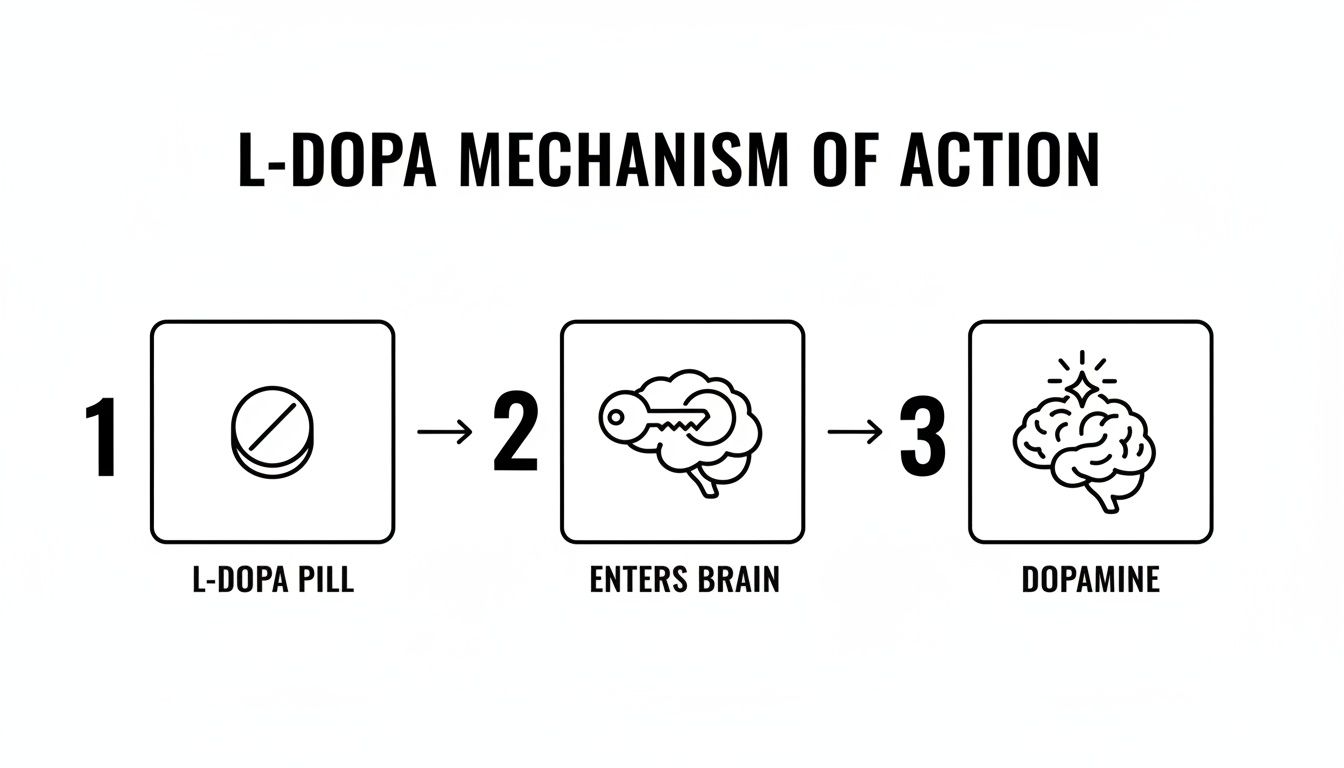
The key takeaway is simple: getting the L-Dopa molecule safely across the blood-brain barrier is the whole game.
The Bodyguard Solution
To solve this problem, L-Dopa is almost always paired with a “bodyguard.” In pharmaceuticals, the most common bodyguard is a compound called carbidopa. Carbidopa’s sole mission is to protect L-Dopa on its trip through the body.
Here’s how it works: carbidopa blocks the AADC enzyme, but only outside the brain. It’s too big to cross the blood-brain barrier itself, so it stays behind in the bloodstream, neutralizing the threat of that premature conversion.
This bodyguard effect completely changes how L-Dopa works:
- Protection: It shields L-Dopa from being broken down too early.
- Efficiency: A much higher percentage of L-Dopa actually makes it to the brain.
- Tolerance: By preventing dopamine buildup in the body, it dramatically reduces side effects.
With carbidopa on guard, a much smaller dose of L-Dopa can achieve a far greater effect. It’s why this combination has become the gold standard in clinical settings.
Maximizing Brain Delivery
The numbers behind this protective strategy are pretty staggering. Without a bodyguard, a huge amount of L-Dopa is lost.
Research shows that when L-Dopa is taken alone, less than 1% of the dose may actually reach the central nervous system. The rest is essentially wasted in the bloodstream.
Adding a decarboxylase inhibitor like carbidopa completely flips the script. It drastically cuts down the peripheral breakdown of L-Dopa, which not only boosts its availability to the brain but also helps it stick around longer in your system. Pharmacokinetic studies show this pairing can cut the clearance rate of L-Dopa by more than half, ensuring more of it gets where it needs to go.
This idea of protecting the main ingredient is crucial. It shows the difference between just a raw compound and an optimized delivery system—a key point when you compare standardized Mucuna supplements and raw powders. This protective strategy is fundamental to making L-Dopa both a safe and effective tool.
Short-Term Relief and Long-Term Challenges
Thinking about how L-Dopa works is a bit like watching a play in two acts. The first act is what clinicians call the short-duration response (SDR). This is the immediate, noticeable lift you get after a dose. It’s directly tied to the amount of L-Dopa in your bloodstream—as the level goes up, symptoms improve, and as it drops, they can creep back in.
The second act is the long-duration response (LDR), which is much more subtle. This is a steady, background benefit that doesn’t swing up and down with each dose. Instead, it builds up over days and weeks of consistent use, creating a more stable foundation for motor control. This powerful one-two punch is why L-Dopa can feel so effective right from the start.
But this is where the long-term challenge comes in. While L-Dopa is an incredible tool, using it for several years can lead to new complications. The brain starts to adapt to the medication in ways that aren’t always helpful, creating a new set of problems that require careful management.
The On-Off Phenomenon
One of the most common long-term issues is the development of motor fluctuations, better known as the “on-off” phenomenon. When you’re “on,” the medication is working, and symptoms are under control. But when you’re “off,” its effects wear off before the next dose is due, and symptoms like stiffness or tremors can return unexpectedly.
This happens because, as Parkinson’s progresses, the brain loses more of its own dopamine-producing cells. These cells don’t just make dopamine; they also store it and release it smoothly. Without them, the brain becomes completely reliant on the peaks and valleys of each L-Dopa dose. The result is a rollercoaster effect on symptom control.
According to patient surveys, this isn’t a rare occurrence—around half of all individuals taking levodopa report experiencing these “off” periods. They can last for a few moments or for several hours a day, taking a serious toll on quality of life.
Levodopa-Induced Dyskinesia
Another major hurdle down the road is levodopa-induced dyskinesia. These are uncontrolled, involuntary movements that are a side effect of the treatment itself, not a symptom of the disease. They can look like fidgeting, writhing, swaying, or head-bobbing.
This complication comes from the brain’s dopamine receptors getting an unnatural, pulsatile stimulation. Instead of the steady, gentle stream of dopamine the brain is built for, long-term L-Dopa therapy creates sharp spikes followed by deep troughs. Think of it like flicking a light switch on and off repeatedly instead of using a smooth dimmer dial.
Over time, this erratic signaling makes dopamine receptors overly sensitive, triggering the involuntary movements of dyskinesia. This highlights a central conflict in treatment: the very drug that restores movement can eventually cause unwanted movement.
Research confirms that the risk of these motor complications goes up with the total dose and duration of therapy. Higher daily doses—especially those over 600 mg per day—significantly increase the risk of dyskinesia over the years. This is why clinicians focus on using the lowest effective dose and finding ways to smooth out L-Dopa delivery to the brain. You can read more about how clinicians balance levodopa’s benefits and risks at the National Center for Biotechnology Information.
Ultimately, the goal is to harness L-Dopa’s power for as long as possible by navigating these long-term challenges. Understanding both its immediate benefits and its potential long-term consequences is critical. You can learn more about the specifics of the molecule and its applications by exploring the role of levodopa in wellness and health. This duality is why the journey with L-Dopa is a dynamic partnership between patient and physician, requiring continuous adjustment and strategy.
Clinical Strategies for Dosing and Application
Translating how L-Dopa works in the brain into a real-world treatment plan is a highly personal journey. There’s no one-size-fits-all dosage. Instead, the entire strategy is built around a single guiding principle: using the lowest effective dose. This approach is all about finding that sweet spot where symptoms are managed effectively, but side effects and long-term complications are kept to a minimum.
The process almost always starts with a very small dose. From there, clinicians titrate the amount—that is, they increase it gradually over days or even weeks. This slow-and-steady method gives the body time to adjust, which helps sidestep initial side effects like nausea or dizziness that can pop up with a sudden high dose. It’s a delicate dance between patient and doctor, requiring careful observation to dial in the perfect amount.
The Art of Titration
This careful dose adjustment, or titration, is the bedrock of long-term success with L-Dopa. Rushing the process or starting too high can backfire, increasing the risk of developing motor issues like dyskinesia down the road. The goal is simple: use just enough L-Dopa to get the job done without overwhelming the brain’s dopamine system.
This isn’t a “set it and forget it” situation, either. As a condition like Parkinson’s progresses, the brain’s natural ability to make and store its own dopamine continues to decline. That means the “lowest effective dose” that worked in year one might not be enough in year five. L-Dopa therapy has to be dynamic, with ongoing tweaks to the dose, the timing, or even the type of L-Dopa formulation being used.
Think of L-Dopa not as a static prescription, but as a responsive tool that adapts to the body’s changing needs. This flexibility is the key to maintaining quality of life and getting the most out of the medication for as long as possible.
Clinically, recommended regimens often land somewhere between 300–1,200 mg per day, split into 3 to 12 doses, to strike that balance between benefits and side effects. Most guidelines suggest starting low—around 150–300 mg per day—and inching up by about 100 mg every few days until symptoms are under control. You can explore more about these clinical guidelines and L-Dopa’s pharmacology on DrugBank.
Advanced Dosing Schedules
As the brain becomes more reliant on external L-Dopa, a new challenge often emerges: managing “off” times. These are the periods between doses when symptoms start to creep back in. To tackle this, clinicians have a few smart strategies up their sleeves:
- Fractionating Doses: Instead of a larger dose three times a day, a patient might switch to smaller doses taken five or six times daily. This creates more stable L-Dopa levels in the blood, smoothing out the peaks and valleys that lead to “off” periods.
- Controlled-Release Formulations: These pills are engineered to release L-Dopa slowly over several hours. This can provide longer-lasting symptom control, making them especially useful for managing symptoms through the night.
- Adding Adjunctive Therapies: Other medications can be brought on board to help L-Dopa work better and last longer. For instance, COMT inhibitors are drugs that block an enzyme that breaks down L-Dopa, giving it more time to do its job.
To give you a clearer picture, the table below shows a simplified, hypothetical example of what a titration schedule might look like.
Sample L Dopa Titration Schedule for Parkinson’s
This table illustrates a hypothetical, simplified titration schedule to demonstrate how L-Dopa doses are gradually increased to find the optimal therapeutic level while minimizing side effects. This is for illustrative purposes only.
| Week | Daily Dose (mg) | Dosing Schedule | Clinical Goal |
|---|---|---|---|
| Week 1 | 150 mg | 50 mg, 3 times daily | Introduce L-Dopa and assess initial tolerance and side effects. |
| Week 2 | 300 mg | 100 mg, 3 times daily | Gradually increase the dose to begin observing symptomatic relief. |
| Week 3 | 450 mg | 150 mg, 3 times daily | Continue titrating to find the minimum dose for effective motor control. |
| Week 4+ | 600 mg | 200 mg, 3 times daily | Establish a stable, effective dose for long-term maintenance. |
This systematic process highlights that using L-Dopa is a marathon, not a sprint. Each adjustment is a strategic move aimed at maximizing its powerful benefits while skillfully navigating its potential challenges.
Navigating Side Effects and Drug Interactions
While L-Dopa is a powerful tool, it’s not something to be taken lightly. Like any compound that directly influences your brain chemistry, it demands respect and a bit of know-how to use safely and effectively.
When you first start, your body often needs a little time to adjust. During this period, some people might notice mild, short-term effects like nausea or a bit of lightheadedness. This is usually just your system getting used to the new dopamine activity. Taking your dose with a light snack (just avoid high-protein foods) can often smooth things over until your body adapts.
For long-term clinical use, like in Parkinson’s therapy, the conversation gets more complex. We’ve already touched on how motor complications, such as the frustrating “on-off” swings or involuntary movements (dyskinesia), can pop up after years of treatment. This is exactly why medical pros almost always start patients on the lowest dose that gets the job done.
Key Drug and Diet Interactions
What you eat and what other medications you take can dramatically change how L-Dopa works. Paying attention to these interactions is the key to getting the benefits you want while avoiding serious problems.
The most critical interaction to know about involves a class of drugs called non-selective MAO inhibitors (MAOIs). Combining L-Dopa with these is a hard stop—it’s extremely dangerous. This mix can block the breakdown of dopamine, causing a sudden, severe spike in blood pressure known as a hypertensive crisis. This is a true medical emergency.
Always tell your doctor about everything you’re taking before you start L-Dopa. That includes prescriptions, over-the-counter meds, and any other supplements. It’s the only way to catch potentially harmful interactions.
It’s not just medications, either. Your lunch can have a surprising effect. Protein is the main culprit here, as it can get in the way of L-Dopa doing its job.
- The Protein Competition: Think of it like a crowded bus. The amino acids from protein (meat, fish, eggs) use the exact same transport system as L-Dopa to get across the blood–brain barrier.
- Reduced Effectiveness: If you take L-Dopa with a protein-heavy meal, it has to fight for a spot on that bus, meaning less of it actually reaches your brain.
- Practical Solution: To get around this, most people find it works best to take their dose 30 minutes before or at least 60 minutes after a meal rich in protein.
Understanding the Broader Safety Profile
Beyond those major interactions, there are a few other things to keep on your radar. L-Dopa can sometimes affect mood or behavior. In rare instances, especially at higher clinical doses, it might cause confusion or even hallucinations. It’s also generally not recommended during pregnancy or while nursing, simply because there isn’t enough safety data to go on.
This is why having an open line of communication with a healthcare professional is non-negotiable. They can help you navigate all these factors, tweak your approach based on your unique health situation, and make sure you’re using L-Dopa safely and effectively. By understanding the full picture—how L-Dopa fits with your diet, your health, and your life—you can manage its effects and harness its potential responsibly.
Natural vs. Synthetic L Dopa Sources
When you start looking into L-Dopa, one of the first questions that comes up is about where it comes from. L-Dopa comes in two main flavors: a natural version found in plants like the velvet bean (Mucuna pruriens), and a synthetic version, called levodopa, that’s made in a lab for pharmaceutical use.
Chemically, they’re the same molecule. But in the real world, how they’re used—and how they work—can be worlds apart.
The Appeal and Challenge of Natural L-Dopa
There’s a natural appeal to using a plant-based source. Mucuna pruriens isn’t new; it has a long history of use in traditional Ayurvedic medicine. The L-Dopa in Mucuna comes packaged with a whole suite of other plant compounds. Some believe these extra compounds might offer a synergistic effect, perhaps influencing how L-Dopa is absorbed and used in the body, though we still need more research to know for sure.
The biggest hurdle with many natural L-Dopa supplements, however, is consistency. The actual amount of L-Dopa in a scoop of raw or low-grade Mucuna powder can swing wildly from one batch to the next. That unpredictability is a major drawback if you’re looking for reliable support for your mood or motivation.
This is exactly why a high-quality, standardized Mucuna extract is a game-changer. A product like Keter Wellness Mucuna L-Dopa 20% solves the consistency problem by guaranteeing a precise concentration of L-Dopa in every single capsule. Standardization bridges the gap between a raw herb and a dependable supplement, ensuring you get the same active dose every time.
For clinical therapy, especially for conditions like Parkinson’s disease, predictable dosing isn’t just a nice-to-have—it’s everything. The entire treatment strategy depends on delivering a precise, reliable amount of L-Dopa to the brain to keep symptoms under control.
Why Synthetic Levodopa Is the Clinical Gold Standard
That need for absolute precision is why synthetic levodopa is the undisputed gold standard in medicine. Pharmaceutical-grade levodopa is produced under incredibly strict controls to ensure 100% purity and an exact dosage.
Crucially, it’s almost always paired with a “bodyguard” molecule like carbidopa. This partner molecule stops L-Dopa from converting into dopamine in your bloodstream, before it ever gets to your brain.
This combination is brilliant because it accomplishes several critical things:
- Maximizes Brain Delivery: It ensures a much, much higher percentage of the L-Dopa actually reaches its target in the brain.
- Reduces Side Effects: By preventing dopamine from forming elsewhere in the body, it dramatically lowers the risk of common side effects like nausea and dizziness.
- Enables Precise Titration: Doctors can adjust doses with pinpoint accuracy, which is essential for managing long-term conditions effectively.
Comparing L Dopa Sources Mucuna Pruriens vs Synthetic Levodopa
To make the differences clear, let’s break down how natural, standardized Mucuna compares to its synthetic, pharmaceutical counterpart. This table highlights their distinct features and typical applications.
| Feature | Standardized Mucuna Pruriens Extract | Synthetic Levodopa (with Carbidopa) |
|---|---|---|
| Primary Use | General wellness, mood, and motivation support | Medical treatment for Parkinson’s disease |
| Composition | Natural L-Dopa within a matrix of other plant compounds | Pure, isolated L-Dopa molecule |
| “Bodyguard” | No—L-Dopa is on its own | Yes—combined with carbidopa or benserazide |
| Dose Precision | Good (with standardization, e.g., 20%) | Extremely high (pharmaceutical-grade) |
| Absorption | Can be less efficient; some converts in the periphery | Highly efficient; bodyguard maximizes brain delivery |
| Side Effects | Generally milder; potential for nausea at high doses | Reduced due to carbidopa, but can still occur |
| Regulation | Sold as a dietary supplement | Prescription-only medication |
While they both deliver the same core molecule, their formulation and purpose are fundamentally different.
The synthetic version offers a level of reliability that unstandardized natural sources just can’t touch. This doesn’t make natural L-Dopa useless; it just means it’s suited for a different purpose. For those exploring the plant-based option for general wellness, a solid understanding of its properties is essential. You can find more details in the definitive guide to Mucuna pruriens L-Dopa to get the full picture on its benefits and safety.
Ultimately, choosing between natural and synthetic comes down to your goal. If you’re managing a diagnosed medical condition under a doctor’s supervision, the precision of synthetic levodopa is non-negotiable. But for general wellness support, a high-potency, standardized Mucuna pruriens extract offers a reliable way to tap into the benefits of natural L-Dopa.
Frequently Asked Questions About L‑Dopa
Alright, let’s round this out by tackling some of the most common questions people have about L‑Dopa. These real-world queries should help tie everything together and give you a practical sense of how it all works.
Can L Dopa Stop the Progression of Parkinson’s Disease
In short, no. L‑Dopa is a powerful tool for managing symptoms, not a cure for the disease itself. It does an excellent job of replenishing dopamine, which helps improve motor control—reducing tremors, stiffness, and slow movement. This can bring significant relief and improve quality of life.
However, it doesn’t slow or stop the underlying loss of the brain cells that produce dopamine. The search for a therapy that can actually change the course of the disease is a major focus of medical research, but for now, L‑Dopa’s role is all about symptom management.
Why Does L Dopa Seem to Work Less Over Time
This is a very common and understandable concern. When it feels like L‑Dopa is losing its punch, it’s usually not the drug’s fault. It’s a combination of two things happening at once.
First, the disease itself is still progressing, meaning fewer healthy brain cells are left to convert the L‑Dopa into dopamine. Second, long-term use can sometimes lead to those motor complications we talked about, like the frustrating “on-off” periods.
The drug is still effective, but the brain’s ability to use it consistently is changing. Doctors manage this by carefully adjusting the dose, tweaking the timing, or sometimes adding other medications to help stabilize the brain’s response.
Should I Take L Dopa With or Without Food
This is a bit of a balancing act. If you’re just starting L‑Dopa, taking it with a small, low-protein snack (like a few crackers or a piece of fruit) can help sidestep the nausea that some people experience.
The big catch, though, is protein. A meal loaded with protein from meat, fish, or dairy can directly compete with L‑Dopa for absorption. The amino acids in the protein and the L‑Dopa molecule use the same doorways to get from your gut into your brain. To make sure the L‑Dopa wins that race, it’s best to take your dose either 30 minutes before or 60 minutes after a protein-rich meal.
Is Natural L Dopa From Mucuna Pruriens Safer
Not automatically. The word “natural” doesn’t always mean “safer,” especially when precision is key. Pharmaceutical L‑Dopa is manufactured to an exact dose and is almost always paired with carbidopa. This combination is designed to make sure a predictable amount reaches the brain while keeping side effects in check.
On the other hand, many unregulated Mucuna supplements can have wildly inconsistent levels of L‑Dopa, which makes them unreliable for managing a serious medical condition. For general wellness support, a high-quality, standardized extract provides a level of consistency that raw, unstandardized powders just can’t match.
Ready to explore the benefits of a high-potency, standardized natural L-Dopa source? Keter Wellness offers a premium Mucuna Pruriens extract standardized to 20% L-Dopa, ensuring you get a consistent and effective dose for mood and motivation support. Learn more at /.
Leave a Reply