

The real power of Mucuna dopa benefits comes from its ability to naturally nudge dopamine levels in the brain. This can lead to some pretty noticeable shifts, like a brighter mood, sharper focus, and a serious boost in motivation.
Because it contains a direct precursor to this all-important neurotransmitter, the L-Dopa in Mucuna pruriens supports both how you think and how you feel physically.
What Is Mucuna Pruriens and Its L-Dopa Connection?
So, what exactly is this stuff? The story starts with a tropical legume called Mucuna pruriens, better known as the “velvet bean.” It’s a climbing plant native to parts of Africa and Asia, and it’s been a staple in traditional Ayurvedic practices for centuries.
But the real magic isn’t in the plant itself—it’s in the seeds. These seeds are one of the richest natural sources of a compound called Levodopa, or L-Dopa. This is the direct, one-step-away building block for dopamine, one of the brain’s most critical chemical messengers. Think of dopamine as the molecule of drive, pleasure, and smooth motor control.
The Brain’s Special Delivery System
So, why is getting L-Dopa from Mucuna so effective? It all has to do with a tight security system in our bodies called the blood-brain barrier. This is a protective filter that stops most things in your bloodstream from just waltzing into your brain. Dopamine itself can’t get past the bouncer.
But L-Dopa has a backstage pass. It’s one of the few molecules that can easily cross the blood-brain barrier. Once it’s safely inside, your brain cells quickly convert it directly into dopamine, right where you need it most.
This conversion process is the core reason Mucuna works so well. It’s not just adding more of a chemical; it’s giving your brain the raw material it needs to produce dopamine on its own, supporting the entire system from the ground up.
This unique ability to deliver the goods right to the brain unlocks the wide range of benefits people report with Mucuna. It’s about restoring the natural production line, not just flooding the system.
For a quick summary, here’s a look at the key details of this fascinating plant.
Mucuna Pruriens At a Glance
The table below offers a snapshot of Mucuna Pruriens, highlighting its main compound and how it works to support the body’s dopamine system.
| Attribute | Description |
|---|---|
| Common Name | Velvet Bean, Cowhage |
| Active Compound | Levodopa (L-Dopa) |
| Primary Role | Serves as a direct precursor to the neurotransmitter dopamine. |
| Mechanism of Action | L-Dopa crosses the blood-brain barrier to be converted into dopamine. |
| Traditional Use | Widely used in Ayurvedic medicine for neurological and vitality support. |
This elegant mechanism—providing the essential building block your brain needs—is what makes Mucuna a powerful tool for supporting mental and physical well-being.
How L-Dopa From Mucuna Works In Your Brain
To really understand the benefits of Mucuna, we have to look at the fascinating journey L-Dopa takes once it gets into your system. It’s helpful to think of your brain as a highly advanced factory. This factory’s most important product is dopamine—the neurotransmitter that acts as your “motivation molecule,” driving everything from your focus and sense of pleasure to your physical coordination.
But like any factory, it needs a steady stream of raw materials to keep the assembly line moving. This is exactly where Mucuna pruriens steps in. The L-Dopa from Mucuna acts like a premium-grade raw material delivered straight to your brain’s factory floor.
Once L-Dopa crosses the highly selective blood-brain barrier—a feat that dopamine itself can’t accomplish—it arrives inside your brain cells. There, specialized “machinery” in the form of an enzyme called DOPA decarboxylase goes to work, efficiently converting L-Dopa into its final, powerful form: dopamine.
The Dopamine Production Line
This direct conversion is the secret to Mucuna’s power. It isn’t just adding a foreign substance to your body; it’s supplying the precise building block your brain needs to ramp up its own natural dopamine manufacturing.
It’s a clear, step-by-step biological pathway, as you can see below.
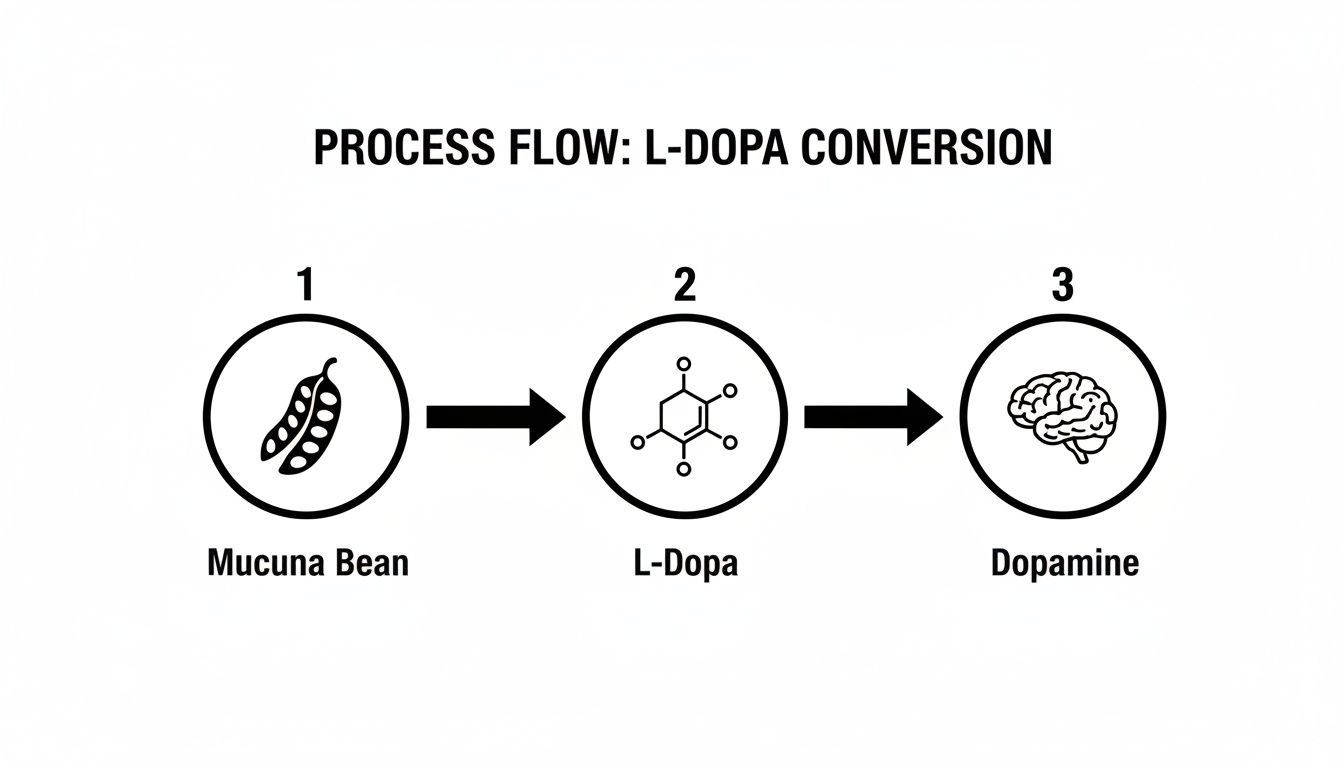
The bean provides the L-Dopa, which the brain then uses to synthesize the dopamine that regulates so many of our critical functions.
By supplying this key ingredient, Mucuna helps ensure the “production line” for motivation, mood, and movement stays well-stocked and active. It’s this replenishment that translates into the tangible feelings of enhanced drive and well-being that users report.
The Brain’s Master Motivator
So, what does having more dopamine actually do? This powerful neurotransmitter is central to your brain’s reward and pleasure centers. It’s the chemical signal that essentially says, “That felt good, let’s do it again!” This fundamental mechanism governs a huge part of your daily life.
Just think about some of dopamine’s key roles:
- Motivation and Drive: It’s the force pushing you to start a project, chase a goal, or even just get out of bed in the morning.
- Focus and Attention: Healthy dopamine levels are critical for locking in on tasks and filtering out all those distractions.
- Mood Regulation: By influencing feelings of pleasure and satisfaction, dopamine is a major player in maintaining a positive, stable emotional state.
- Motor Control: It’s absolutely essential for orchestrating smooth, coordinated, and voluntary muscle movements.
Dopamine isn’t just about feeling happy; it’s the neurological engine that powers our ambition and allows us to interact with the world purposefully. Supporting its production is fundamental to both our mental and physical vitality.
This growing understanding of Mucuna’s role has led to a huge surge in its popularity. In fact, the global market for mucuna pruriens seeds recently hit USD 184.6 million, highlighting a worldwide interest in natural sources of L-Dopa.
It’s also worth noting that the natural L-Dopa in Mucuna comes packaged with other beneficial plant compounds, like alkaloids and flavonoids. Some research suggests these extra compounds work together, creating a more balanced and sustained effect compared to isolated, synthetic L-Dopa. To dive deeper into the brain’s complex chemistry, you can learn more about the science of L-Dopa and its role in our comprehensive guide.
The Cognitive and Mood-Enhancing Benefits of Mucuna

Knowing the science behind L-Dopa is one thing, but feeling the difference is what really matters. By giving your brain the raw material it needs to make dopamine, Mucuna pruriens can lead to real, noticeable improvements in how you feel and think every day. The most common mucuna dopa benefits show up in three key areas: mood, motivation, and mental sharpness.
Think of your brain’s dopamine system like the engine in your car. When the fuel—dopamine—is low, the engine sputters, struggles to get going, and might not even start. But when the tank is full, it runs smoothly, responds instantly, and has the power to get you wherever you need to go. Taking Mucuna is like making sure your engine always has high-quality fuel.
This direct support for your brain’s “motivation molecule” is what helps you feel more engaged, driven, and clear-headed in your daily life.
Elevating Mood and Cultivating Well-Being
One of the best-known effects of healthy dopamine levels is the profound impact it has on your mood. Dopamine is hardwired into your brain’s pleasure and reward circuits. It’s the neurotransmitter that fires when you finish a project, enjoy a great meal, or hear your favorite song, creating that feeling of satisfaction.
When dopamine levels are low, you might feel apathetic or emotionally flat—like things that used to be fun just aren’t interesting anymore. It’s often described as seeing the world in grayscale.
By providing the L-Dopa needed for dopamine production, Mucuna can help bring the color back. It supports your brain’s natural ability to feel pleasure and satisfaction from everyday life, helping to lift the fog and foster a more positive mindset. It’s not about an artificial high; it’s about restoring your capacity for genuine joy.
Igniting Motivation and Overcoming Procrastination
Motivation isn’t just about willpower; it’s a biological process driven by dopamine. This neurotransmitter fuels your ambition, making it easier to start tasks, stick with them, and push through challenges. It’s the difference between saying you’ll go to the gym and actually getting up and going.
Procrastination and a lack of drive are often signs that your brain’s reward system isn’t firing on all cylinders. Without enough dopamine, the effort a task requires feels like it outweighs the reward, so you put it off.
Mucuna’s ability to support dopamine production directly influences this mental cost-benefit analysis. By ensuring a healthy supply of dopamine, it helps make the future reward of finishing a task feel more immediate and compelling, giving you the mental push to get started and follow through.
This can show up in a few practical ways:
- Easier to Start: You may find it’s not so hard to begin those projects you’ve been avoiding.
- Sustained Effort: Sticking with long-term goals, whether at work or at home, feels less like a chore.
- Increased Drive: A general sense of ambition and the desire to achieve things returns.
This boost in drive is a core reason many people use Mucuna to improve their productivity and overall effectiveness.
Sharpening Focus and Enhancing Cognitive Function
Beyond mood and motivation, dopamine is a critical player in your executive functions—the high-level mental skills that let you plan, focus, and remember things. It acts like a gatekeeper for your attention, helping your brain zero in on what’s important while tuning out distractions.
When dopamine is in balance, your ability to concentrate on complex tasks improves. You can hold your focus for longer, switch between tasks more smoothly, and absorb new information more easily. This is especially helpful during mentally demanding work like studying, problem-solving, or any deep work.
Dopamine also plays a key role in working memory, which is your brain’s “mental notepad” for holding information temporarily. By supporting this system, Mucuna can help you recall details, follow multi-step directions, and connect ideas more easily. The result is a feeling of enhanced mental clarity and sharpness, empowering you to perform at your best.
Mucuna’s Role In Physical Health and Parkinson’s Support

While the mental lift from Mucuna is impressive, the mucuna dopa benefits run much deeper, right into our physical health—especially when it comes to movement and motor control. We often think of dopamine as a “feel-good” chemical, but it’s also the brain’s primary conductor for physical motion. It’s the neurotransmitter that ensures our muscles get clear, coordinated signals to move smoothly and with intention.
Think of it like trying to drive a car with a spotty connection between the steering wheel and the tires. The car would feel jerky, unresponsive, and hard to control. In our bodies, dopamine is that critical connection, translating the brain’s commands into fluid, precise physical actions.
When dopamine levels are where they should be, this whole system works like a charm. But when the cells that produce dopamine start to decline, the physical fallout can be profound. This is the core issue in conditions like Parkinson’s disease, and it’s where Mucuna pruriens has become one of its most researched and vital applications.
Supporting Motor Function in Parkinson’s Disease
Parkinson’s disease is a neurodegenerative condition defined by the progressive loss of dopamine-producing neurons in a part of the brain called the substantia nigra. As these essential cells die off, the brain’s dopamine supply plummets. This leads to the classic motor symptoms of the disease: tremors, stiffness, and trouble with balance and coordination.
For decades, the conventional medical approach has been to replenish this depleted dopamine supply with synthetic L-Dopa, the very same precursor found naturally in Mucuna. This is where the velvet bean’s therapeutic power really shines. By offering a natural, potent source of L-Dopa, Mucuna helps to “refill the tank,” letting the brain produce the dopamine it needs to manage motor function again.
For many, this can bring significant improvements in physical symptoms and overall quality of life. The L-Dopa from Mucuna crosses the blood-brain barrier, converts into dopamine, and helps restore the lines of communication between the brain and muscles.
The core idea behind using Mucuna for Parkinson’s support is simple: replenishment. It tackles the root biochemical problem—a lack of dopamine—by providing the exact raw material the brain needs to make up for its diminished production.
This isn’t just an idea from ancient Ayurvedic medicine; it’s now being increasingly validated by modern scientific research.
Clinical Evidence and a Favorable Profile
The scientific community has taken a serious look at Mucuna pruriens, and the results are compelling. An analysis of 26 preclinical and clinical trials highlighted its significant potential, showing that Mucuna naturally contains L-Dopa at an average concentration of 5.3%. Research has even found that Mucuna pruriens powder is just as effective as conventional L-Dopa combined with benserazide in managing symptoms. You can discover more about the therapeutic efficacy of Mucuna in this detailed review.
What makes Mucuna especially interesting to researchers, though, is its complex makeup. Unlike synthetic L-Dopa, which is just a single isolated molecule, Mucuna contains a whole suite of other compounds. Some studies suggest these extra compounds might lead to a better experience for some people.
Here are a few potential advantages noted in the research:
- Faster Onset of Action: Some studies show the L-Dopa from Mucuna may get absorbed and start working more quickly than standard versions.
- Longer Duration of Effect: Its effects might also last longer, providing more sustained relief from motor symptoms.
- Fewer Dyskinesias: There’s also some evidence suggesting a lower rate of dyskinesias (involuntary movements), a common side effect of long-term synthetic L-Dopa use.
This suggests that the natural “package” of compounds in Mucuna may work together synergistically, offering a more balanced and well-tolerated effect.
Neuroprotective Antioxidant Power
Beyond just topping up dopamine levels, Mucuna pruriens adds another layer of support with its powerful antioxidant properties. The plant is packed with compounds like flavonoids and alkaloids that help fight oxidative stress—a key factor believed to fuel the progression of neurodegenerative diseases.
Think of oxidative stress as biological “rust” that damages cells, including the fragile dopamine-producing neurons in the brain. The antioxidants in Mucuna act like a rust-proofing spray, helping to neutralize the harmful free radicals that cause this damage.
This dual-action benefit is what makes Mucuna so compelling. It not only helps manage symptoms by boosting dopamine but may also help protect the remaining neurons from further harm. This neuroprotective quality is a huge part of its reputation as a brain-supportive herb, offering a more holistic approach to maintaining neurological health and physical well-being.
How To Choose a High-Quality Mucuna Supplement
So, you understand the benefits of Mucuna. That’s step one. Step two is navigating the supplement aisle, which can feel like a maze. Not all Mucuna products are created equal, and knowing what to look for is the key to getting a safe, effective, and consistent product.
Choosing a great supplement isn’t about grabbing the prettiest bottle or the most popular brand. It’s about reading the label like a pro and spotting the specific markers of quality that separate the good from the useless. The big three are standardization, purity, and the form of Mucuna you’re actually getting.
Standardization: The Most Important Factor
If you only look for one thing, make it standardization. You’ll see labels that say something like “standardized to 20% L-Dopa.” This isn’t just marketing fluff; it’s a guarantee of potency and consistency.
Think of it this way: buying “coffee powder” is a gamble. One batch might be weak, the next might be incredibly strong. But if you buy coffee that’s standardized for a specific caffeine content, you know exactly what you’re getting every single time. Mucuna is no different. An unstandardized powder could have 3% L-Dopa in one jar and 7% in another, making your dose completely unpredictable.
A standardized extract, like Keter Wellness Mucuna L-Dopa 20%, guarantees that every capsule contains a precise, reliable amount of the active compound. This is absolutely essential for getting predictable effects and using it safely.
This consistency is what allows for accurate dosing. It makes it much easier to find the right amount for your body and maintain stable, dependable results.
Comparing Mucuna Pruriens Supplement Types
Mucuna comes in several forms, and each has its place. Understanding the differences will help you pick the right product for your specific goals. Here’s a quick breakdown to help you decide.
| Supplement Type | Key Feature | Best For | Consideration |
|---|---|---|---|
| Standardized Extract | Guaranteed L-Dopa percentage (e.g., 20%). | Individuals seeking consistent, potent, and predictable results for mood and focus. | Higher cost due to the extraction and standardization process. |
| Whole Bean Powder | Contains the full spectrum of the bean’s natural compounds. | Those wanting a more holistic, traditional form of the plant. | L-Dopa content is low and highly variable, making dosing inconsistent. |
| Raw Beans | The unprocessed, natural form of the plant. | Not recommended for consumption. | Can contain anti-nutrients and requires special preparation to be safe. |
For most people who want targeted cognitive and mood benefits, a standardized extract is clearly the superior choice. If you want to dive deeper into the science, you can explore the differences between standardized Mucuna vs. raw powder in our detailed guide.
Ultimately, the right form depends on your objective, but for reliability and targeted effects, standardized extracts win hands down.
Your Quality Checklist for Buying Mucuna
When you’re ready to buy, run through this quick checklist. A reputable company will be transparent about these quality markers, making it easy to spot a top-tier product.
- Third-Party Testing: This is a big one. Look for brands that send their products to independent labs for analysis. This confirms two things: that the product is free from nasty contaminants like heavy metals and pesticides, and that the L-Dopa content on the label is accurate.
- GMP Certification: Good Manufacturing Practices (GMP) certification means the supplement was made in a facility that meets strict FDA quality standards. This is a non-negotiable seal of trust.
- Sourced from Seeds: The highest concentration of L-Dopa is found in the seeds of the Mucuna plant. Make sure the supplement specifies it’s a seed extract, not a blend of leaves or stems, to ensure you’re getting maximum potency.
By focusing on these three factors—standardization, third-party testing, and proper sourcing—you can confidently choose a high-quality Mucuna supplement that is both safe and effective.
Safe Dosing Guidelines and Potential Side Effects
To really get the most out of Mucuna, it’s not enough to know what it does—you have to respect how it works. While it’s a natural supplement, its powerful effects on your brain chemistry mean a thoughtful, responsible approach is essential. Think of this section as a practical guide, not a substitute for professional medical advice.
Always talk with your healthcare provider before adding any new supplement to your routine, especially one as potent as Mucuna pruriens. They can look at your unique health profile and help you decide if it’s a good fit.
Finding Your Optimal Dose
With Mucuna, the golden rule is to start low and go slow. This simple mantra is the best way to see how your body responds and find the minimum dose that gives you the benefits you’re looking for, without overdoing it.
A typical starting point for a standardized extract is often just one capsule per day. Taking it with a meal can help with absorption and prevent any potential stomach upset. Give it a few days to see how you feel, and only then consider making a gradual adjustment if you feel you need to.
The goal isn’t to take the highest possible dose. It’s to find the lowest dose that delivers the support you need for your mood, motivation, and focus. More isn’t always better here, and smart dosing is the key to a great experience.
Common Side Effects and How to Manage Them
Most people handle Mucuna just fine, but side effects can happen, especially when you first start or if the dose is too high. The good news is that most are mild and tend to fade as your body gets used to it.
Here are a few things you might notice:
- Gastrointestinal Upset: This is the most common one—things like nausea, bloating, or cramping. Taking your Mucuna with food almost always solves this.
- Dizziness or Lightheadedness: Can happen as your body adjusts to the shifts in dopamine activity.
- Headaches: Some people report headaches, particularly in the first few days of use.
- Increased Heart Rate: A less common effect, but you might feel a racing or pounding heart.
If you run into any of these, the first step is usually to lower your dose or simply stop taking it and check in with your doctor. If you’re exploring Mucuna specifically for mood, you can find more in-depth guidance on the recommended Mucuna pruriens dosage for depression and what to consider.
Important Contraindications and Drug Interactions
Mucuna L-Dopa isn’t for everyone. Certain health conditions and medications can create negative interactions, so it’s crucial to know when to avoid it for your safety.
Who Should Avoid Mucuna Pruriens?
- Pregnant or Nursing Women: There isn’t enough research to confirm it’s safe.
- Individuals with Melanoma: L-Dopa is a precursor to melanin, the pigment in skin, so it’s not recommended for anyone with a history of this cancer.
- People with Psychosis or Schizophrenia: Directly altering dopamine levels can make symptoms of these conditions worse.
- Those with Severe Liver or Kidney Disease: These organs are key to processing L-Dopa, and impairment could cause issues.
On top of that, Mucuna can interact with several prescription drugs. It is critically important to avoid taking it alongside MAOIs (Monoamine Oxidase Inhibitors). This combination can trigger a dangerous spike in blood pressure. You also need to be extremely cautious and consult your doctor if you’re on other medications that influence dopamine or mood, like antipsychotics or certain antidepressants.
Common Questions About Mucuna L-Dopa
Let’s wrap up by answering a few of the most common questions people have. These quick, practical answers should help clarify the key points and give you more confidence.
How Long Does It Take for Mucuna to Work?
This really varies from person to person. Some people report feeling a subtle shift in their mood, focus, or motivation within just a few days of starting.
For the more noticeable and stable effects, though, it’s a good idea to give it 1-2 weeks. This gives your brain time to adjust to having more L-Dopa available and really put it to good use. Patience is your friend here—look for a gradual improvement, not an overnight flip of a switch.
Can You Take Mucuna Every Day?
Many people do take it daily, but some seasoned users prefer to “cycle” it. A common approach is to take it for a period, like five days on, followed by a short break of two days off.
The thinking behind this is to prevent your brain from getting too used to the external supply of L-Dopa. Taking regular breaks helps keep your system responsive and ensures the supplement continues to work effectively over the long run.
Key Takeaway: Cycling isn’t a strict rule for everyone, but it’s a smart strategy for long-term use. It helps maintain the supplement’s benefits by giving your dopamine pathways a chance to reset.
Is Mucuna the Same Thing as Dopamine?
This is a great question, and it’s a crucial difference to understand. No, Mucuna is not dopamine. It contains L-Dopa, which is the direct building block your brain uses to create its own dopamine.
Here’s a simple analogy: think of L-Dopa as the perfectly prepped ingredients for a cake, and dopamine is the finished cake itself. Your brain is the oven. You can’t just stick a finished cake in the oven and expect it to work; you need to provide the raw materials. Mucuna supplies those precise ingredients so your brain can “bake” fresh dopamine right where it’s needed.
Ready to feel the balanced mood and motivation support that a high-quality, standardized Mucuna supplement can offer? Keter Wellness provides a premium Mucuna L-Dopa 20% extract, designed for consistent potency and results you can rely on. Visit Keter Wellness to learn more and begin your journey toward enhanced well-being.
Leave a Reply