

So you’ve started a new supplement. The big question on your mind is probably, "When am I going to feel this working?" The honest answer is, it depends entirely on what you're taking and why. The timeline can range from almost instantly to several months.
Some supplements give you a noticeable jolt within hours, while others need weeks or even months of consistent use to build up in your system and deliver their real benefits.
Setting the Timeline for Supplement Results
It helps to think of supplements as different kinds of tools for your body.
Some, like a pre-workout with caffeine, are like a hammer—you feel the impact right away. That energy surge hits you within 30-60 minutes because it directly stimulates your central nervous system. It's a fast, acute effect.
Others are more like a slow, steady watering can for a garden. Things like Vitamin D or collagen don't create an overnight miracle. Instead, they work quietly in the background, gradually fixing a deficiency, rebuilding tissues, or supporting your overall health. For these, the timeline is much longer. You're often looking at one to three months of daily use before you'd notice changes in skin elasticity, immune resilience, or bone density tests.
This visual breaks down the general speed you can expect from different categories.
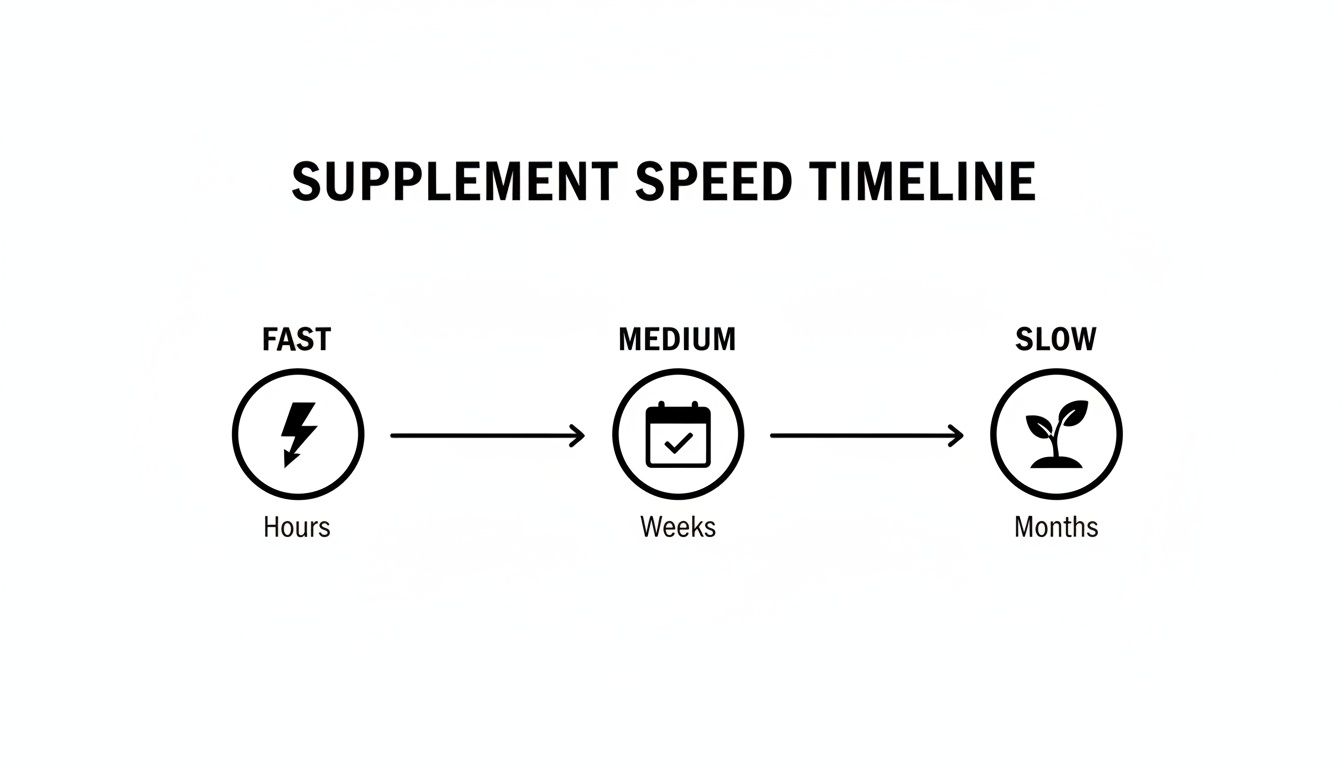
The key takeaway is that a supplement’s mechanism of action—whether it’s giving you a quick boost or rebuilding your body's nutrient stores—is what really dictates its timeline.
What to Expect at a Glance
Managing your expectations is a huge part of seeing success with supplements. It keeps you from giving up on something beneficial just because you didn't feel a major shift in the first week.
Remember, your unique body, current nutrient levels, and lifestyle all play a role. Someone who is severely deficient in a vitamin will likely notice improvements much faster than someone whose levels are already close to optimal.
The core principle is patience and consistency. Supplements aren't magic pills; they are long-term partners for your health, designed to support your body's natural processes over time.
To give you a clearer picture, here’s a quick-glance table summarizing the timelines for some common supplement types.
General Timeline for Common Supplement Categories
This table offers a general guide to help you set realistic expectations for when you might start noticing a difference.
| Supplement Category | Typical Onset Time | Mechanism of Action |
|---|---|---|
| Pre-Workouts/Energy | 30-60 Minutes | Stimulates the central nervous system for an acute energy boost. |
| Vitamins (Water-Soluble) | 2-4 Weeks | Corrects deficiencies; used by the body quickly and needs regular replenishment. |
| Vitamins (Fat-Soluble) | 4-12+ Weeks | Builds up in fatty tissues over time to correct deeper, long-term deficiencies. |
| Herbal Adaptogens | 2-8 Weeks | Works cumulatively to help the body adapt to stress and regulate systems. |
| Collagen/Joint Support | 3-6 Months | Supports the slow process of rebuilding connective tissues and cartilage. |
Ultimately, whether a supplement works in minutes or months, its goal is to support your body’s functions. The key is knowing what to expect so you can stick with it long enough to see the results.
The Four Core Factors That Set Your Supplement Clock

Have you ever wondered why your friend feels an energy boost a week after starting a new vitamin, while you’re still waiting for something to happen? It’s not that the supplement isn't working. It’s because your own internal “supplement clock” is set by a completely unique combination of factors.
Getting a handle on these variables is the key to setting realistic expectations. The real question isn’t just about the pill itself, but about the entire biological and lifestyle landscape it enters. Four main factors really control this timeline, and each one plays a huge part in how quickly you'll notice a difference.
The Nature of the Supplement Itself
First things first, the chemical makeup of the supplement dictates how your body absorbs, uses, and stores it. The biggest difference here is whether a compound is water-soluble or fat-soluble.
-
Water-Soluble Vitamins (like Vitamin C and B Vitamins): These dissolve in water, and your body doesn’t really store them. It takes what it needs right away and gets rid of the rest. This means you need a consistent daily supply to keep your levels up, and you’ll often feel their effects within a few weeks as they get to work quickly.
-
Fat-Soluble Vitamins (like Vitamins A, D, E, and K): These need fat to be absorbed and are stored in your liver and fatty tissues. Because they have to build up in your system over time, it can take much longer to correct a deficiency—often one to three months or more before you see significant changes.
Think of it like watering a plant. A thirsty plant (water-soluble) perks right up after a drink. But a plant that needs better soil (fat-soluble) requires consistent feeding over a whole season to truly build its strength.
Your Unique Personal Biology
No two bodies are the same. Your individual physiology—your metabolism, genetics, age, and any health conditions—is a massive factor in how you process nutrients.
But the single most important piece of the puzzle is your baseline nutrient level. Let’s use a simple analogy: a car’s gas tank. If your Vitamin D tank is running on empty, you’ll notice the benefits of refueling much more dramatically than someone whose tank is already three-quarters full.
A person with a confirmed iron deficiency, for example, might feel their fatigue lift within three to four weeks of starting a supplement as their red blood cell count climbs. Someone taking iron for general wellness without being deficient might not feel a noticeable difference at all.
This is exactly why the answer is always "it depends." Your body's first priority is to correct major shortfalls.
Dosage and Unwavering Consistency
This one is simple but absolutely non-negotiable: you won’t get results from a supplement you don't take regularly. So many supplements, especially herbal formulas and fat-soluble vitamins, depend on a cumulative effect. They need to build up to a therapeutic level in your system to do their job.
Skipping days kills that momentum. Imagine trying to fill a leaky bucket—if you only add water now and then, you’ll never get it full. Taking the right dose is just as important. Too little, and you might never reach the threshold needed to produce a noticeable effect.
This is also where quality comes in. Ensuring your supplements are accurately labeled is vital. Learning about supplements with GMP certification can help you understand how quality control guarantees you’re getting the exact dosage on the bottle, which is essential for consistency.
Your Supporting Lifestyle Habits
Finally, no supplement works in a vacuum. Your daily habits can either supercharge its effectiveness or throw up roadblocks that slow you down. Several lifestyle factors have a direct impact:
-
Diet: A whole-foods diet provides the co-factors needed for absorption. For instance, taking a fat-soluble vitamin with a meal containing healthy fats like avocado or olive oil makes a huge difference in its uptake.
-
Stress Levels: Chronic stress can mess with your digestion and gut health, which means you won’t absorb nutrients as well from food or supplements.
-
Sleep Quality: Your body does most of its heavy lifting—repair and regeneration—while you sleep. Bad sleep can get in the way of the very processes a supplement is trying to support, delaying the results you’re looking for.
By optimizing these four areas, you create the perfect environment for your supplements to get to work efficiently, helping you feel the benefits as soon as possible.
Understanding the Timeline for Herbal Supplements

Unlike a fast-acting pain reliever that just masks a symptom, herbal supplements work on a completely different philosophy. They aren’t designed to force an immediate, artificial outcome. Instead, they work with your body, gently encouraging its own natural systems to find balance.
This cooperative approach is why patience is the most important ingredient in any herbal routine. The bioactive compounds need time to accumulate in your system and start influencing physiological processes—what we call a “build-up” period. Think of it like learning a new skill; you don’t become fluent in a language overnight. Consistent daily practice is what builds the foundation for long-term mastery.
For most herbal supplements, especially adaptogens and those for mood or cognitive function, this build-up phase typically lasts between two and eight weeks. It's during this window that your body really starts to adapt and respond.
It's All About the Cumulative Effect
The real power of herbs lies in their complexity. A single plant contains hundreds of compounds that work together in synergy. This is a huge contrast to a pharmaceutical drug, which usually has one isolated, highly concentrated ingredient designed for a single, powerful effect.
Herbal supplements aim for a more holistic influence. For instance, instead of just blocking one chemical pathway, an adaptogenic herb might help regulate your entire stress-response system. This is a gradual process of re-tuning your body, not just flipping a switch.
This is why consistency is non-negotiable. Skipping doses is like trying to fill a bucket with a slow leak; you lose momentum and never reach the level needed for the herb to show its full benefits.
A Real-World Example: St. John’s Wort
St. John's Wort is a fantastic real-world example because it's one of the most studied herbs for mood support, and the research gives us a clear timeline.
Most people report noticeable improvements in mood and energy within 2 to 4 weeks of consistent daily use. This lines up perfectly with clinical trials, where systematic reviews have shown significant benefits appearing right around the four-week mark. This gives us a valuable benchmark for other herbs that work on similar neurological pathways.
This gradual onset is the perfect way to understand how high-potency standardized formulas work. The body needs time to integrate and respond to the consistent supply of active compounds that are there to support its natural functions.
The Keter Wellness Mucuna L-Dopa Example
This same principle applies directly to specialized herbal products like our Mucuna L-Dopa 20%. Mucuna pruriens contains L-Dopa, a direct precursor to the neurotransmitter dopamine, which is central to motivation, focus, and mood. The goal isn't to create a sudden, unnatural spike, but to give your brain the building blocks it needs to support healthy dopamine levels day in and day out.
Just like with St. John's Wort, users often report the most meaningful benefits after a period of regular use. Many feel a real shift in motivation, mental clarity, and vitality within a similar 2-4 week window.
Key Takeaway: The first few weeks are all about building a foundation. The real magic happens when the supplement becomes a reliable part of your daily routine, allowing your body to fully leverage its benefits.
This build-up phase is a testament to the supportive action of high-quality botanicals. If you are exploring ways to manage daily pressures, our guide on herbal stress relief supplements offers more information on how different botanicals can support your well-being over time. True success with herbs comes not from seeking an instant fix, but from committing to a consistent routine and giving your body the time it needs to respond.
How Long Vitamins and Minerals Take to Rebuild Your Foundation
When you start taking vitamins and minerals, the timeline for feeling a difference comes down to one core idea: repletion.
Think of your body’s nutrient stores like a reservoir. How long it takes to fill that reservoir depends entirely on how low the water level is when you start.
This is why someone with a minor dip in their levels might not notice much, while a person with a significant deficiency can feel a profound shift. The goal isn't a quick jolt but a steady, foundational rebuild of your body’s essential building blocks. The timeline is just a reflection of your starting point.
For instance, someone diagnosed with mild iron-deficiency anemia might notice their persistent fatigue lifting within three to four weeks. It simply takes that long for the supplemental iron to be absorbed and used by the body to create new, healthy red blood cells that can carry oxygen properly.
Water-Soluble vs. Fat-Soluble Timelines
The type of vitamin you’re taking creates two very different timelines. Your body handles water-soluble and fat-soluble vitamins in fundamentally different ways, which directly impacts how long you’ll be waiting for results.
-
Water-Soluble Vitamins (like B Vitamins and Vitamin C): These dissolve in water, get used by the body almost immediately, and aren’t stored in any significant amount. Whatever your body doesn't use gets flushed out. This means you need a consistent daily intake, but it also means they can get to work relatively quickly. You might feel the benefits of a B-complex vitamin, like better energy metabolism, within two to four weeks.
-
Fat-Soluble Vitamins (like Vitamins A, D, E, and K): These are entirely different. They need fat for absorption and are stored in your liver and fatty tissues. Because they have to build up over time, fixing a deficiency is a much slower process. Think of it as a long-term investment, not a quick fix.
This distinction is crucial for setting expectations. You wouldn't expect a single deposit to fill a large savings account, and you can't expect one week of Vitamin D to fix a long-standing deficiency.
A severe Vitamin D deficiency, for instance, isn't a week-long project. It's often a months-long journey of consistent, daily supplementation to slowly and safely bring your levels back into an optimal range. The process can take anywhere from six weeks to over three months to show significant changes on a blood test.
The only way to know your personal starting line is to get tested. By testing for vitamin and mineral deficiencies, you transform your supplementation plan from guesswork into a targeted strategy.
The Role of Cellular Turnover
Another piece of the puzzle is cellular turnover—the natural rate at which your body replaces old cells with new ones. This process varies wildly throughout the body and explains why you feel some benefits faster than others.
Let’s look at a couple of examples:
-
Red Blood Cells: These cells have a lifespan of about 120 days. When you start taking iron or B12 for anemia, your body immediately begins making healthier cells. But it takes time for these new, improved cells to make up a significant portion of your total blood volume. That’s why it often takes a few weeks to finally feel less tired.
-
Bone Cells: Bone is a living tissue that is constantly being broken down and rebuilt in a process called remodeling. This cycle is incredibly slow. When you take Vitamin D and calcium for bone density, you are supporting a process that takes many months, or even years, to produce measurable changes.
Ultimately, taking vitamins and minerals is about giving your body the raw materials it needs to repair and rebuild. The timeline isn't dictated by the supplement, but by the natural pace of your own biology.
How Clinical Trials Measure Supplement Timelines
When you read that an herbal supplement takes four to eight weeks to show results, that timeline isn’t just a wild guess. It comes from the methodical, scientific process used in clinical trials. Understanding how researchers get these numbers helps explain why patience is so important.
Instead of just asking participants, "So, do you feel better yet?" scientists use structured tools to track changes week by week. This approach paints a clear, objective picture of how long it really takes for a supplement to start working.
It pulls back the curtain on the science, showing that the timelines you see on product labels or in health articles are grounded in real evidence, not just marketing fluff.
Tracking Progress with Patient-Reported Outcomes
One of the most valuable tools in supplement research is the Patient-Reported Outcome (PRO). A PRO is exactly what it sounds like: a direct report from a patient about their health status, with no interpretation from a doctor or researcher.
Think of it as a structured diary. Researchers use validated questionnaires that ask participants to rate their symptoms on a scale, maybe from 1 to 10. For instance, in a trial for a mood-support supplement, participants might rate their daily feelings of stress or focus.
By collecting this data at regular intervals—say, at week 2, week 4, and week 8—researchers can pinpoint exactly when significant changes start to happen for the group taking the supplement versus the group taking a placebo. This is how we discover those crucial "build-up" periods.
Evidence in Action for Herbal Timelines
Herbal medicine is full of great examples of this process. Research on black cohosh and sage for menopausal symptoms consistently shows relief kicking in after 4 to 8 weeks of use.
In one key study, black cohosh significantly reduced hot flushes and improved quality of life, with symptoms dropping off sharply by week 8. Sage performed similarly, showing a week-by-week decrease in hot flush frequency after 8 weeks. These timelines aren't a coincidence—studies on gynecological issues show that over 80% of positive outcomes measured by PROs fall within that same 4-to-8-week window. You can dig into the specifics in the full pharmacology research paper.
This evidence-based approach confirms that the time it takes supplements to work isn't random. It's a reflection of the cumulative biological effect observed in controlled settings, giving you a reliable roadmap for your own health journey.
From Clinical Data to Your Daily Routine
The results from these trials are what inform the guidance you receive. When a study repeatedly shows that a botanical ingredient creates measurable, positive changes at the eight-week mark, that becomes the recommended timeframe.
This process gives us two practical takeaways:
- Patience is backed by data. The waiting period for many supplements, especially herbals, is supported by scientific observation of hundreds or thousands of people.
- Consistency is the key to success. Clinical trials require participants to take a precise dose every single day. This is what allows the active compounds to build up in the body and produce the effects the researchers are measuring.
By understanding how these timelines are set, you can approach your supplement routine not with guesswork, but with the confidence that you're following a path paved by solid scientific inquiry.
How to Track Your Progress and Make Smart Decisions
Knowing the science is one thing, but how can you tell if a supplement is actually working for you? Moving from theory to practice takes a little personal detective work. The single best way to measure progress is to get a clear baseline before you even open the bottle.
This doesn't have to be some complex scientific study. Just starting a simple journal—on paper or even a notes app on your phone—can make all the difference. Before you begin taking anything new, give yourself about a week to jot down notes on the specific things you’re trying to improve.
Setting Your Personal Baseline
Your goal here is to create a snapshot of your starting point. This gives you something real to compare against later, so you're not left with that vague feeling of, "I think this is helping?" Your pre-supplement log should track whatever is relevant to your goals.
- For Mood and Focus: Try rating your mood, mental clarity, and motivation on a simple 1-10 scale each day.
- For Energy and Sleep: Note your energy levels when you wake up, in the afternoon, and before bed. Track when you go to sleep, roughly how long it takes to nod off, and how you feel in the morning.
- For Physical Discomfort: If you're taking something for joint health, for instance, describe the level and frequency of the discomfort. Is it a dull ache or a sharp pain? Does it happen after certain activities?
Once you start the supplement, just keep tracking the exact same things. After a few weeks, you’ll have a clear, personalized record staring back at you. This kind of objective data helps you spot the subtle but meaningful changes that are so easy to miss in the day-to-day grind. It also brings the information to life when you're learning how to read supplement labels, connecting the ingredients on the bottle to your actual, real-world experience.
Knowing When to Stop or Reassess
Knowing when to call it quits is just as important as knowing when to start. If you've been consistent with a supplement for its expected timeframe and feel absolutely nothing, that's a clear signal to rethink things.
If you've diligently taken an herbal supplement for 8-12 weeks—well past the typical build-up period—and your journal shows zero improvement in what you've been tracking, it probably isn't the right fit for your unique biology.
This isn’t a failure; it’s just valuable information. It means you can stop spending money on something that isn’t delivering and start exploring other options.
Ultimately, this whole process is best done in partnership with a healthcare professional. Before starting any new regimen, run your goals and choices by a doctor or registered dietitian. They can offer personalized advice, check for any safety issues, and help you make smart decisions for your unique health profile. And when you show up with your tracking journal, you're giving them the exact data they need to guide you effectively.
Common Questions About Supplement Timelines

As you start your supplement journey, a few common questions are bound to pop up. Getting clear on the answers will help you manage your expectations and make smarter, more confident decisions about your health routine.
Can I Make My Supplements Work Faster?
While you can't speed up a supplement's core biological mechanism, you can absolutely create the ideal conditions for it to work efficiently. Think of it like clearing the path for a delivery truck—the truck has its own top speed, but you can make sure there are no roadblocks along the way.
You can support the process by:
- Ensuring Consistent Dosing: Taking the right amount every day is key to maintaining a steady, effective level in your system.
- Pairing with Food: Always take fat-soluble vitamins (like D, E, A, and K) with a meal that contains healthy fats. This is non-negotiable for maximizing absorption.
- Supporting Overall Health: A balanced diet, good hydration, and quality sleep create an environment where your body can actually use the nutrients you’re giving it.
Why Did I Feel a Benefit at First but Not Anymore?
This is a very common experience and usually points to one of two good things. First, you may have successfully corrected a deficiency. Once your body’s nutrient stores are full, that initial dramatic improvement often levels off into a new, healthier normal. The benefit is still there; it just feels less obvious because it has become your new baseline.
Second, this often happens with adaptogens or mood-support supplements. As your body adjusts to a state of better balance, that feeling becomes your new standard. In many cases, people only realize just how much a supplement was helping after they stop taking it and the old feelings return.
Is It Safe to Take Multiple Supplements at Once?
Combining supplements can be perfectly safe, but it requires a thoughtful approach to avoid negative interactions or creating new nutrient imbalances. Certain minerals, for instance, compete for absorption. Taking high doses of zinc over a long period can interfere with your body's ability to absorb copper.
Always consult a professional. A healthcare provider or a registered dietitian can look at your entire regimen, flag any potential conflicts, and help you build a safe, effective plan tailored to your personal health goals.
While general timelines exist, specific compounds have unique onset periods. For detailed answers on things like how long specific supplements like Berberine take to work, seeking out evidence-based guides is always the smart move.
At Keter Wellness, we believe in empowering your health journey with high-quality, standardized herbal supplements that deliver consistent and reliable results. Discover the difference that purity and potency can make by exploring our products today.
Leave a Reply